

 Flat 4


30 60 90 Day Plan for Executives: How to Create One [+ Examples]
The first 90 days in an executive role are disproportionately consequential. Research consistently shows that leadership transitions carry a failure rate between 30-40%, with most derailments traceable to what happened — or did not happen — in the first quarter. The difference between executives who build lasting credibility and those who struggle to gain traction almost always comes down to whether they had a structured plan for the transition.
A 30 60 90 day plan for executives is that structure. It maps the first three months into distinct phases — assessment, strategy, and execution — tailored to the unique challenges that come with leading teams, managing stakeholder expectations, and inheriting organizations you did not build.
This guide walks you through how to build one, with detailed examples for different executive roles (VP, C-suite, Director), the specific KPIs to track, and ready-to-use 30 60 90 day plan templates for presenting your plan to the board or leadership team. For a foundational overview of 30-60-90 day planning across all roles, see our ultimate guide to 30 60 90 day plans.
What Is a 30 60 90 Day Plan for Executives?
A 30 60 90 day plan for executives — sometimes called a 30/60/90 day executive business plan — is a strategic roadmap that outlines what a new leader should learn, assess, decide, and deliver during their first three months in a new position. It is structured in three phases:
- Days 1–30 (Assessment): Understand the organization, its people, its financials, and its challenges. Build relationships. Listen more than you speak.
- Days 31–60 (Strategy): Develop your point of view. Set objectives. Begin implementing changes based on what you learned in month one.
- Days 61–90 (Execution): Drive results. Deliver quick wins. Present your long-term strategic roadmap to the board or leadership team.
What makes an executive plan different from a standard 30 60 90 day business plan is the scope of responsibility. A sales rep’s plan focuses on personal pipeline and quota. An executive’s plan must account for team performance, cross-functional alignment, board expectations, organizational culture, inherited initiatives, and the political dynamics of senior leadership — all simultaneously.
The plan also serves a signaling function. How a new executive approaches their first 90 days sets the tone for their entire tenure. Leaders who rush to make changes without understanding the context often alienate the teams they are supposed to lead. Leaders who spend too long in observation mode lose the confidence of stakeholders expecting action. The 30-60-90 framework balances both impulses.
Why Executives Need a 30 60 90 Day Plan
Executive transitions are high stakes. A study by McKinsey found that successful leadership transitions result in teams being 90% more likely to meet their three-year performance goals, while unsuccessful transitions lead to 20% lower team engagement and 15% lower performance. The margin for error is thin, and the consequences of getting it wrong compound quickly.
- You are inheriting an organization you did not build. Every executive walks into a team with existing dynamics, ongoing projects, unresolved conflicts, and institutional knowledge that takes time to decode. A structured executive onboarding plan ensures you invest the right amount of time understanding the landscape before reshaping it.
- Stakeholders have high expectations and limited patience. The board, the CEO, and your peer executives expect to see momentum quickly. A 30-60-90 plan lets you demonstrate progress at regular intervals — visible enough to maintain confidence, measured enough to avoid reckless change.
- Your first impression as a leader is sticky. The decisions you make (or avoid) in the first 90 days define how your team perceives you. A plan helps you be deliberate about when to listen, when to act, and when to hold back — rather than reacting to whatever lands on your desk first.
- Quick wins build the political capital you need for bigger moves. The structural changes you eventually want to make — reorganizations, budget reallocations, process overhauls — require trust. Trust is earned through early, visible wins. A plan helps you identify and execute those wins systematically rather than hoping they surface on their own.
How the Situation You Walk Into Changes Your Plan
Not every executive transition is the same. The 30/60/90 plan you need depends heavily on the context you are inheriting. Before writing a single goal, assess which scenario you are walking into.
Turnaround
The organization or team is underperforming, and you were hired to fix it. Stakeholders expect visible change quickly. Your first 30 days should compress the assessment phase — focus on identifying the three biggest problems and building relationships with the people who can help you solve them. Be prepared to make difficult decisions (personnel changes, budget cuts, process overhauls) by day 45-60, not day 90.
Sustaining Success
The team is performing well, and you are replacing a respected leader. The risk here is disruption. Your first 30 days should emphasize understanding what works and why before changing anything. Earn the team’s trust by respecting what they have built. Your 60-90 day goals should focus on incremental improvements and scaling what already works — not reinventing the wheel.
Following an Icon
The previous leader was beloved or highly successful. Everyone is watching to see if you measure up. This scenario requires the longest assessment phase. Resist the urge to differentiate yourself through change. Instead, focus your first 60 days on building relationships and demonstrating that you value the existing culture. Save strategic shifts for after day 90, once you have established your own credibility.
Startup or New Function
You are building something from scratch — a new department, a new market, or a new initiative. There is no existing team or process to inherit. Your plan should be heavily weighted toward execution from day one. Hire fast. Set up systems fast. Deliver an early proof of concept by day 60 that justifies the investment.
Identifying your scenario early changes everything about how you allocate time across the three phases. A turnaround plan looks nothing like a sustaining-success plan, even though both follow the same 30-60-90 structure.
How to Create a 30 60 90 Day Plan for Executives
Whether you are building a CEO onboarding plan, a VP transition roadmap, or a director-level 90-day executive onboarding plan, the creation process follows the same four phases.
Before Day 1: Prepare
The transition begins before your first day. Use the period between accepting the offer and starting the role to build your knowledge base.
- Research the organization deeply. Go beyond the website. Read the most recent annual report, investor presentations, and earnings call transcripts (if public). Review press coverage from the past 12 months. Study the competitive landscape. Understand the company’s financial trajectory — growing, flat, or declining — because it shapes every priority in your plan.
- Connect with your network. Talk to anyone in your network who knows the company, the industry, or your predecessor. Former employees, board members, industry analysts, and customers can all provide context that you will not get from internal briefings.
- Reflect on your own transition history. What worked well in your last role change? What would you do differently? Write a brief private journal entry capturing your insights. The patterns from previous transitions often predict the mistakes you are most likely to repeat.
- Draft a preliminary plan. You will revise it significantly after your first two weeks, but having a written starting point forces you to think structurally before the chaos of day one hits.
Days 1–30: The Listening Phase
The first month belongs to assessment. The single biggest mistake new executives make is acting before they understand the context. Resist the pressure to demonstrate decisiveness. At this stage, the most decisive thing you can do is listen.
- Conduct a listening tour. Schedule 30-60 minute one-on-one meetings with every direct report, key cross-functional peers, and at least one layer below your direct reports. Ask consistent questions across every meeting: What is working well? What is broken? What would you change if you were in my position? What should I know that nobody will tell me? Document the themes that emerge.
- Assess the team. Map each direct report on two dimensions: performance (are they delivering results?) and potential (can they grow into bigger roles?). Do not make personnel decisions yet — but begin forming hypotheses. Pay attention to who the informal leaders are, who the team trusts, and where the skill gaps exist.
- Understand the financials. Review budgets, P&L statements, cost structure, and capital allocation. Identify the 3-5 numbers that matter most for your function. If you are a CRO, that is, pipeline, revenue, and win rates. If you are a COO, the metrics are cost per unit, cycle time, and utilization. If you are a CMO, that is customer acquisition cost, pipeline contribution, and brand metrics. Know your numbers cold.
- Map the stakeholder landscape. Stakeholder mapping is one of the most critical exercises in your first 30 days. Identify who your key stakeholders are — board members, the CEO, peer executives, major clients, key partners — and understand what each one expects from you. Build a simple stakeholder map: who supports you, who is neutral, who may be resistant, and why.
- Identify 2-3 potential quick wins. Even in the listening phase, you will spot small, high-visibility improvements you can make without deep organizational knowledge. A process that everyone hates. A tool that needs upgrading. A meeting that wastes everyone’s time. Flag these for action in month two.
- Day 30 deliverable: Present a written assessment to your manager or the board — themes from your listening tour, initial observations about the team and operations, and a preview of your priorities for the next 60 days.
Days 31–60: The Strategy Phase
Month two is where you transition from observer to architect. You have enough context now to form a strategy — but not so much time that stakeholders will accept continued passivity.
- Set clear objectives. Based on your month-one assessment, define 3-5 strategic priorities for the next quarter. These should follow the SMART goal framework — specific, measurable, achievable, relevant, and time-bound — and be aligned with the company’s broader objectives. Share them with your manager and direct reports — alignment at this stage prevents conflict later.
- Execute quick wins. Remember those small improvements you flagged in month one? Now is the time to deliver them. Quick wins serve two purposes: they produce tangible value, and they demonstrate that you can move from assessment to action. Choose wins that are visible to multiple stakeholders and achievable within 2-3 weeks.
- Begin building your operating rhythm. Establish the meeting cadence, reporting structure, and communication norms that will define how your team operates going forward. This includes weekly leadership team meetings, one-on-one cadences with direct reports, cross-functional touchpoints, and board or executive reporting formats.
- Address personnel gaps. If your month-one assessment identified clear performance issues or skill gaps, begin addressing them — but thoughtfully. For underperformers, initiate honest conversations and set documented improvement targets. For missing capabilities, begin recruiting or reallocating resources. Do not reorganize the entire team in month two — but do signal that you are paying attention and taking action.
- Engage the board or senior leadership. If you report to a board, this is the right time for an informal update. Share your assessment themes, your emerging priorities, and any early wins. Boards appreciate executives who communicate proactively rather than waiting for the formal quarterly review.
- Day 60 deliverable: A strategic priorities document shared with your leadership team, with defined objectives, owners, timelines, and success metrics.
Days 61–90: The Execution Phase
By month three, you should be driving results, not just planning them. The listening tour is over. The strategy is set. Now it is about execution, accountability, and momentum.
- Drive progress on strategic priorities. Each of the 3-5 priorities you set in month two should have visible progress by day 90. Assign clear owners. Track milestones weekly. Remove blockers personally when needed — this demonstrates that you are an operator, not just a strategist.
- Deliver your first significant results. This will look different depending on your role and scenario. For a turnaround, it might be hitting a revised cost target or stabilizing a declining metric. For a sustaining-success scenario, it might be a new initiative launched or a measurable improvement in an existing KPI. Whatever it is, make sure it is documented and communicated.
- Conduct initial performance reviews. By day 90, you should know your team well enough to give substantive, specific feedback to every direct report. Formalize this in written reviews — documented strengths, development areas, and specific goals for the next quarter. This is often the first signal your team gets about how you evaluate performance and what you value.
- Present your long-term roadmap. Draft and present a 6-12 month strategic roadmap to the board, CEO, or senior leadership team. This should build on the foundation of your first 90 days and articulate where you plan to take the function over the next year. Include resource requirements, hiring plans, key milestones, and risks.
- Reflect and recalibrate. Schedule a personal reflection session — and an honest conversation with your manager — about what worked and what did not in your first 90 days. What assumptions were wrong? What surprised you? What would you have done differently? This reflection sets the tone for continuous improvement in the quarters ahead.
- Day 90 deliverable: Strategic roadmap presented to leadership. Performance reviews completed for all direct reports. First 90 days retrospective documented.
30 60 90 Day Plan Examples for Executives
Below are three sample 30 60 90 day plans for executives at different levels and in different transition scenarios. Use them as a reference chart for structuring your own plan — each includes specific goals, deliverables, and metrics per phase.
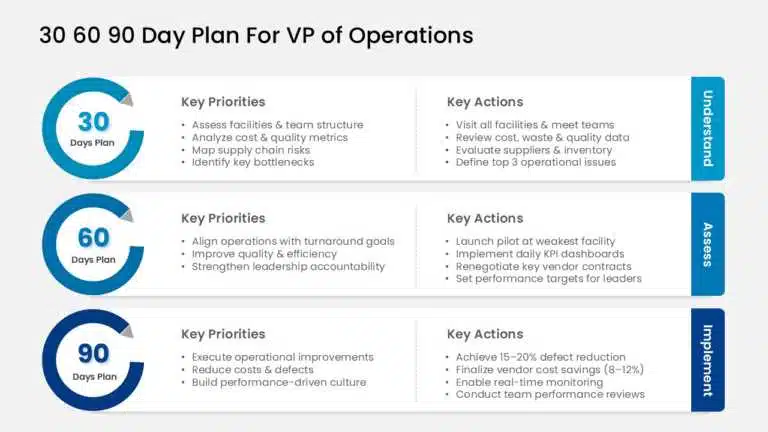
Example 1: VP of Operations (Manufacturing Company, Turnaround Scenario)
Context: Hired to lead operations at a mid-size manufacturer with declining margins and quality issues. Team of 45 across three facilities.
Days 1–30: Assessment
- Tour all three facilities. Meet every plant manager and shift supervisor.
- Analyze cost structure: raw materials, labor, waste rates, and overhead per facility.
- Review quality metrics for the past 4 quarters — defect rates, customer complaints, returns.
- Map the supply chain: key suppliers, lead times, inventory levels, and single points of failure.
- Identify the top 3 operational bottlenecks based on data and team input.
- Deliverable: Operations assessment report with prioritized problem areas and preliminary recommendations.
Days 31–60: Strategy
- Launch a pilot improvement program at the facility with the worst quality metrics — target: 20% defect rate reduction.
- Implement daily production meetings across all facilities with standardized KPI dashboards.
- Begin vendor renegotiation for the top 3 raw material costs.
- Address the two underperforming plant managers: documented feedback, clear 30-day improvement targets.
- Present turnaround strategy to the CEO with phased milestones and investment requirements.
- Deliverable: Turnaround plan with 90-day, 6-month, and 12-month targets.
Days 61–90: Execution
- Pilot facility achieves measurable defect reduction (target: 15-20% improvement).
- Complete vendor renegotiations — target: 8-12% reduction in top 3 material costs.
- Implement real-time production monitoring across all facilities.
- Complete first performance reviews for all direct reports.
- Present 90-day results and updated 12-month roadmap to the board.
- Deliverable: Board presentation with quantified results and forward plan.
Get the template: Use our 30 60 90 Day Plan for Executive Managers Template to present your operations turnaround plan. Designed for senior leaders with sections for assessment findings, strategic priorities, and execution milestones.
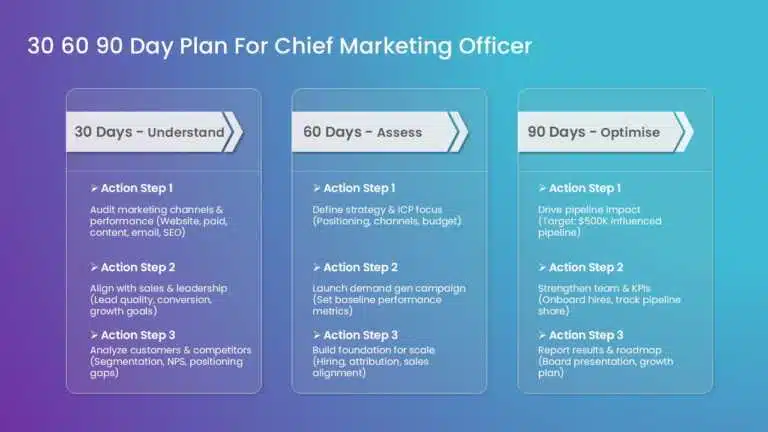
Example 2: Chief Marketing Officer (SaaS Company, New Hire)
Context: First CMO at a Series C SaaS company ($40M ARR) that has relied on founder-led sales and now needs to build a scalable marketing engine. Inheriting a team of 8.
Days 1–30: Assessment
- Audit existing marketing channels: website analytics, paid acquisition performance, content output, email campaigns, SEO footprint.
- Interview the sales team (AEs and SDRs) to understand lead quality, conversion rates, and the sales-marketing handoff.
- Review the customer base: segmentation, retention rates, NPS scores, expansion revenue.
- Meet with the CEO and CFO to align on marketing’s role in the company’s growth plan and budget expectations.
- Benchmark against 3 direct competitors: positioning, messaging, channel strategy, content volume.
- Deliverable: Marketing audit deck with channel performance, competitive gaps, and preliminary investment thesis.
Days 31–60: Strategy
- Define the marketing strategy: positioning, ICP refinement, channel priorities, and budget allocation.
- Launch one demand generation campaign targeting the highest-potential segment — establish baseline metrics.
- Hire for the two most critical skill gaps identified in the audit (likely demand gen and content/SEO).
- Implement marketing attribution and pipeline reporting — connect marketing activity to revenue metrics.
- Establish a weekly marketing-sales alignment meeting with the VP of Sales.
- Deliverable: Marketing strategy document with 12-month roadmap, budget, and quarterly targets.
Days 61–90: Execution
- First campaign delivers measurable pipeline contribution — target: $500K in influenced pipeline.
- New hires onboarded and contributing.
- Marketing-sourced pipeline as a % of total pipeline established as a tracked KPI.
- Present marketing strategy and first 90 days results to the board.
- Complete performance reviews for all 8 direct reports with growth plans.
- Deliverable: Board presentation with 90-day results and 12-month marketing plan.
Get the template: Use our 30 60 90 Day Plan Detailed Template to structure your CMO onboarding plan with space for audit findings, strategy, and execution milestones.
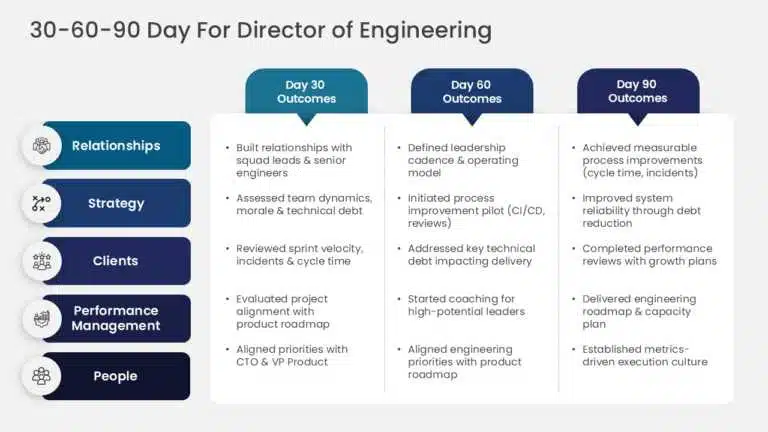
Example 3: Director of Engineering (Tech Company, Sustaining Success)
Context: Promoted internally to Director of Engineering, now leading a team of 30 engineers across 4 squads. The previous director was well-liked and left for a VP role at a larger company.
Days 1–30: Assessment
- Conduct 1:1 meetings with all 4 squad leads and at least 10 senior engineers to understand team dynamics, technical debt, and morale.
- Review sprint velocity, deployment frequency, incident rates, and cycle time for the past 3 quarters.
- Map in-progress projects against the product roadmap — identify alignment gaps or capacity issues.
- Understand the architecture decisions made by the previous director and the rationale behind them.
- Meet with the VP of Product and CTO to align on engineering’s priorities and any tension points between product and engineering.
- Deliverable: Engineering health assessment with team performance data, morale themes, and architectural observations.
Days 31–60: Strategy
- Establish your leadership operating model: 1:1 cadence with squad leads, engineering all-hands (biweekly), architecture review sessions.
- Identify one process improvement to pilot — e.g., streamlined code review process, improved CI/CD pipeline, or better incident response protocol.
- Address the most pressing technical debt item that is impacting velocity or reliability.
- Begin one-on-one coaching sessions with the two squad leads who are closest to being ready for senior promotions.
- Deliverable: Engineering priorities document aligned with the product roadmap, shared with the VP of Product and CTO.
Days 61–90: Execution
- Process improvement pilot shows measurable impact (e.g., 15% reduction in cycle time, 20% fewer post-deployment incidents).
- Technical debt initiative delivers a quantifiable improvement to system reliability or performance.
- Complete first performance reviews for all squad leads with specific feedback and growth plans.
- Present engineering roadmap and capacity plan to leadership for the next two quarters.
- Deliverable: Quarterly engineering review with sprint metrics, project status, and team development plan.
Get the template: Use our 30 60 90 Day Plan for Leaders Template for a structured format that works for internal promotions, where you need to balance respecting the existing culture with driving improvement.
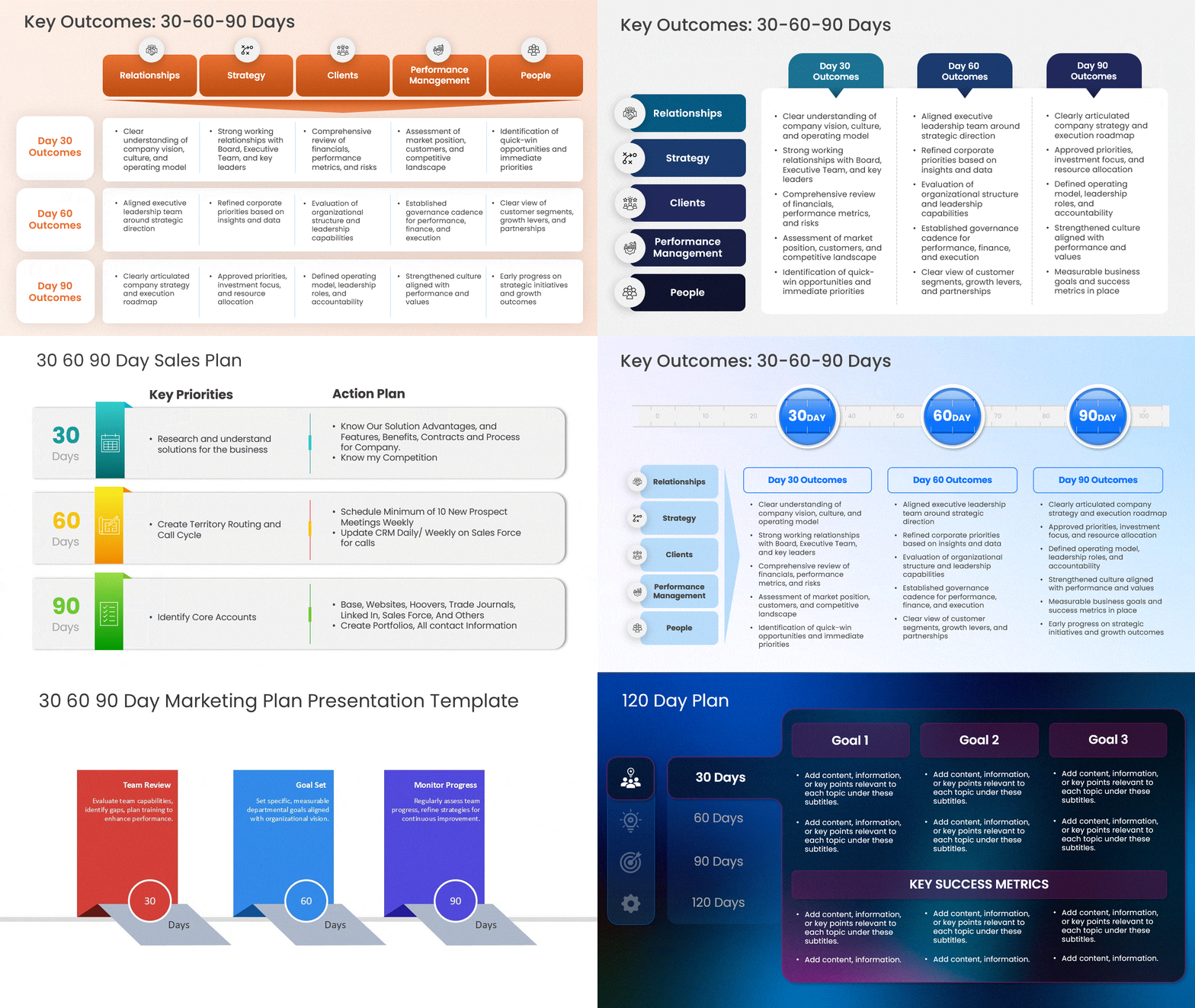
Browse the full collection of 30 60 90 day plan templates for executives for more options.
Executive KPIs to Track in Your First 90 Days
Setting goals without measuring them is a common executive failure mode — especially during transitions, when the volume of new information makes it easy to lose focus on what matters. These are the metrics that matter at each phase.
Days 1–30 Metrics (Assessment Phase)
Your first-month KPIs are relationship and knowledge metrics, not performance metrics. You are building the foundation.
| Metric | What It Measures | Target |
| Stakeholder meetings completed | Breadth of relationship building | 100% of direct reports + 10 key stakeholders |
| Listening tour completion | Depth of organizational understanding | All direct reports + one layer below |
| Financial review completed | Business acumen and readiness | Full P&L and budget review documented |
| Quick wins identified | Ability to spot early value | 2-3 actionable items flagged |
| 30-day assessment delivered | Structured thinking and communication | Written document shared with manager |
Days 31–60 Metrics (Strategy Phase)
Month two shifts to action and strategic clarity.
| Metric | What It Measures | Target |
| Strategic priorities defined | Clarity of direction | 3-5 priorities with owners and timelines |
| Quick wins delivered | Execution capability | At least 2 completed and communicated |
| Operating rhythm established | Leadership infrastructure | Recurring meetings, reporting cadence, 1:1s active |
| Personnel actions initiated | Willingness to address tough issues | Underperformance conversations or hiring started |
| Stakeholder alignment score | Political capital | Manager and 3+ peers endorse your priorities |
Days 61–90 Metrics (Execution Phase)
Month three is about results that others can see and measure.
| Metric | What It Measures | Target |
| Strategic priority progress | Execution against plan | Measurable progress on all 3-5 priorities |
| First significant result delivered | Tangible impact | At least 1 KPI improvement attributable to your actions |
| Performance reviews completed | People leadership | 100% of direct reports reviewed with written feedback |
| Strategic roadmap presented | Vision and communication | 6-12 month plan delivered to board/leadership |
| Team engagement signal | Cultural impact | Qualitative feedback from team on leadership transition |
30-60-90 Day Business Plan (for Executives)
A 30-60-90 day business plan is a phased plan for what the business will achieve in its first three months — not what you personally will learn in a new role. Executives use it to set company or team goals across the 30, 60, and 90-day horizons, where an onboarding plan focuses on ramping into the position. The two are often confused, but they answer different questions: an onboarding plan is about you; a business plan is about the business.
If you’re stepping into an executive role, you’ll often need both. Your onboarding plan (covered above) maps how you’ll ramp. Your business plan maps what the organization will deliver under your leadership in the same window — the initiatives, targets, and outcomes you’ll drive.
30-60-90 day business plan vs onboarding plan
| Onboarding plan | Business plan | |
| Focus | You — learning the role | The business — goals and results |
| Days 1–30 | Meet the team, learn the systems | Assess current performance, set the baseline |
| Days 31–60 | Deliver early personal wins | Launch priority initiatives |
| Days 61–90 | Own your responsibilities | Deliver measurable business outcomes |
| Used for | Interviews, first 90 days in a job | Board plans, turnarounds, new-venture strategy |
What goes in a 30-60-90 day business plan
- Days 1–30 — Assess: review current performance, financials, and team capability. Set the baseline you’ll measure against. Identify the top three business priorities.
- Days 31–60 — Act: launch the highest-priority initiatives. Reallocate resources. Fix the most visible operational gaps.
- Days 61–90 — Deliver: show measurable business results — revenue, efficiency, or growth metrics — and set the roadmap for the next quarter.
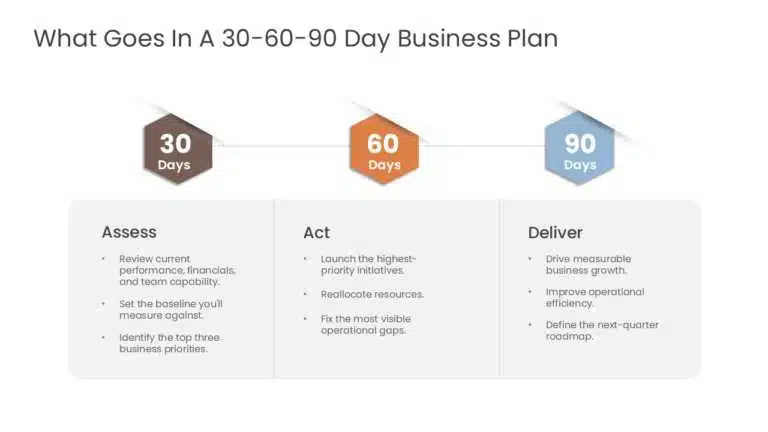
The key difference from an onboarding plan is that every item ends in a business outcome, not a personal milestone. “Understand the sales process” is onboarding; “increase qualified pipeline by 15%” is a business plan.
Download the 30-60-90 day business plan template to build yours in PowerPoint or Google Slides. For the broader framework, see our full 30-60-90 day plan guide.
Common Mistakes in Executive 30 60 90 Day Plans
Moving Too Fast Without Understanding the Context
The most dangerous executive mistake. You were hired to make an impact, and the pressure to demonstrate value is intense. But restructuring a team in week three, cutting a program before you understand why it exists, or announcing a new strategy before talking to the people who will execute it — these actions destroy trust faster than any slow start ever will. Earn the right to change things by demonstrating that you understand them first.
Spending Too Long in Assessment Mode
The opposite failure. Some executives use “I am still learning” as a shield against making difficult decisions. By day 45, your team and your peers should see you shifting from observer to architect. If you are still conducting listening tours in month three, you are losing credibility. Assessment has a shelf life — use it, then act.
Ignoring the Inherited Team’s Perspective
Your direct reports have been running the operation before you arrived. Many of them know the organization better than you ever will. Dismissing their input, overriding their decisions without explanation, or signaling that you plan to “bring in your own people” creates adversarial dynamics that take months to repair. Start with the assumption that the team is capable until data tells you otherwise.
Failing to Manage Upward
Executive success depends as much on your relationship with the board and CEO as it does on your relationship with your team. Many new executives focus entirely downward — managing their teams — and neglect the stakeholders who will ultimately evaluate their performance. Schedule regular check-ins with your manager. Proactively share progress. Ask what success looks like in their eyes. Misalignment with the person who hired you is one of the top reasons executive transitions fail.
Not Delivering Any Quick Wins
Quick wins are not optional. They are the mechanism by which you build the credibility needed to make bigger changes later. An executive who has no visible accomplishment by day 60 — no process improved, no meeting fixed, no cost reduced, no blocker removed — creates a perception that they are all planning and no action. Find something small, execute it decisively, and make sure the right people know about it.
Writing a Generic Plan
A plan that could apply to any executive at any company is not a plan — it is a template. Your 30 60 90 day plan should reference your specific company, your specific team, your specific challenges, and your specific metrics. Generic goals like “build relationships” and “understand the business” are table stakes, not strategy. The plan should answer: what will be different about this organization because I was here for 90 days?
Conclusion
The first 90 days as an executive are not just an onboarding period — they are an audition. Every meeting, every decision, every email sends a signal about the kind of leader you are going to be. A 30 60 90 day plan gives you control over those signals by ensuring your actions are deliberate, your priorities are clear, and your progress is visible.
The plan does not need to be perfect on day one. It needs to be thoughtful, specific to your situation, and adaptable as you learn more. Start with assessment. Build toward a strategy. Execute with accountability. And remember: the executives who succeed in their first 90 days are not the ones who made the most changes — they are the ones who made the right changes, at the right time, for the right reasons.
Explore our full collection of 30 60 90 day plan templates for executives to present your transition plan with clarity and professionalism.
FAQs
-
Who should create the 30 60 90 day plan — the executive or the company?
Both. The best plans are collaborative. The company or hiring manager should provide context: organizational priorities, team structure, known challenges, and performance expectations. The executive should build the plan — it demonstrates strategic thinking and ownership. Many boards or CEOs ask executive candidates to present a 30-60-90 day plan during the final interview round as a way to evaluate their approach to the role.
-
How should a 30 60 90 day plan for directors differ from a C-suite plan?
Directors typically have a narrower scope — one team or function — so the plan can be more tactically specific. A director’s plan might include goals like “reduce customer support response time by 20%.” A C-suite plan (CEO, CMO, CIO, CRO, COO) operates at a higher level of abstraction — “establish the company’s customer experience strategy and hire a VP of Support to execute it.” The structure is the same; the altitude of the goals changes.
-
Can I use a 30 60 90 day plan during an executive job interview?
Yes, and at the executive level, it is often expected. Boards and CEOs hiring senior leaders want to see how a candidate thinks about transitions. A well-crafted executive business plan for the first 90 days demonstrates that you have researched the company, understand the challenges, and have a structured approach to the role. Keep the interview version to 1-2 pages and focus on the themes you would explore rather than specific actions (since you lack inside knowledge).
-
What if I am inheriting a high-performing team?
This is the “sustaining success” scenario described earlier. Your plan should emphasize understanding and preserving what works before introducing change. Spend an extended listening period (the full 30 days) understanding the team’s systems, culture, and strengths. Your month-two and month-three goals should focus on incremental improvements and scaling existing wins — not transformation. The fastest way to lose a high-performing team is to change things that are not broken.
-
How long should an executive 30 60 90 day plan be?
One to three pages. Executives communicate through concise, structured documents — not lengthy reports. A one-page version with a table or grid format is ideal for board presentations and interviews. A two-to-three page version with more detail is appropriate for sharing with your direct leadership team. If you need more than three pages, you are overcomplicating it.
-
What is the best way to present a 30 60 90 day plan to the board?
A clean slide deck — 5 to 7 slides. Include: your assessment of the current state (1 slide), your 3-5 strategic priorities (1 slide), your plan by phase with key milestones (1 slide per phase), and your success metrics (1 slide). Keep each slide to 4-5 bullet points. Speak to the strategy, not the slides. Boards value executives who communicate with clarity and conviction.
-
What is the difference between a 30-60-90 day business plan and an onboarding plan?
An onboarding plan focuses on you ramping into a new role — learning the team, systems, and priorities. A 30-60-90 day business plan focuses on what the business will achieve in the same window — the goals, initiatives, and results you’ll drive. Executives often need both.
-
What should a 30-60-90 day business plan include?
Days 1–30: assess current performance and set priorities. Days 31–60: launch key initiatives. Days 61–90: deliver measurable business results and set the next quarter’s roadmap. Every item should end in a business outcome, not a personal milestone.
Table Of Content


Related posts from the same category
3 Mar, 2021 | SlideUpLift
30-60-90 Day Plan for Interview: Examples, Templates & Sample Answers
A 30-60-90 day plan for an interview is a short presentation or one-page document that outlines what you will accomplish in your first 30, 60, and 90 days in the

28 Oct, 2024 | SlideUpLift
The Ideal 30 60 90 Day Plan For Managers (+ Examples!)
Navigate your new managerial role with confidence using a leadership 30 60 90 day plan for managers. This plan helps you outline your tasks in three sections, each 30 days

20 Oct, 2023 | SlideUpLift
30 60 90 Day Marketing Plan
Nеw marketing managers, еspеcially thosе stеpping into lеadеrship rolеs, already know that 30-60-90 day marketing plans arе invaluablе. A 90-day markеting strategy not only provides a clear direction and focus

27 Oct, 2023 | SlideUpLift
30 60 90 Day Onboarding Plan for New Hire/Employee
Employee onboarding is thе final stеp in thе hiring procеss, еncompassing thе dеlivеry of thе offеr lеttеr, еmploymеnt background chеcks, papеrwork, and thе initial activitiеs on thе first day. However,

20 Oct, 2023 | SlideUpLift
“What is Your 30 60 90 Day Plan” Interview Question: How to Answer?
Hiring manager grills you heavily during a job interview in order to discover your qualifications and desires for your new employment. It can be a strеssful moment, but holds paramount

6 Nov, 2024 | SlideUpLift
30 60 90 Day Plan: Templates, Examples, and How to Write One
A 30-60-90 day plan divides the first three months in a new role into three practical phases. Days 1-30 are usually focused on learning the company, role, team, tools, and

18 Jul, 2024 | SlideUpLift
30 60 90 Day Sales Plan: How to Create One + Examples & Templates
Starting a new sales role is equal parts exciting and overwhelming. You have targets to hit, a CRM to learn, prospects to reach, and a team to prove yourself to
![Best Work Plan Templates For Easy Task Organization [With Examples]](https://slideuplift.com/wp-content/uploads/2024/03/Best-Work-Plan-Templates.jpg "Best Work Plan Templates For Easy Task Organization [With Examples]")
6 Mar, 2024 | SlideUpLift
Best Work Plan Templates For Easy Task Organization [With Examples]
A project's success depends on having a detailed task plan. How can you perform tasks without having a plan for them? You and your team can produce the ideal work

29 Aug, 2025 | SlideUpLift
50 ChatGPT Prompts for Presentations (Copy-Paste Ready, Categorized for Professionals)
Most professionals don’t have a ChatGPT problem. They have a prompt problem. If you’ve ever asked ChatGPT to “make me a presentation on quarterly sales” and watched it spit out

2 May, 2025 | SlideUpLift
150+ Informative Speech Topics for 2026 (Students, College & Work)
Picking the right informative speech topic is half the battle: it decides how easy your research will be, how confident you'll sound, and whether your audience leans in or checks