30 60 90 Day Plan for Interview: How to Create, Present & Answer [+ Examples]
Walking into a job interview with a 30 60 90 day plan is one of the most effective ways to separate yourself from every other candidate. While they are answering questions reactively, you are presenting a concrete strategy for how you will contribute from day one.
A 30 60 90 day plan for an interview outlines what you would accomplish in your first three months if hired — structured into learning, contributing, and delivering results. It demonstrates that you have researched the company, thought critically about the role, and are ready to execute rather than just talk.
This guide covers everything you need: how to create the plan with limited information as an outsider, how to present it during the interview, how to answer when the hiring manager asks about your 90-day plan, and full written examples you can adapt for any role. For a broader understanding of 30-60-90 day planning across all professional contexts, see our ultimate guide to 30 60 90 day plans.
What Is a 30 60 90 Day Plan for an Interview?
A 30 60 90 day plan for an interview is a structured document — typically one page — that outlines the goals, priorities, and actions you would take during your first 90 days if the company hired you. It divides the first quarter into three phases: the first 30 days focused on learning, the next 30 on contributing, and the final 30 on delivering measurable results.
The difference between an interview plan and an on-the-job plan is context. When you are already employed, you have internal data, team access, and institutional knowledge. When you are interviewing, you are building the plan from the outside — using the job description, company website, annual reports, and whatever you can learn during the interview process. That constraint is actually what makes it impressive. A candidate who can build a credible 90-day strategy from publicly available information demonstrates the kind of resourcefulness and strategic thinking that hiring managers want on their team.
Some hiring managers will explicitly ask you to prepare a 30 60 90 day plan. Others will ask the question verbally: “What would you do in your first 90 days?” Either way, having a plan ready — written or rehearsed — gives you a significant advantage.
Why Bring a 30 60 90 Day Plan to Your Interview
Most candidates show up with a polished resume and rehearsed answers to common questions. Very few bring a written strategy for the role they are applying for. That asymmetry is your opportunity.
- It proves you have done real research. Building a 30 60 90 day plan requires you to understand the company’s challenges, the role’s responsibilities, and the industry context. The plan itself becomes evidence that you have invested time in preparation beyond surface-level Googling.
- It shifts the conversation from hypothetical to tactical. Instead of answering “Where do you see yourself in three months?” with a vague aspiration, you hand the interviewer a document that shows exactly what you plan to learn, build, and deliver. The interview moves from evaluating your personality to discussing your strategy, which is a much stronger position for you.
- It gives hiring managers something to evaluate concretely. Recruiters and hiring managers assess dozens of candidates. Most blend together. A written plan creates a tangible artifact they can share with the rest of the hiring committee, reference after the interview, and use to compare against other candidates. You become the person who “brought a plan” — and that sticks.
- It reduces the risk for the employer. Hiring is expensive. A candidate who demonstrates structured thinking about their first 90 days signals that they will onboard faster, need less hand-holding, and start contributing sooner. For the hiring manager, that reduces the risk of a bad hire.
How to Create a 30 60 90 Day Plan for an Interview (Step by Step)
The biggest challenge of building an interview plan is that you are working with incomplete information. You do not have access to internal data, team dynamics, or the company’s actual priorities. That is fine. The goal is not to build a perfect plan — it is to demonstrate that you think in structured, strategic terms.
Step 1: Research the Company and Role
Start with the job description. Read it line by line and extract every responsibility, required skill, and stated objective. These become the raw material for your plan’s goals.
Then go deeper. Review the company’s website — mission statement, recent press releases, leadership bios, product pages. Check their LinkedIn page for recent posts, hiring patterns, and team structure. Read Glassdoor reviews to understand the culture and any recurring challenges. If the company is publicly traded, skim the most recent annual report or investor presentation for strategic priorities.
Look for trigger events that signal what matters to them right now: a new product launch, expansion into a new market, leadership changes, funding announcements, or restructuring. Tying your plan to a specific company initiative is what separates a good interview plan from a generic one.
Write down three things: what the company is trying to achieve right now, what the person in this role is expected to contribute, and what challenges you would likely face in the first three months. These three answers become the foundation of your plan.
Step 2: Define Your 30-Day Learning Goals
The first month is about proving that you can absorb information quickly and build the right relationships. No hiring manager expects a new hire to deliver results in month one — but they do expect initiative and curiosity.
Frame your 30-day goals around four areas:
- Understanding the business. Learn the company’s products, services, revenue model, competitive landscape, and customer base. Set a specific goal: “Complete all available product training and be able to articulate our value proposition against the top three competitors by day 21.”
- Meeting the right people. Schedule one-on-one meetings with your direct manager, peers, and key cross-functional partners. If you are in a client-facing role, include early introductions to key accounts. Specify a number: “Conduct 1:1 meetings with all team members and 5 cross-functional stakeholders within the first 3 weeks.”
- Learning the tools and processes. Every company has its own systems — CRM, project management tools, reporting workflows, communication norms. Commit to full proficiency on core tools by a specific date.
- Identifying early insights. Even in the learning phase, you should be forming observations about what is working and what could improve. Frame this carefully in an interview: “By day 30, I would prepare a brief assessment of initial observations and questions to discuss with my manager — not to propose changes, but to show that I am actively processing what I am learning.”
Step 3: Define Your 60-Day Contribution Goals
Month two shifts from absorbing to contributing. You are not running the show yet, but you should be taking ownership of specific tasks and adding visible value.
- Active contribution to projects. Identify the types of projects or deliverables the role involves (from the job description) and set a goal to be independently contributing by day 45-60. Example: “Lead the preparation of one client deliverable with manager oversight” or “Own the weekly reporting process end to end.”
- Applying what you have learned. Tie your month-two goals to what you planned to learn in month one. If you spent the first 30 days understanding the customer base, month two should involve using that knowledge — whether through client outreach, campaign execution, process improvement, or whatever the role demands.
- Building your feedback loop. Schedule a formal check-in with your manager at day 45 to review progress, adjust priorities, and ask for candid feedback on where you are excelling and where you need to improve. Mentioning this in your interview plan shows self-awareness and coachability — two qualities hiring managers value highly.
- Developing a 60-day summary. Commit to documenting your accomplishments and areas of focus by day 60. This is unusual for most employees and signals a level of self-management that impresses hiring managers.
Step 4: Define Your 90-Day Impact Goals
By month three, you should be operating with minimal supervision and delivering measurable results. This is the hardest section to write for an interview because you lack inside knowledge — but it is also the most important. Hiring managers want to see ambition grounded in realism.
- Set one or two outcome-based goals. These should tie directly to the role’s KPIs. For a marketing role: “Launch one campaign independently and report on performance metrics.” For an operations role: “Identify and implement one process improvement that reduces cycle time by X%.” For a people management role: “Complete initial performance reviews for all direct reports with documented feedback and development goals.”
- Frame longer-term thinking. Show that you are thinking beyond 90 days by mentioning a plan for the next quarter. Example: “By day 90, I would present a proposed Q2 roadmap to my manager that builds on the foundation established in the first quarter.” This signals long-term commitment — something every employer wants to hear.
- Acknowledge the unknowns. A smart candidate does not pretend to have all the answers. Include a brief note: “These goals are based on my current understanding of the role and company. I expect to refine them as I gain access to internal data and context in the first few weeks.” This shows humility and adaptability rather than overconfidence.
Step 5: Format and Finalize Your Plan
The plan should be clean, scannable, and no longer than one page — two pages absolute maximum for senior roles. Hiring managers are busy. If your plan requires more than 2 minutes to read, it is too long.
Best format options:
A single-page table works best for most situations. Three columns (30 / 60 / 90 days) with rows for “Focus,” “Key Priorities,” “Goals,” and “Success Metrics.” This format is easy to scan and demonstrates structured thinking.
A brief slide deck (3-5 slides) works well if you are presenting in person or via video. One title slide, one slide per phase, and one summary slide. Keep each slide to 5-6 bullet points maximum.
A verbal walkthrough with a leave-behind works when the interviewer asks the question spontaneously. Have a one-page printed version in your portfolio that you can hand over after discussing it verbally.
Regardless of format, use specific language throughout. Replace “learn about the company” with “complete product training and map the competitive landscape.” Replace “start contributing” with “independently manage two client accounts.” Specificity is what makes a plan credible.
30 60 90 Day Plan for Interview Examples
Below are three complete examples showing what a finished interview plan looks like for different roles. Each one is written from the candidate’s perspective — using only publicly available information.
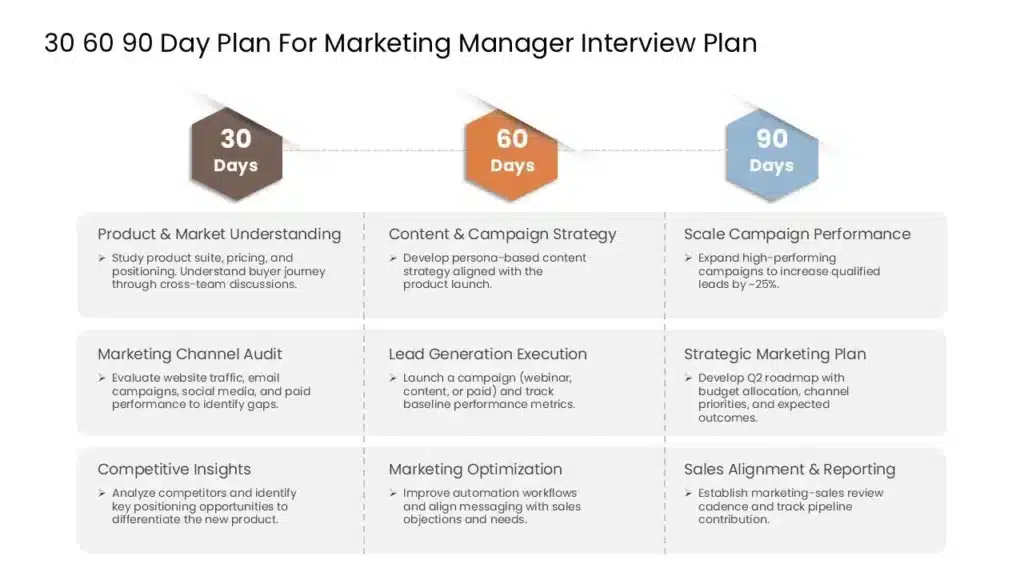
Example 1: Marketing Manager Interview Plan
Context: Applying for a marketing manager role at a mid-size B2B SaaS company that recently launched a new product line.
Days 1–30: Learn
- Complete onboarding and study the full product suite, pricing, and positioning.
- Audit existing marketing channels: website traffic, email campaigns, social media, and paid advertising performance.
- Meet with sales, product, and customer success teams to understand the buyer journey and current pain points.
- Review the competitive landscape and identify 3 positioning gaps we can exploit.
- Deliverable: Present a marketing channel audit summary to the marketing director.
Days 31–60: Contribute
- Develop a content strategy aligned with the new product launch, targeting the top 3 buyer personas.
- Launch one lead generation campaign (webinar, gated content, or paid social) and establish baseline performance metrics.
- Implement or optimize the marketing automation workflow for lead nurturing.
- Collaborate with sales on messaging alignment — ensure marketing materials address the objections sales encounters most.
- Deliverable: Campaign performance report with initial results and optimization recommendations.
Days 61–90: Deliver
- Scale the highest-performing campaign from month two. Target: 25% increase in qualified leads over the baseline.
- Propose a Q2 marketing plan with budget allocation, channel priorities, and projected outcomes.
- Establish a monthly marketing-to-sales pipeline review cadence.
- Deliverable: Q2 marketing roadmap presented to leadership.

Example 2: Operations Manager Interview Plan
Context: Applying for an operations manager position at a logistics company undergoing a technology modernization initiative.
Days 1–30: Learn
- Shadow the current operations workflow end to end — from order intake through fulfillment and delivery.
- Meet with warehouse managers, logistics coordinators, and the technology team to understand current systems and pain points.
- Review existing KPIs: order accuracy, cycle time, cost per shipment, and on-time delivery rates.
- Identify the top 3 operational bottlenecks based on team feedback and data review.
- Deliverable: Operations assessment document with initial findings and prioritized improvement areas.
Days 31–60: Contribute
- Design and pilot one process improvement targeting the highest-impact bottleneck identified in month one.
- Work with the technology team to evaluate how the new system can address the identified gaps.
- Establish standardized reporting dashboards for weekly KPI tracking.
- Begin cross-training team members on new processes or tools as needed.
- Deliverable: Pilot results with measured impact on the target KPI.
Days 61–90: Deliver
- Roll out the piloted improvement across the full operation. Target: 15% reduction in the bottleneck metric.
- Develop SOPs (standard operating procedures) for any new processes introduced.
- Present a 6-month operations improvement roadmap to leadership with phased milestones and resource requirements.
- Deliverable: Full rollout report and Q2 improvement plan.

Example 3: Team Leader / People Manager Interview Plan
Context: Applying for a team lead position managing a team of 10 at a professional services firm.
Days 1–30: Learn
- Conduct one-on-one meetings with every team member to understand their current projects, strengths, development goals, and challenges.
- Review team performance data from the past two quarters: project delivery rates, client satisfaction scores, utilization rates, and attrition.
- Shadow key client meetings and internal reviews to understand how the team operates day to day.
- Meet with senior leadership and peer managers to understand team expectations and cross-functional dependencies.
- Deliverable: Team assessment summary with individual strengths/gaps and initial observations.
Days 31–60: Contribute
- Establish a regular meeting rhythm: weekly team stand-up, biweekly one-on-ones, and monthly team retrospective.
- Identify the top 2 coaching priorities for the team and begin structured development sessions.
- Address any immediate performance or resource gaps with documented, specific action plans.
- Collaborate with HR on any pending hiring needs or role adjustments.
- Deliverable: Team operating cadence documented and active. Coaching sessions underway.
Days 61–90: Deliver
- Target: team achieves 95%+ on-time project delivery for the quarter.
- Complete first-round performance reviews with documented feedback and growth plans for each team member.
- Propose one workflow or process improvement based on team retrospective insights.
- Present a team development plan to leadership: skills gaps to close, hiring needs, and retention strategies.
- Deliverable: Performance reviews completed and Q2 team plan submitted.

How to Answer “What Is Your 30 60 90 Day Plan?” in an Interview
Not every interviewer will ask you to prepare a written plan in advance. Many will simply ask the question during the conversation: “What would you do in your first 30, 60, and 90 days?” or “Walk me through your plan for the first three months.”
This is one of the most common later-stage interview questions. Hiring managers typically ask it when they are seriously considering you for the position — often in the second or final round. They are testing three things: whether you have genuinely thought about the role, whether you think in structured terms, and whether your priorities align with what the company actually needs.
Here is how to answer it well, with sample scripts for three different career levels.
Sample Answer for an Entry-Level Role
“In my first 30 days, I would focus on learning the foundations — understanding how the team operates, getting trained on the tools and processes you use, and building relationships with my teammates and manager. I would set a goal to be fully proficient on your core systems by the end of month one.
In the next 30 days, I would start taking on tasks independently. For example, if this role involves client support, I would aim to handle routine cases on my own while escalating complex ones, and I would track my resolution rate to make sure I am improving week over week.
By day 90, I want to be someone the team can rely on — handling my full workload independently, contributing ideas in team meetings, and looking for ways to improve the processes I have learned. I would also schedule a check-in with my manager to get feedback and set goals for the next quarter.”
Sample Answer for a Mid-Level Role
“Based on what I have learned about this role, my first 30 days would be about getting deep into the business context. I would study your product, your customers, and how the team currently operates. I would schedule one-on-ones with everyone I would work closely with — including cross-functional partners — so I understand priorities and dependencies.
By day 60, I would be actively contributing. In my previous role, I was able to take ownership of projects within 6 weeks. Here, I would aim to lead one deliverable end-to-end by the midpoint, whether that is a campaign, a process rollout, or a client engagement — whatever is most aligned with the team’s current priorities.
By day 90, I would be fully ramped and delivering measurable results. I would have a clear view of what is working and where there are opportunities, and I would present a recommended plan for the next quarter to my manager. I would also want to formalize a feedback loop — regular check-ins where we review progress and adjust goals as needed.”
Sample Answer for a Management Role
“In the first 30 days, my priority would be understanding the team, the business, and the expectations from leadership. That means one-on-one conversations with every direct report to understand their strengths, goals, and challenges. It means reviewing performance data from the past two quarters. And it means aligning with you on what success looks like for this team in the next 6-12 months.
From days 31 to 60, I would focus on building the right operating rhythm — establishing a regular cadence of team meetings, one-on-ones, and cross-functional touchpoints. I would also start addressing any immediate gaps, whether that is coaching, process improvements, or resource allocation.
By day 90, I would expect the team to have clear goals, consistent communication, and a path toward improved performance. I would deliver my first round of performance reviews, present a team development plan to leadership, and have at least one measurable improvement underway — whether that is a KPI improvement, a process change, or a capability uplift.”
How to Present Your 30 60 90 Day Plan in an Interview
Creating the plan is half the work. Presenting it effectively is what actually makes the impression.
Format Options: One-Pager vs Slide Deck vs Verbal Walkthrough
The one-pager is the safest choice for most interviews. Print two copies — one for the interviewer, one for yourself to reference. A clean table layout with three columns (30 / 60 / 90 days) works best. Hand it over at the right moment: either when the interviewer asks about your plan, or toward the end of the interview when you are asked “Do you have any questions?” — pivot to “I actually prepared a brief plan for the first 90 days. May I walk you through it?”
- A slide deck is appropriate when the company has explicitly asked you to present. Keep it to 3-5 slides. Use clean, professional templates — your 30 60 90 day plan PowerPoint templates are built for exactly this. One slide per phase, with 4-5 bullet points each. Speak to the slides rather than reading them.
- A verbal walkthrough is your fallback when the question comes up unexpectedly. Structure your answer as: “I have thought about this in three phases…” and walk through each 30-day block in 60-90 seconds. Keep it concise — the interviewer can ask follow-up questions to go deeper on anything that interests them.
Dos and Don’ts of Presenting Your Plan
- Do tie every goal back to the company or role. Generic goals (“learn the business”) land flat. Specific goals (“complete your product certification and map your competitive positioning against Competitor X”) land hard.
- Do invite the interviewer’s input. After presenting, ask: “Does this align with what you see as the priorities for this role?” This turns the presentation into a conversation and shows you are collaborative, not rigid.
- Do keep it brief. Walk through the plan in 3-5 minutes. Leave room for discussion. The plan is a conversation starter, not a monologue.
- Don’t overcommit to specific results without internal knowledge. Saying “I will increase revenue by 20% in 90 days” without understanding the current baseline sounds reckless, not ambitious. Use directional language: “My goal would be to identify the top opportunities and begin executing against them.”
- Don’t criticize the company’s current approach. Even if you have identified gaps during your research, frame improvements diplomatically: “I would want to understand the current process before suggesting any changes” rather than “Your marketing seems outdated.”
- Don’t read your plan word for word. Speak naturally. Use the document or slides as reference points, not a script.
30 60 90 Day Plan for Interview Templates
Presenting your plan in a professional, visually clean format reinforces the impression that you are thorough and detail-oriented. Here are templates designed specifically for the interview context.
30 60 90 Day Plan for Interview Template
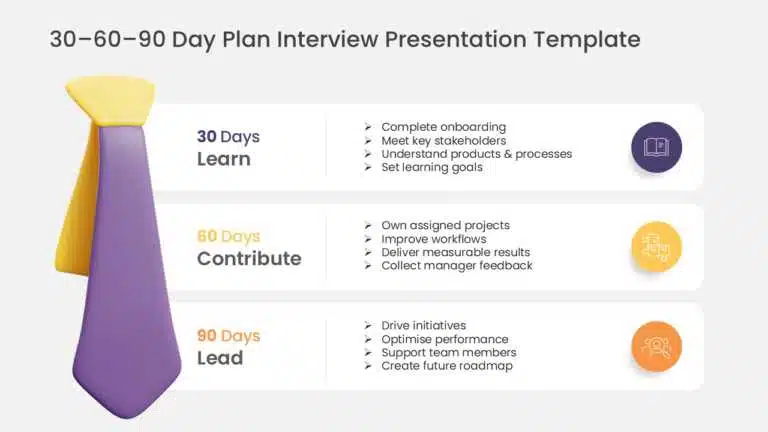
An animated three-phase layout designed for candidates. Each phase highlights key goals and actions with a clean visual progression. Ideal for printing as a one-pager or presenting as a slide deck.
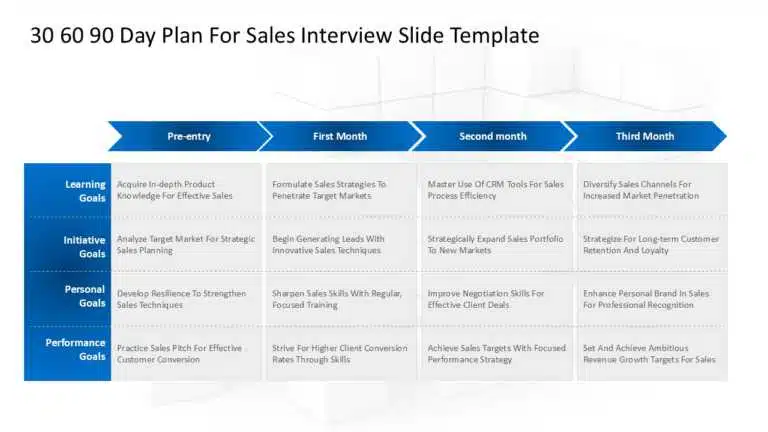
30 60 90 Day Interview Plan — Detailed Template
A more detailed version with space for goals, actions, and success metrics in each phase. Works well for senior or management-level interview plans where more specificity is expected.
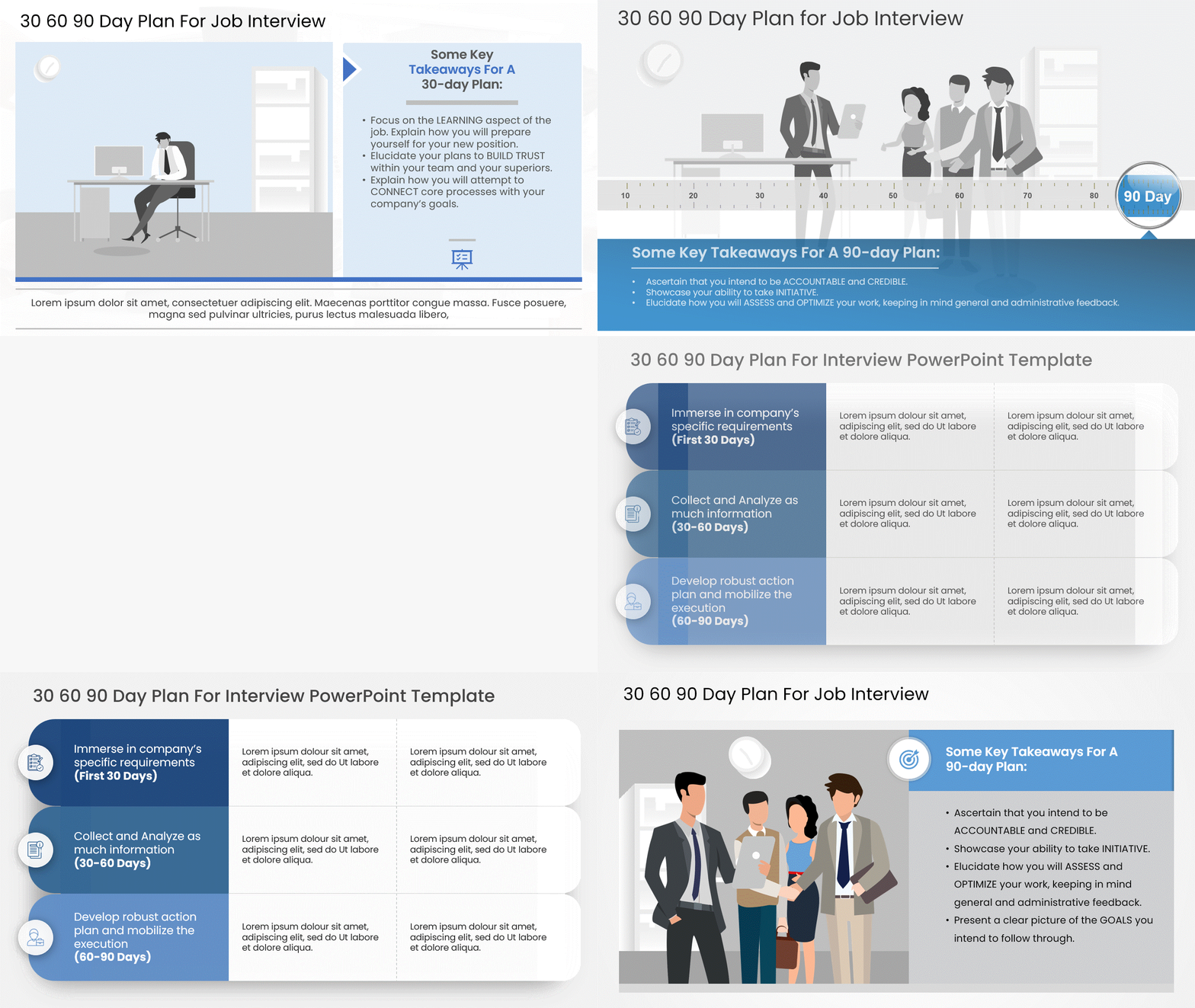
30 60 90 Day Interview Presentation Template
Designed for the “presentation format” interview where you are asked to present your plan formally. Clean slide layout with structured content areas for each 30-day block.
Browse the full collection of 30 60 90 day plan templates for more options across different styles and formats.
Common Mistakes in Interview 30 60 90 Plans
Being Too Generic
“Learn the company culture” and “build relationships with the team” appear in every plan. They are expected, not impressive. The winning plans tie goals to specific company details: “Review the Q3 product launch roadmap and identify where my skills can accelerate the timeline” is infinitely more compelling than “understand department goals.” The more specific you are, the more the hiring manager believes you are actually prepared — not just filling a template.
Making It Too Long
One page. That is the rule. Two pages maximum for director-level or executive roles. Hiring managers do not have time to read a five-page document, and submitting one signals that you cannot prioritize and synthesize — exactly the opposite of what you are trying to demonstrate. If you cannot communicate your 90-day strategy in one page, your strategy is not clear enough.
Not Tying Goals to the Company’s Priorities
The most common failure mode is building a plan around what you want to do rather than what the company needs you to do. Your plan should be built from the job description outward, not from your resume inward. Every goal in your plan should connect to a stated responsibility, company objective, or business challenge. If the connection is not obvious, make it explicit.
Promising Results You Cannot Deliver Without Inside Knowledge
“Increase conversion rates by 30% in 90 days” sounds ambitious, but an interviewer will immediately think: “How can you promise that without knowing our current rates, our funnel, our market, or our constraints?” Ambitious claims without a basis in reality make you look naive, not impressive. Use directional language (“improve,” “identify opportunities,” “establish a baseline and begin optimizing”) and frame your goals as achievable first steps rather than heroic outcomes.
Conclusion
A 30 60 90 day plan for an interview is not just a document — it is a demonstration of how you think, how you prepare, and how you would approach the role if hired. In a competitive job market where most candidates rely on resume bullets and rehearsed answers, showing up with a structured strategy for your first 90 days puts you in a different category entirely.
The plan does not need to be perfect. It needs to be specific, tied to the company’s priorities, and presented with confidence. Build it from the job description outward. Keep it to one page. Invite the interviewer to challenge it. And treat their feedback as a gift — it is the conversation, not the document, that wins the job.

Explore our collection of 30 60 90 day plan templates for interviews to present your plan with a polished, professional layout.
FAQs
-
Do I need to bring a written plan to every interview?
Not necessarily. If the company specifically asks for a 30 60 90 day plan, absolutely prepare a written document. If they have not asked, you should still prepare one mentally — structure your thinking into three phases so you are ready when the question comes up verbally. Bringing an unsolicited written plan can be a powerful differentiator, but read the room. In a casual first-round conversation, it may feel premature. In a final-round or panel interview, it almost always impresses
-
How specific should my plan be if I do not have inside information?
As specific as publicly available information allows. Use the job description, company website, press releases, LinkedIn, and Glassdoor to ground your goals in the company’s reality. Where you lack specifics, acknowledge it: “Based on my research, I would prioritize X — though I would adjust this once I have access to internal data.” That honesty is a strength, not a weakness.
-
When during the interview should I present the plan?
The ideal moment is when the interviewer asks about your approach to the role or your first 90 days. If that question does not come up naturally, use the “any questions?” opportunity at the end: “I actually prepared a brief plan for how I would approach my first 90 days. Would you be open to me walking through it quickly?” Very few interviewers will say no — and the proactive move itself leaves an impression.
-
Should I adjust the plan after each interview round?
Yes. Every interview conversation gives you more information — about the company’s priorities, the team’s challenges, and what the hiring manager cares about most. Refine your plan between rounds. If the first interviewer mentioned a specific challenge, address it directly in the updated version. This level of responsiveness shows you are listening, adapting, and taking the process seriously.
-
What if the hiring manager disagrees with my plan?
That is actually a good outcome. The purpose of the plan is not to be “right” — it is to start a strategic conversation. If the interviewer pushes back on a priority or goal, engage with it: “That is helpful context. Based on what you are telling me, it sounds like X should be the priority instead. Here is how I would adjust the plan.” Demonstrating that you can take feedback and adapt in real time is more impressive than having a perfect plan.
-
What format works best for a virtual interview?
Share your screen and walk through a 3-slide deck, or drop a one-page PDF in the chat. If you use slides, keep them visually clean — no walls of text. Alternatively, email the PDF to the interviewer immediately after the call with a brief note: “Thanks for the conversation. Attached is the 90-day plan we discussed. I have updated it based on your feedback about [specific point].” This follow-up compounds the impression.