
 Flat 4


Complete Guide For Preparing Job Interview Presentation With Examples
This guide gives you a 9-slide outline, guidance on how long to speak, examples for sales, marketing, consulting and teaching roles, delivery tips for in-person and video interviews, and six SlideUpLift templates.
Quick answers
- How long should it be? Use the time the recruiter gives you. With no guidance, aim for 5 to 10 minutes and leave time for questions.
- How many slides? About one slide per minute, so 5 to 10 slides for a 5 to 10 minute talk.
- What should it include? An opening, who you are, the answer to the brief, evidence, your plan for the role, and a close. The 9-slide outline below shows the order.
- How should I start? State the question you will answer and your headline answer in the first 30 seconds.
- How should I end? Summarise in three points, say what you would bring to the role, and invite questions.
- What is the most common mistake? Text-heavy slides, and ignoring the brief or the time limit.
What is a job interview presentation?
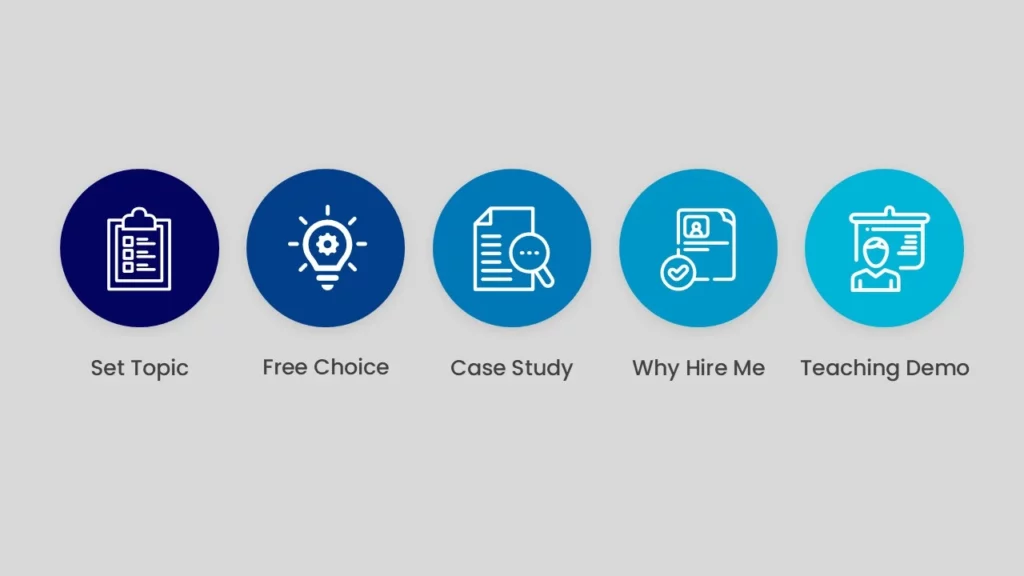
A job interview presentation, sometimes called a candidate presentation, is a talk you deliver as part of the selection process, either on a topic the employer sets or one you choose. It gives the panel a live sample of your communication, preparation and judgement. It is more common for senior, client-facing and teaching roles, but any employer can ask for one, so check the invitation.

| Type | What you do | What it tests |
| Set-topic presentation | Present on a topic the employer gives you | Research, structure, clarity |
| Free-choice presentation | Choose your own topic, such as a career achievement or an industry trend | Judgement, relevance to the role |
| Case study or task | Analyse a scenario or data and recommend an action | Problem-solving, commercial thinking |
| “Why hire me” or portfolio presentation | Present your experience, results and plan for the first months | Fit, self-awareness |
| Teaching or demo session | Teach a short lesson or show a skill | Explaining, engaging an audience |
What does the employer look for in a presentation for an interview?
The panel is judging more than the content. They are asking whether you could present to their clients and colleagues, and whether you can follow instructions.
| What they assess | What it looks like | How to show it |
| Communication | Clear, jargon-free, spoken rather than read | One message per slide; talk to the panel, not the screen |
| Structure | A logical order the audience can follow | Open with an agenda or a headline, signpost each section |
| Role and industry knowledge | You understand the company and its market | Use company-specific facts and current examples |
| Following the brief | Right topic, format and length | Confirm the brief in writing and rehearse against a timer |
| Attention to detail | Consistent, proofread slides | Same fonts and spacing throughout; check spelling twice |
| Composure under pressure | Calm answers to unplanned questions | Rehearse tough questions; pause before answering |
| Creativity (open briefs) | A fresh angle that still fits the role | One original idea, backed by evidence |
Read the job description again before you build anything: the panel will measure your presentation against it.
If you are given no topic or audience details (a blind presentation), the panel can also see how you work under pressure and how imaginative you are.
How long should a job interview presentation be, and how many slides?
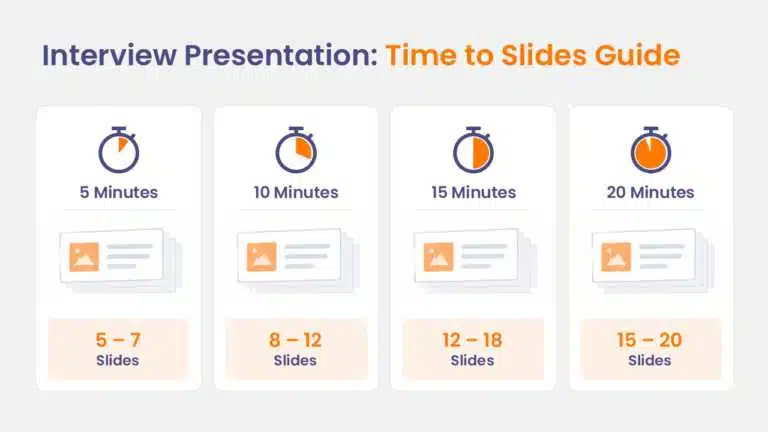
Follow the time limit in your invitation. If none is given, ask the recruiter; if you cannot ask, plan 5 to 10 minutes of speaking plus time for questions. A reliable rule is about one slide per minute.
| Speaking time | Slides | How to adjust the outline |
| 5 minutes | About 5 | Merge slides 1 and 2, and slides 8 and 9 |
| 10 minutes | 8 to 10 | Use the full 9-slide outline below |
| 15 minutes | 12 to 15 | Add a second evidence or case slide |
| 20 minutes | Up to 20 | Add a worked example and a risks slide |
For longer talks, see how many slides for a 30 minute presentation. Always rehearse against a timer, because running over reads as poor time management.
What to include in a job interview presentation template: a 9-slide outline
Use this order for a 10 minute presentation, then trim or expand using the table above.
- Title slide. Your name, the role, and a one-line promise such as “How I would grow [metric] in my first 90 days”. See how to create a title slide.
- Agenda. Three or four items, so the panel knows where you are going. See agenda slide examples.
- About you. Two or three facts most relevant to this role, not your whole CV.
- Career path. A short timeline of roles that lead to this job. For layouts, see personal timeline examples.
- Key skills with proof. Three skills, each with one result. Use your own numbers: [X% growth], [N clients], [saved N hours].
- The brief. Your answer to the topic or case: the problem, your analysis, your recommendation.
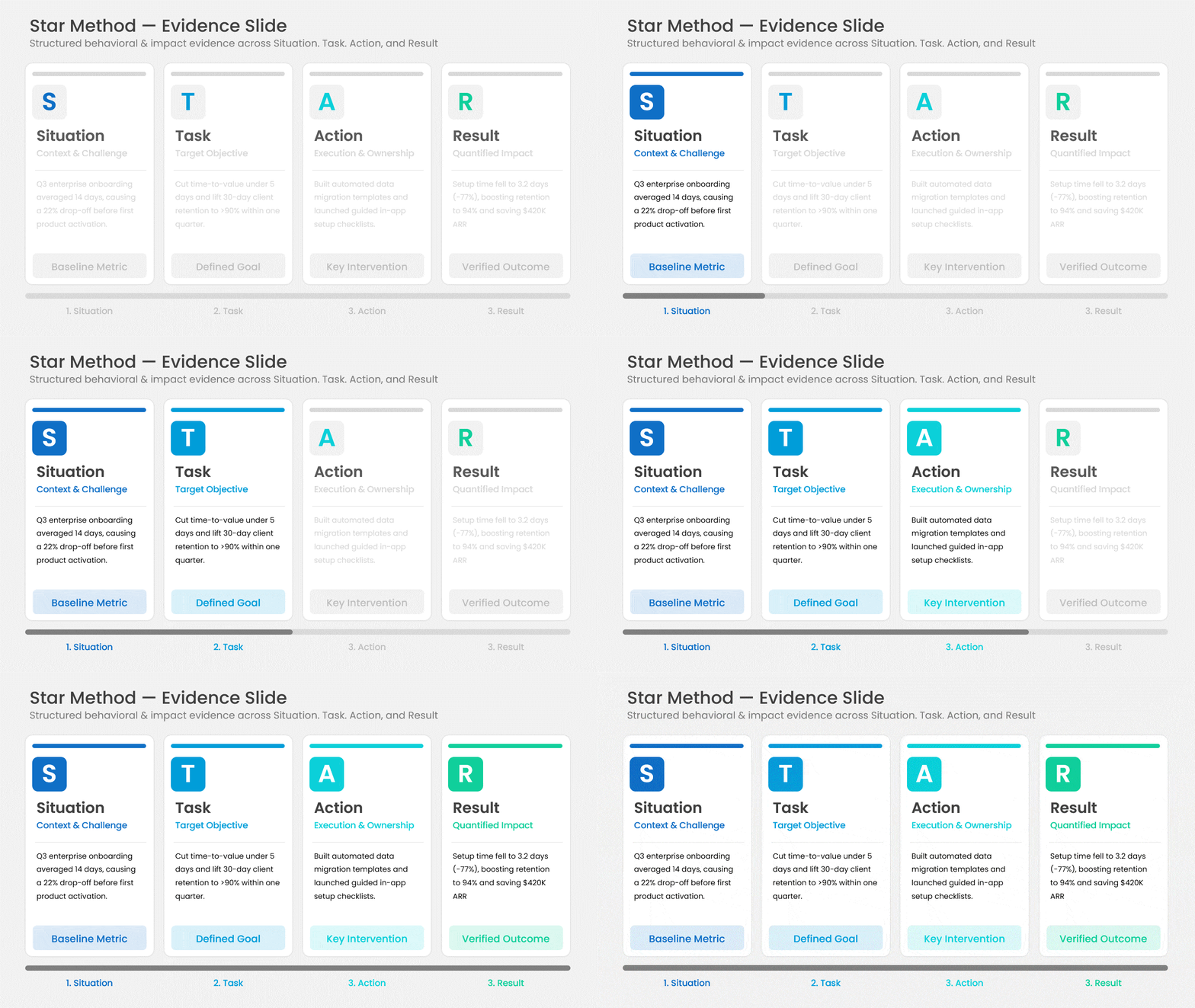
- Evidence. A project or result that backs the recommendation, told with the STAR method (situation, task, action, result).
- Your plan for the role. A 30-60-90 day plan. See our 30 60 90 day plan guide.
- Summary and questions. Three takeaways, what you would bring, and an invitation to ask questions.
Three example slides from a sales interview presentation: the title slide, the proof slide and the 90-day plan. Sample content; all names and figures are fictional.
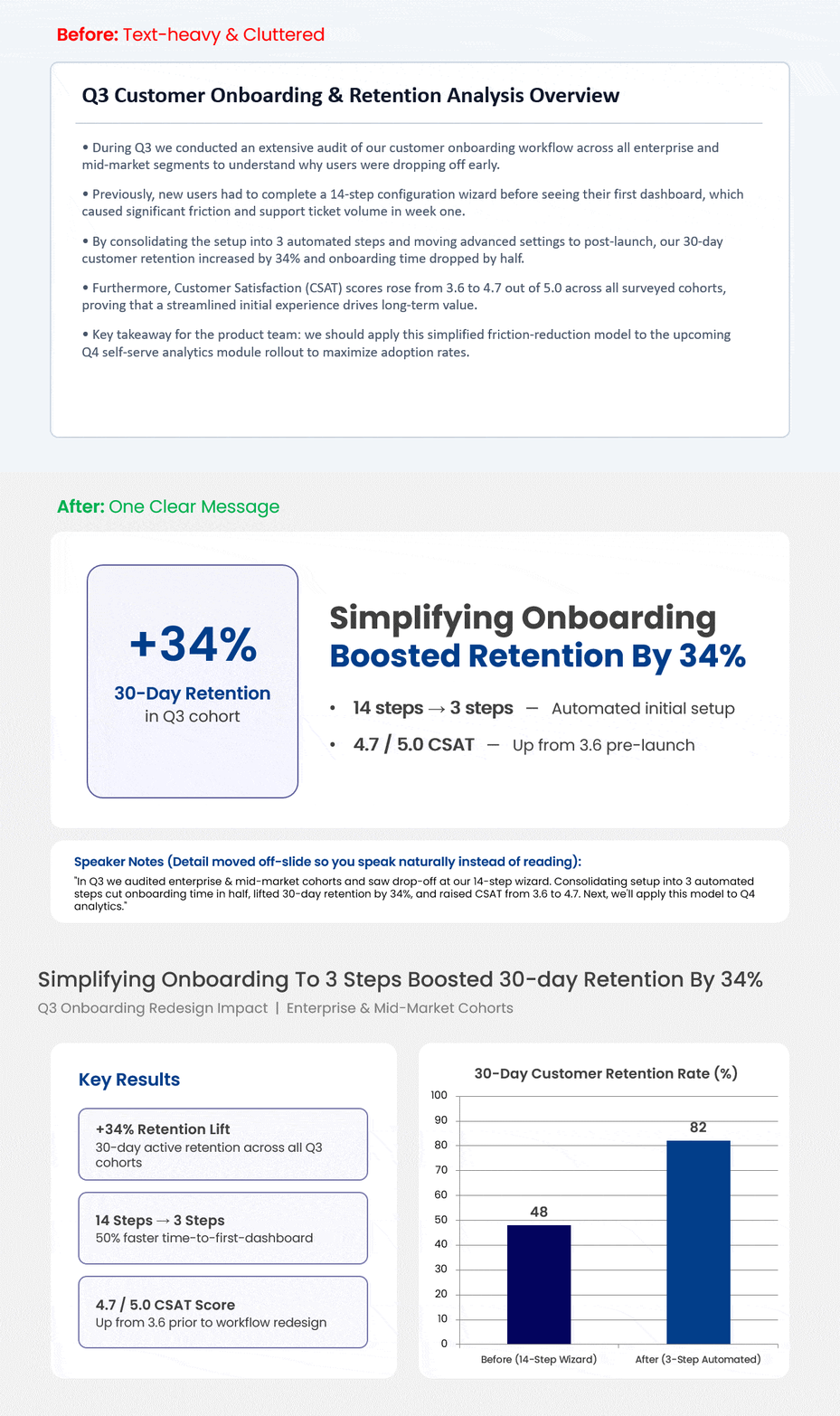
Keep one message per slide and replace paragraphs with a chart, a number or a short phrase. Our 5-5-5 rule guide and tips for making a PowerPoint attractive cover layout. If the employer has a visible brand, borrow its colours lightly; do not copy its logo or templates.
If you include research, add a key finding and a quote from a respected figure in the industry. It shows business awareness and adds authority to your ideas.
How do you prepare a presentation for a job interview?
- Confirm the brief. Topic, time limit, audience, equipment, and whether you send the slides in advance. Ask the recruiter in writing.
- Research the company. Read its website, recent news and press releases, its products and its competitors. Check its recent social media posts to see the tone it uses. Use two or three company-specific facts in the talk.
- Know the audience. Find out who will attend and what they do. A hiring manager and a technical lead care about different details.
- Choose one central idea. Everything in the talk should support a single point the panel can repeat after you leave.
- Build the slides, then the notes. Draft the outline first, then add speaker notes so you can talk without reading.
- Rehearse out loud. Practise with a timer, record yourself, and present to friends or family. Ask them what went well and what to improve, and ask one to put difficult questions. See how to prepare for a presentation.
Your 7-day preparation plan
| When | What to do |
| 7 days before | Confirm the brief, time limit, audience, equipment and whether to send slides in advance. Highlight the five most important requirements in the job description. |
| 6 to 5 days | Research the company and choose your central idea. Draft the 9-slide outline on paper first. |
| 4 days | Build the slides and add speaker notes. Ask one person to read them and say what they remember. |
| 3 days | First full rehearsal out loud with a timer. Cut to fit the time. |
| 2 days | Rehearse with the likely questions below. Record once and watch it; fix the slides that confuse you. |
| 1 day | Export a PDF backup. Test on the device or platform you will use. Pack laptop, charger, adapter and printed copies. |
| Day of | Arrive early, open the file and run the first slide. Know your first sentence by heart. |
With only 48 hours, do days 7 to 5 in one sitting and keep the two rehearsals.
What topic should you choose when the brief is open?
Pick a topic that shows you can do the job. Five job interview presentation ideas that work for most roles:
- A project you led and its result, told as a short story with numbers.
- Your plan for the first 90 days, which shows strategic thinking.
- A problem the company faces and your proposed fix, which shows research.
- An industry trend and what it means for the employer.
- A skill or tool you would bring, with an example of using it.
Avoid topics unrelated to the role, and avoid anything that needs the panel to know your previous employer’s confidential details.
For more speech-style structures, see informative speech topics.
How should you design interview presentation slides?
| Element | Do | Avoid |
| Text | Short phrases, one message per slide, detail in speaker notes | Paragraphs, reading from the slide |
| Fonts | One or two fonts, large enough to read from the back of the room. See best presentation fonts | Decorative fonts, many sizes |
| Colour | Two or three colours from one palette, with strong contrast. See PowerPoint colour palettes | Low-contrast text over images |
| Charts | One chart, one takeaway, a title that states the takeaway | Many series, unlabelled axes |
| Images | Relevant, high quality pictures, ideally your own | Clip art and stock photos that add nothing |
| Hierarchy | One clear focal point per slide. See visual hierarchy examples | Equal emphasis on everything |
| Animation | Subtle reveals that follow your speaking order | Flying text and sound effects |
| Branding | A light touch of the employer’s colour | Copying their logo or templates |
| Accessibility | Readable on a projector and in black and white | Colour as the only signal |
What should your “about me” slide say?
Use three parts: who you are now, what you have done that matters for this role, and why you want it. Keep it to about 30 seconds.
I’m a [role] with [N] years in [industry]. At [company] I [result with a number]. I’m applying because [specific reason tied to this company], and today I’ll show how I would [goal].
On the slide itself show only your name, role and one proof point. Say the rest. For stronger wording, see powerful words and statements for presentations.
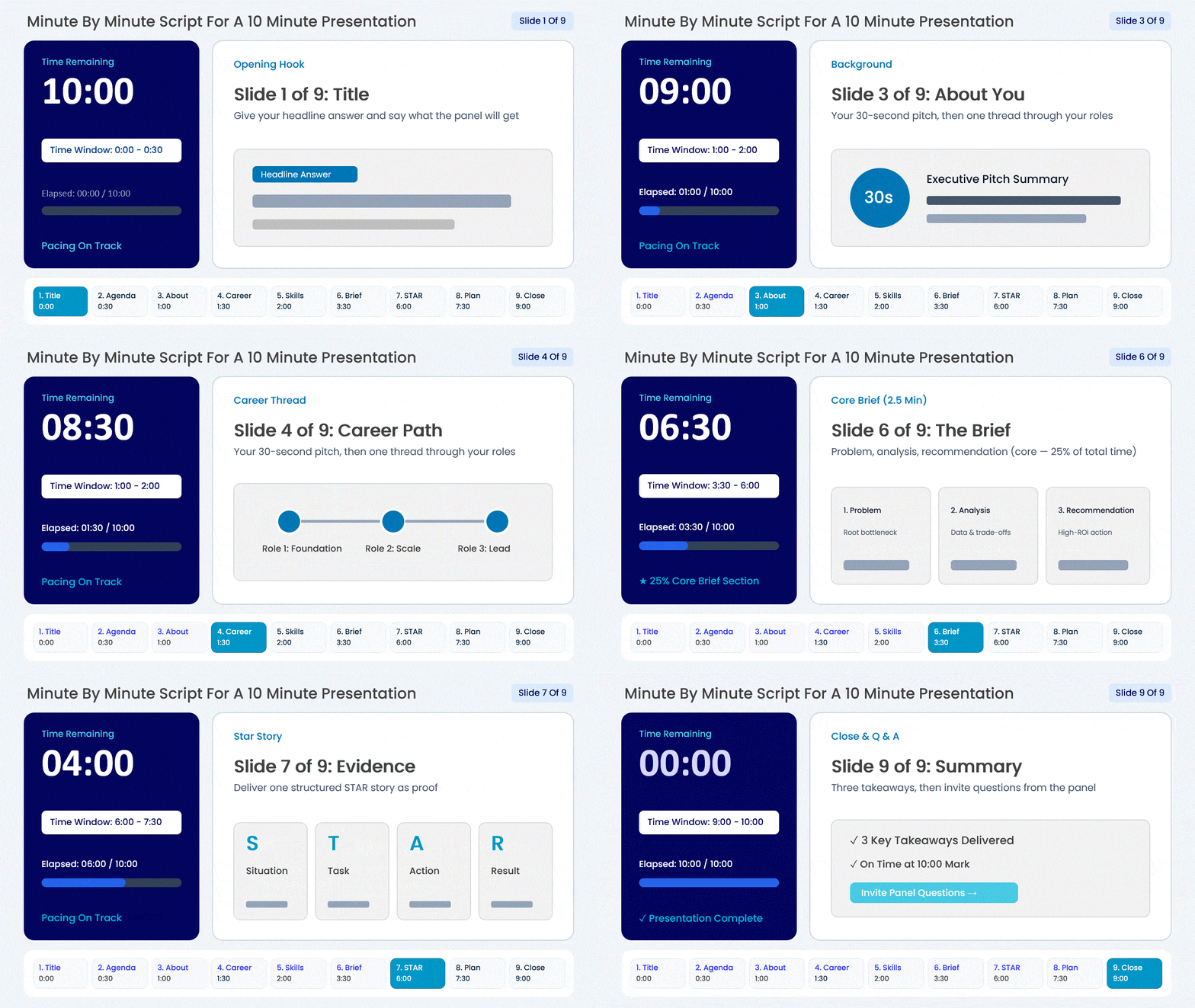
Minute-by-minute script for a 10 minute presentation
| Time | Slide | What you do |
| 0:00 to 0:30 | 1. Title | Give your headline answer and say what the panel will get |
| 0:30 to 1:00 | 2. Agenda | Name the three parts |
| 1:00 to 2:00 | 3 and 4. About you, career path | Your 30-second pitch, then one thread through your roles |
| 2:00 to 3:30 | 5. Skills with proof | Three skills, one result each |
| 3:30 to 6:00 | 6. The brief | Problem, analysis, recommendation. This is the core, about a quarter of the time |
| 6:00 to 7:30 | 7. Evidence | One STAR story |
| 7:30 to 9:00 | 8. Your plan | The 30-60-90 day plan |
| 9:00 to 10:00 | 9. Summary | Three takeaways, then invite questions |
Job interview presentation examples by role
These interview presentation examples show how to build a presentation for an interview in sales, marketing, consulting, teaching and other roles. Treat these job interview presentation samples as starting points to adapt: they are slide outlines, not scripts. Each presentation for a job interview example below shows the slide order and the point of each slide. Replace anything in [brackets] with your real figures, and keep the structure that fits the brief.
Sales interview presentation example: “My 90-day plan to grow [territory]”
Scenario: the employer asks how you would build pipeline and hit target in the first three months.
- Title: the goal in one line, such as “Growing [territory] revenue in 90 days”.
- What I learned about your market: two or three facts from your research.
- My track record: [X% of quota] in [previous role], with one deal told in STAR format.
- My sales process in four steps.
- Days 1 to 30, 31 to 60, 61 to 90: learn the product, build pipeline, close the first deals.
- How you can measure me: three KPIs, such as pipeline created, win rate, [your KPI].
- Summary and questions.
Tip: show one real customer story rather than a list of claims. See the 30 60 90 day sales plan guide for a ready structure.

A complete sample: the sales deck, slide by slide. Everything in [brackets] is yours to replace.
- Title. On the slide: “Growing [territory] revenue in 90 days, [your name]”. Say: “In ten minutes I’ll show how I would build pipeline in [territory], what I’ve done in a similar market, and how you can measure me.”
- Your market. Say: “From your website and recent news, three things stood out: [fact 1], [fact 2] and [fact 3]. Together they point to [segment] as the biggest opportunity.”
- Track record. Say: “At [company] I took [territory] from [X] to [Y] in [N] months. The situation was [context]. My task was [goal]. I [action]. The result was [result].”
- My process. Say: “I work in four steps: research, outreach, discovery and close. I review each stage every week.”
- First 90 days. Say: “In days 1 to 30 I learn the product, customers and CRM. In days 31 to 60 I build a pipeline of [N] accounts and hold [N] discovery calls a week. In days 61 to 90 I close the first [N] deals and forecast the next quarter.”
- How to measure me. Say: “Judge me on pipeline created, win rate and [your KPI]. I’ll report on them weekly.” For picking measures, see KPI examples.
- Close. Say: “To sum up: I understand the market, I’ve done this before, and I have a plan. What would you like to dig into?”
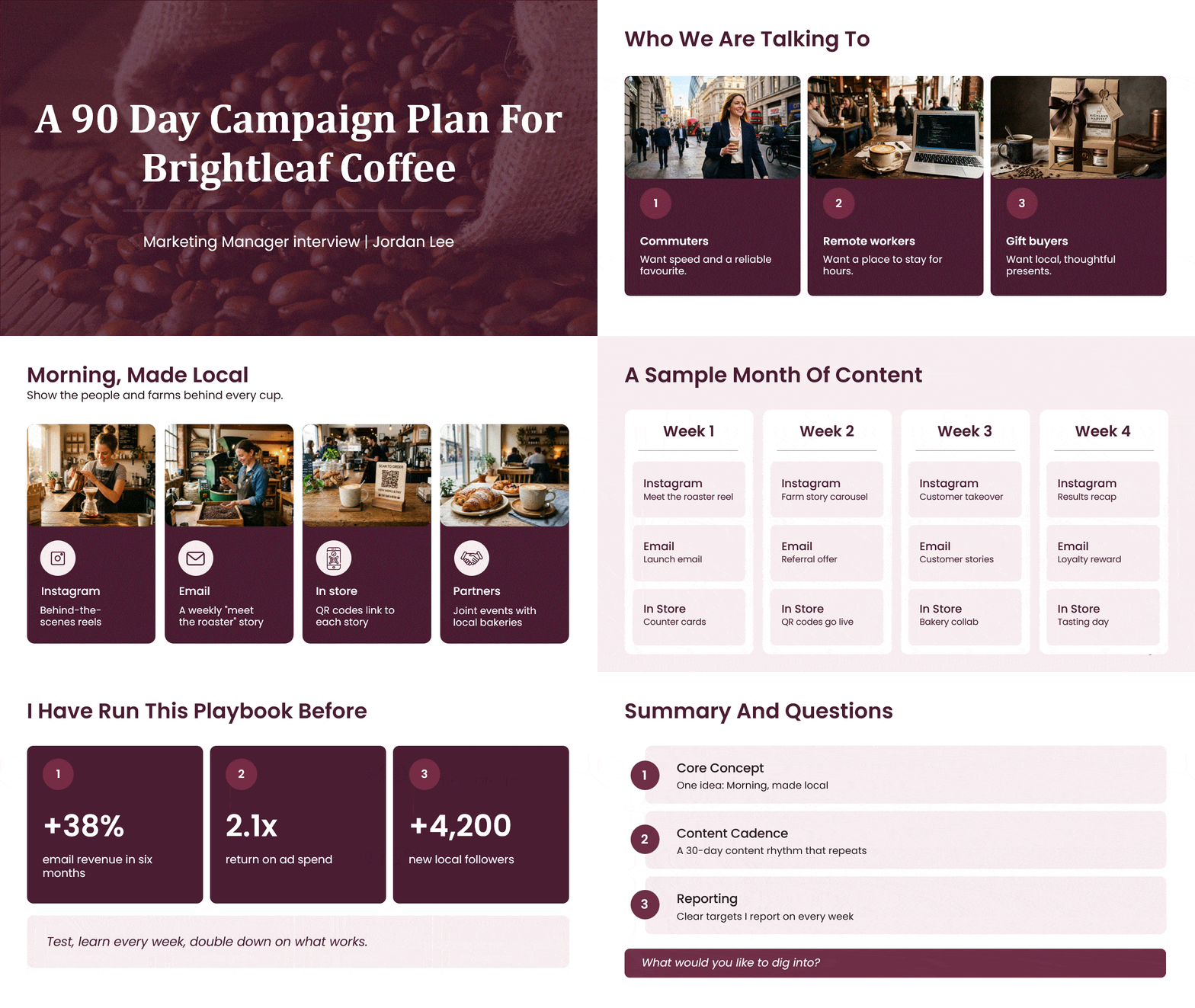
Marketing interview presentation example: “A 90-day campaign plan for [brand]”
Scenario: you are asked to propose a campaign or critique the company’s current marketing.
- Title and the one-sentence idea.
- Audience and positioning: who you are talking to and what they care about.
- What is working and what could improve: three observations from the company’s public channels. Lead with strengths.
- The campaign idea and the channels it uses.
- A sample month of content.
- Budget and KPIs: [target metric] by [date].
- A past campaign you ran, with the result.
- Summary and questions.
Tip: include screenshots of the company’s own channels so the panel sees you did the research. See our marketing plan presentation guide.
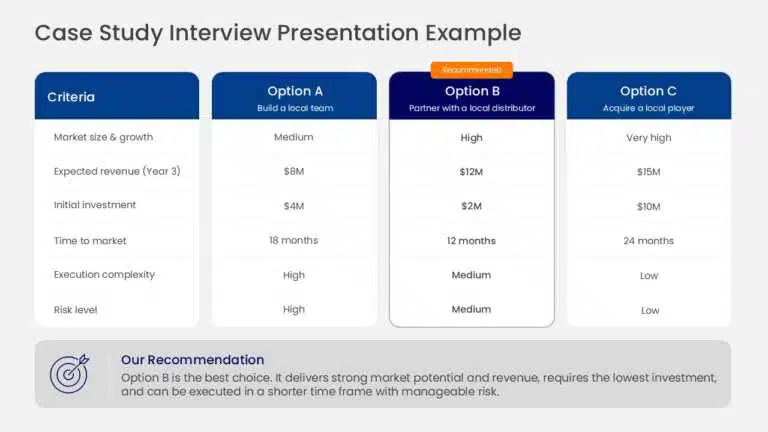
Consulting or case study presentation example: “Should [client] enter [market]?”
Scenario: you receive a case and data and must recommend an action.
- The question and your answer in one slide (answer first).
- Your approach: the framework you used.
- Findings: two or three facts with a chart.
- Options compared in a table.
- Recommendation and why.
- Risks and how to reduce them.
- Next steps.
Tip: state the recommendation before the analysis. Panels remember the answer, and the rest of the talk becomes the proof. See top executive summary slides.
Teaching demo example: “Teaching what a thesis statement is”
Scenario: a school asks you to teach a ten-minute lesson.
- Learning objective: “By the end you can spot and write a thesis statement.”
- A hook question: “What is this essay actually arguing?”
- Explanation: a thesis statement is a sentence that states the main argument of a paper.
- A weak and a strong example side by side.
- A quick activity: students fix a weak thesis.
- Summary and how you would check understanding.
Tip: teach, do not describe teaching. Interact with the panel as if they were students. For academic settings, see our academic presentation guide.
A complete sample: the teaching demo, section by section.
Introduction. As a seasoned academic writer, I plan to teach English in middle schools. A thesis statement is a crucial sentence that sums up your paper’s central topic. I will define a thesis statement today and give you an example to see what one may look like in an academic work.
Defining a thesis statement. A thesis statement is a sentence that exposes the reader to the primary idea of a paper or essay in the opening paragraph. Your thesis statement is one of the most crucial sentences in your work and one of the first things the reader will see, but it may also be one of the most difficult to compose!
An example of a thesis statement. For a literary devices-related English paper: The central premise of this novel is that hardship can lead to triumph with hard effort and perseverance; the author presents this idea through metaphors and foreshadowing.
Summary. As I explained in my presentation today, a thesis statement is a paper’s central notion. Since it’s an essential component of the writing process, young children must know this subject as soon as possible. I appreciate your attention to my presentation. Do you have any questions concerning my credentials or the information I provided? I would be happy to help.
How do you do a presentation for a second interview?
A second or final-round presentation is usually for a more senior panel and expects more depth. Use what you learned in round one.
- What I heard in round one: three priorities the team mentioned.
- How my plan addresses each priority.
- A 90-day plan with milestones, using the 30 60 90 day plan template.
- Risks and what I would need (people, tools, time).
- Summary and questions.
Ask the recruiter who will attend and what they most want to see. For executive-level roles, our 30 60 90 day plan for executives shows how to pitch the first quarter.

Example second-interview slide: three priorities heard in round one. Sample content.
For design, engineering or data roles, present two pieces of your work: the problem, your role, your process and the result. See case study templates.
More role examples
| Role | Typical brief | Slides to show | What it proves |
| Project manager | Plan a project kickoff | Goal and scope, timeline, risks, team, KPIs. See how to create a project presentation | Planning and risk control |
| Software or data | Explain a technical project to non-experts | The problem, your approach, one result metric, trade-offs, next steps | Clear explanation to a mixed audience |
| HR or recruiting | Improve onboarding or retention | Current state, the insight from [data], your proposal, cost, how you will measure it. See the 30 60 90 day onboarding plan | People and process thinking |
| Finance | Interpret a dataset or budget | The question, the data, the finding, the recommendation, the risks | Accuracy and judgement |
| Product manager | Propose a product idea | The user problem, the evidence, the solution, priorities, success metrics | Prioritisation |
| Designer or creative | Walk through a portfolio | Two or three case studies: problem, your role, process, result | Process and taste |
| Consultant | Solve a short case or review a client scenario | The question, your structure, the analysis, the recommendation, the risks and next steps | Structured thinking and clear recommendations |
| Account manager | Grow or retain a key client account | Account snapshot, goals, risks, growth plan, review rhythm, success measures | Relationship and planning skills |
| Business development manager | Plan how to open a new market or partner channel | Market view, target accounts, outreach approach, pipeline targets, first 90 days | Commercial thinking and pipeline planning |
| Academic (job talk) | Present your research or a teaching sample, often called a job talk | The research question, method, findings, contribution, teaching fit, next steps | Research clarity and teaching ability |
How do you give a portfolio presentation?
Pick two or three pieces that match the role, not everything you have made. For each, spend two to three minutes on the problem, your specific role if it was team work, the process and the result. Show the work in progress as well as the final version. Keep a copy offline in case the connection fails.
How do you present to a panel?
Look at each panel member in turn, not only the person who asks questions. When someone asks a question, start your answer with them and then include the others. Bring a printed copy of the slides for each person if the room allows it.
How do you tell a story in your presentation?
A proven storytelling structure makes your message stick, whether you are presenting a finished project or a technical topic. Follow these four steps:
- Describe the issue.
- Explain why the issue matters.
- Describe the difficulties you faced while looking for the solution.
- Finish with a strong result and a resolution.
Cast yourself as the main character of the story without overselling. Back each claim with evidence, and show how you could help the company reach its key goals quickly. Stay positive when you talk about challenges: show how you improved a difficult situation or the steps you took to fix a problem, and let the data lead so the panel can follow your thinking.
How should you start a job interview presentation?
Open with your headline answer and what the panel will get from the next few minutes. Skip long thank-yous and apologies. Four openings that work:
- The answer first: “I recommend we do X, and here is why.”
- A question: one the panel cares about.
- A short story: a 20-second moment from a past project.
- A relevant number from the company’s business.
More options in how to start a presentation.
How should you end a job interview presentation?
Summarise in three points, say what you would bring to the role, then invite questions. Leave the summary slide on screen during Q&A rather than switching to a bare “Thank you” slide. See how to end a presentation for nine techniques.
Other ways to close: a broad, open-ended question that came up in your research; a one- to three-word takeaway that helps the panel remember your main point; or a quotation placed next to the company’s mission, vision and goals. End by inviting questions to show you welcome discussion.
How to deliver your presentation for an interview in person
- Stand, face the panel and make eye contact, especially when making a key point.
- Talk to the people, not the screen. Use the slides as support.
- Slow down and pause after key points.
- Practise with the same kind of equipment you will use, and arrive early to set up.
- Bring a backup of the file (PDF and PPTX) and a printed copy.

Body language matters too: keep your shoulders back, smile naturally and use small hand gestures to make points. Allow time for a final check of your equipment, and bring spare batteries for a remote clicker.
For more on structure and delivery, see our presentation skills guide and storytelling tips.
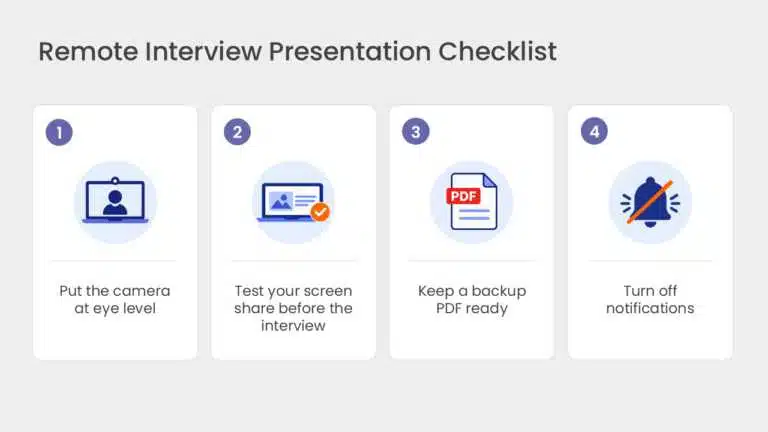
How do you present in a remote or video interview?
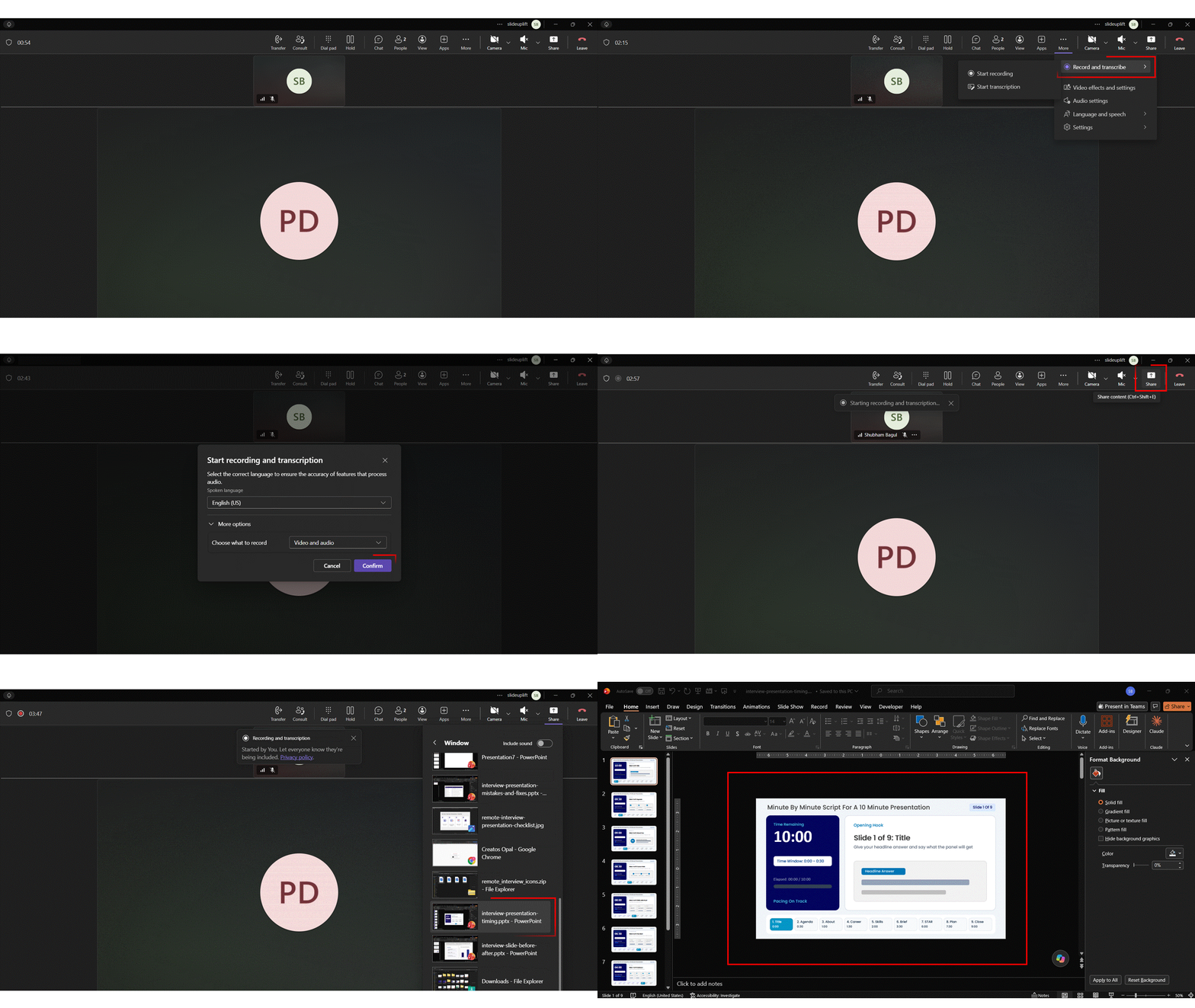
- Test the platform and screen sharing before the day, and share only the presentation window.
- Put the camera at eye level and look at it when you make key points.
- Close other apps and mute notifications.
- Send a PDF in advance if allowed, as a backup if sharing fails.
- Ask the panel at the start whether they can see your slides.
- Keep notes outside the shared area.
See virtual meeting etiquette for more, and how to record a presentation to rehearse.
How do you handle questions?
Expect questions during or after the talk. Likely ones:
- Why did you choose this approach?
- What would you do differently with more time?
- How would you measure success?
- What is the biggest risk in your plan?
- Can you give an example from your own experience?
- What would you do in your first week?
- What if the budget were half?
Pause, restate the question, answer in two or three sentences, and check you answered it. If you do not know, say so and explain how you would find out.
How do you manage nerves before the presentation?
- Memorise your first sentence. Starting smoothly makes the next minute easier.
- Rehearse until the structure is automatic. The 7-day plan above gives you two full run-throughs with questions.
- Slow down at the start. Nervous speakers speed up; pausing after your first sentence sets the pace.
- Pause instead of filling gaps. A one-second silence reads as confidence, a stream of “um” does not.
- Arrive early so you are not setting up under pressure, and ask for a glass of water.
- If you lose your place, look at the slide, take a breath and restate your last point.
Which software should you use?
Use the tool the employer can open without trouble. A PowerPoint presentation for an interview (a PPT or PPTX file) is the safest choice for most employers, and Google Slides is the usual alternative; Keynote works if you export. Ask the recruiter what they prefer, and always export a PDF backup. For comparisons, see presentation software, Keynote vs PowerPoint and how to save PowerPoint as a PDF.
Should you bring a handout?
A one-page summary with your three takeaways and contact details can help, but check whether the employer wants materials only through the recruiter. If you bring copies, hand them out at the end so the panel looks at you, not the paper.
What should you do after the presentation?
Send a short thank-you within 24 hours. Mention one thing from the discussion and, if allowed, attach the slides as a PDF.
Dear [Name], thank you for the opportunity to present on [topic] today. I enjoyed the discussion about [specific point]. I’ve attached the slides as a PDF. I’m excited about [specific part of the role] and happy to answer any follow-up questions. Best regards, [Your name]
Helpful tips for a job interview presentation
Six quick reminders to check before the day:
- Create the outline. Clarify the topic, time limit, equipment and who will attend, and stay within the brief.
- Build a clear framework. Open with an introduction that sets the scene, then tell your story with statistics and first-hand examples that show how your skills help the company reach its goals.
- Use visuals to support what you say. Use fewer words and more images, charts and diagrams to illustrate your points.
- Practise enough. Even a better idea than the other candidates’ can fail if it is delivered badly, so practise with friends or family and ask for feedback.
- Be ready to adjust. The panel may try to throw you off balance, so think about likely questions while you draft.
- Pay attention to the small things. Make eye contact, keep open body language, arrive early to set up, check your equipment and bring spare batteries for any remote clicker.
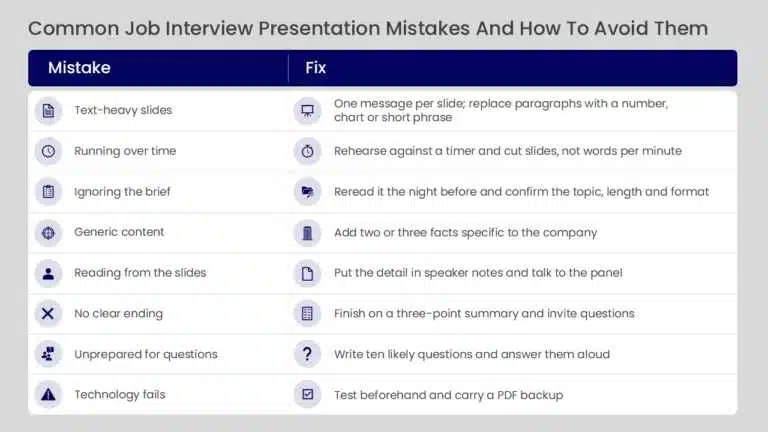
Common job interview presentation mistakes and how to avoid them
| Mistake | Fix |
| Text-heavy slides | One message per slide; replace paragraphs with a number, chart or short phrase |
| Running over time | Rehearse against a timer and cut slides, not words per minute |
| Ignoring the brief | Reread it the night before and confirm the topic, length and format |
| Generic content | Add two or three facts specific to the company |
| Reading from the slides | Put the detail in speaker notes and talk to the panel |
| No clear ending | Finish on a three-point summary and invite questions |
| Unprepared for questions | Write ten likely questions and answer them aloud |
| Technology fails | Test beforehand and carry a PDF backup |
Job interview presentation templates
SlideUpLift is well known for its collection of professionally designed PowerPoint templates, including job interview PowerPoint presentation templates. One category is job interview presentations, with templates tailored to interview scenarios, from employee profiles to the STAR method for highlighting your skills.
- Why Hire Me presentation template: a structure for the “why hire me” pitch.
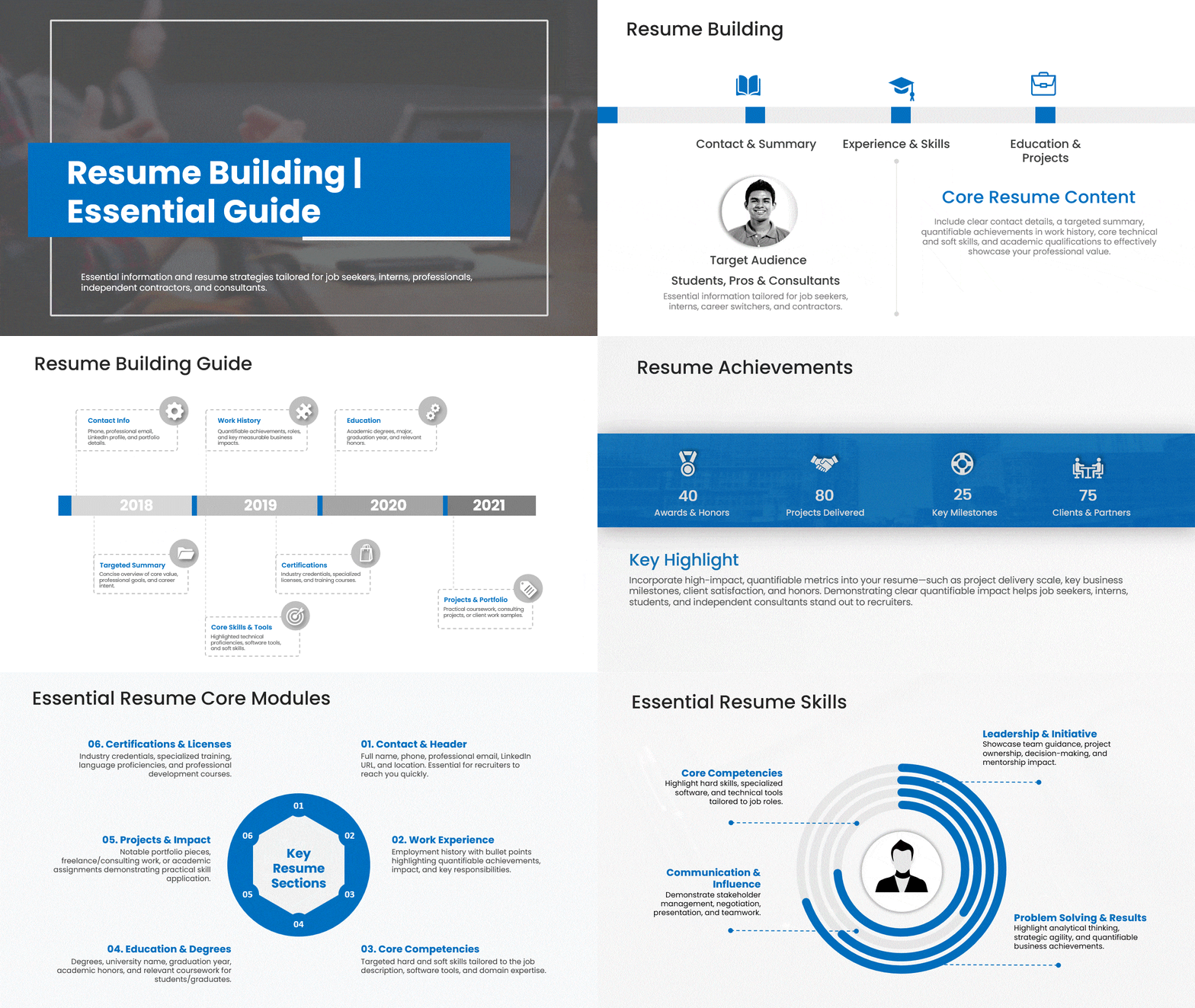
- Interview Resume presentation template: 11 slides with the relevant information a job seeker should include in a resume. Job seekers, interns or students, professionals looking for a promotion, independent contractors and consultants can all use it.
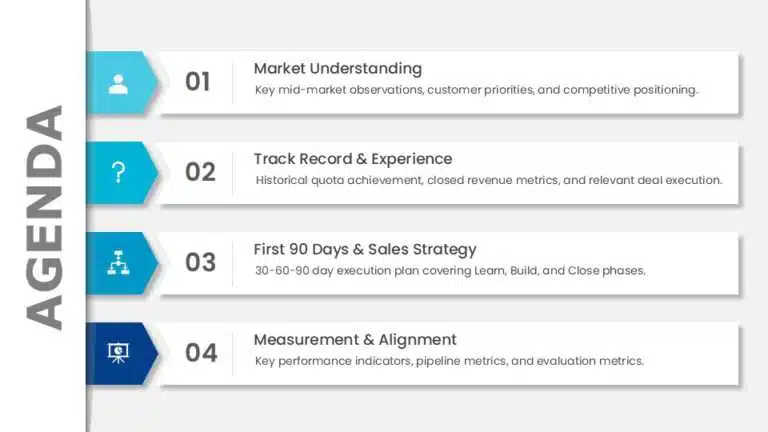
- Presentation Agenda template: four dedicated agenda layouts with a clear, organised look that highlights key topics. Use one as slide 2 of your outline to show the panel what you will cover.
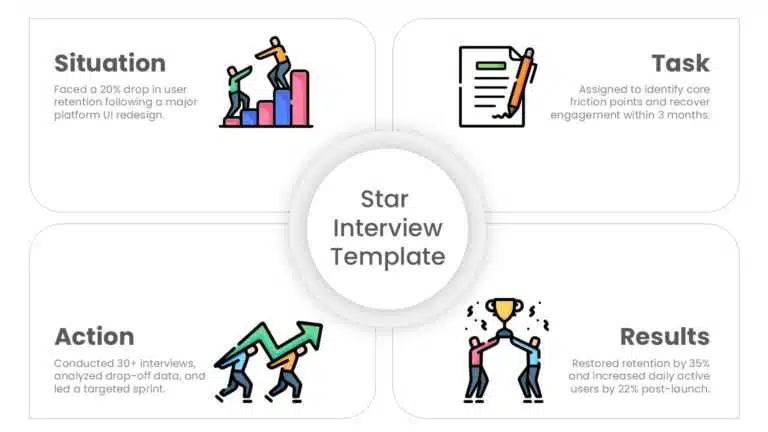
- STAR interview template: four blocks (Situation, Task, Action, Result), each with space to describe your experience in the STAR method. Use it for your evidence slide.
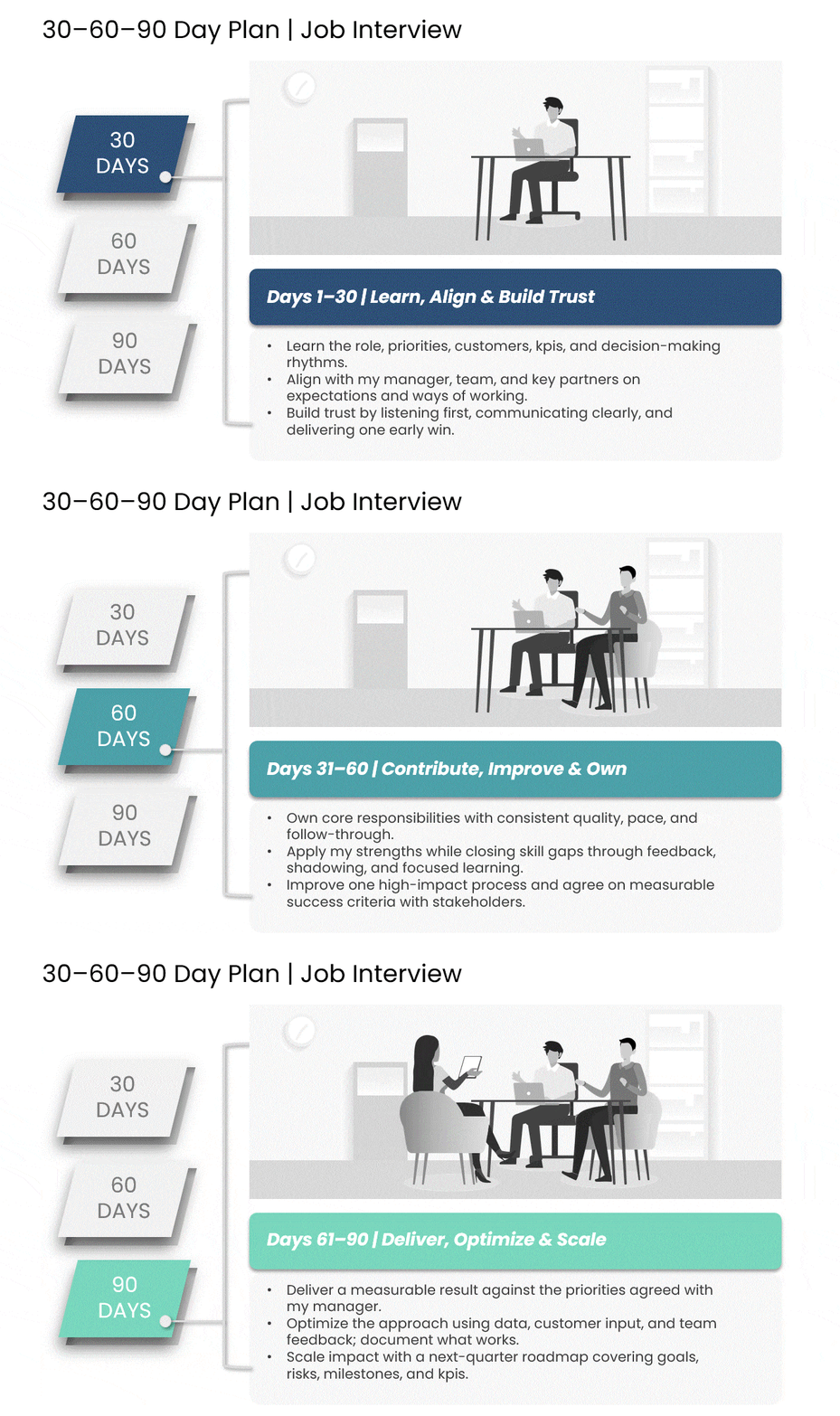
- 30 60 90 day plan for interview: a structured outline of what you plan to do in your first three months in the role. It shows your understanding of the position, your strategic thinking and your ability to set and reach goals. Use it for slide 8.
- Animated resume template: a resume template with animations that make the presentation more engaging. Download it, add your details and customise it.

Browse more in the resume templates collection. Short on time? You can create your slides with Creatos AI from a short description of the role and your talking points, then personalise the result.
Conclusion
A strong job interview presentation answers the brief, follows a clear order and fits the time you are given. Start from the 9-slide outline, choose the role example closest to yours, rehearse out loud against a timer, and prepare for questions. Then download a template and fill it with your own results.
If the design side feels overwhelming, browse our collection of PowerPoint presentation templates and choose elements such as data charts, shapes and diagrams to give your slides the visual appeal they need.
FAQs
-
How long should my job interview presentation be?
Aim for a concise presentation, typically 5 to 10 minutes, to keep the audience engaged. Follow the time limit in your invitation if there is one, and rehearse against a timer so you finish on time.
-
How many slides should I use in a job interview presentation?
Use about one slide per minute. A 10 minute presentation usually fits 8 to 10 slides, and a 5 minute one about 5. Fewer, simpler slides are better than many dense ones.
-
What should I include in a job interview presentation?
Include a title slide, an agenda, a short introduction of you, your career path, three skills with proof, your answer to the brief, supporting evidence, your plan for the role, and a summary with questions.
-
How do I start a job interview presentation?
Open with your headline answer and what the panel will get from the talk, within the first 30 seconds. You can also start with a question, a short story or a relevant number from the company. Skip long thank-yous.
-
What's the best way to conclude my job interview presentation?
The best way to conclude is to summarise your key points, say what you would bring to the role, express enthusiasm for it and open the floor to questions from the panel. Keep the summary slide on screen during Q&A instead of switching to a plain “Thank you” slide.
-
What if the employer does not give me a topic?
Choose one that shows you can do the job: a project you led, a plan for your first 90 days, a problem the company faces with your proposed fix, or an industry trend and what it means for them. Confirm your choice with the recruiter if possible.
-
How do I do a presentation for a second interview?
Use what you learned in round one. Open with the priorities you heard, show how your plan addresses each, add a 90 day plan with milestones, and state the risks and what you would need. Ask who will attend and what they want to see.
-
Can I use AI to make my interview presentation?
Yes, to draft an outline and first slides. Check every fact, replace generic text with your own results and company details, and be ready to explain every slide. Tools such as Creatos AI can create a first version from a short description, which you then edit.
-
What should be the key focus of my job interview presentation?
Prioritise showing your skills and experience and how they match the job requirements and the company’s values. Use the brief and the job description to choose what to include.
-
How can I handle questions during or after the presentation for an interview?
Be prepared by anticipating the questions the panel might ask about your content, your experience or the role. Pause, restate the question, answer in two or three sentences, and check that you answered it.
-
How can SlideUpLift help me prepare a job interview presentation?
SlideUpLift offers professionally designed PowerPoint templates, including templates for job interview presentations. They give you a ready structure, so you can focus on your content and build a strong, clear presentation.
Table Of Content


Related posts from the same category

5 Aug, 2021 | SlideUpLift
Nail That Interview Using The STAR Interview Technique
Interviews can be daunting. They are usually the first interaction you have with a potential employer, and your continued progress and ultimate success in the hiring process hinges on nailing

14 Apr, 2021 | SlideUpLift
How To Write A Vision Statement For Your Business That Actually Inspires
Running a business is not easy- numerous stakeholders, team members, and clients have ideas on priorities, focus areas, and where the business should go. They need a guiding light to

16 Sep, 2022 | SlideUpLift
Create A Team Charter For Effective Teamwork
Working in a team can be both rewarding and tricky. Ensuring that everyone in the team is working towards a common goal, collaborating and communicating progress, and delivering results is

11 Mar, 2021 | SlideUpLift
Wheel Of Change – The Perfect Model for Change Management Strategy
The world of business is constantly evolving. Traditional processes are being abandoned, as newer business models are created and adopted. With COVID-19 the pace of these changes has accelerated at

21 May, 2025 | SlideUpLift
What Is a Pecha Kucha Presentation? The Complete 20×20 Guide (With Examples & Ideas)
Quick Answer: A Pecha Kucha presentation (also written PechaKucha) is a format in which you show 20 slides for 20 seconds each, and the slides advance automatically. The whole talk

20 Feb, 2024 | SlideUpLift
Start Stop Continue Retrospective: A Complete Guide With Examples, Templates & Exercises
A Start Stop Continue retrospective is a team reflection exercise where each member names one thing the team should start doing, one it should stop, and one it should continue.

6 May, 2025 | SlideUpLift
VBA in PowerPoint: How to Automate Your Slides
Quick answer: VBA (Visual Basic for Applications) is the programming language built into PowerPoint. You use it to write macros that automate repetitive tasks — formatting every slide, inserting logos,
5 Mar, 2026 | SlideUpLift
Quarterly Business Review (QBR): What It Is, Examples & How to Present One
A QBR, or quarterly business review, is a strategic meeting held every three months to evaluate business performance, review key metrics, and align on goals for the next quarter. QBRs

11 Sep, 2023 | SlideUpLift
Complete Guide to Outsourcing PowerPoint Presentations
The importance of compelling presentations cannot be emphasized. They serve as channels for exchanging knowledge, influencing choices, and communicating ideas. A well-designed presentation can influence perceptions, motivate action, and boost

9 May, 2023 | SlideUpLift
6 Steps For Designing A Mind Map Presentation (With Templates)
Have you ever been tasked with creating a presentation, only to find yourself struggling with organizing your ideas? Many of us have experienced this situation, and it can feel overwhelming.