 Fall Sale
  Flat 40% off on our Unlimited Access Yearly Membership plan!

Work Breakdown Structure (WBS) Templates for PowerPoint & Google Slides
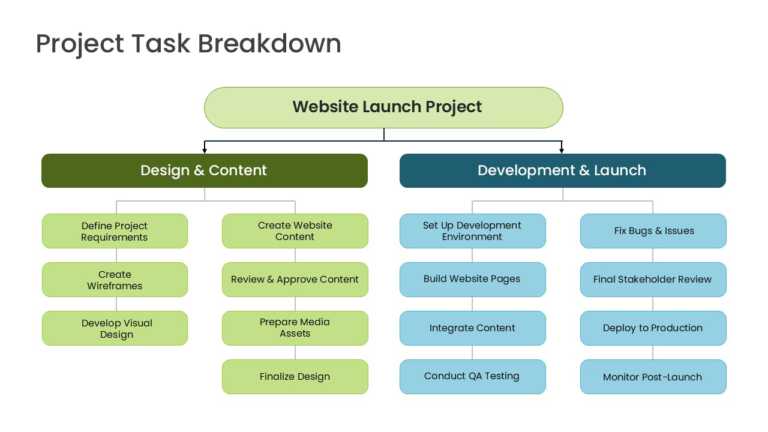
This slide presents a three-tier hierarchical work breakdown structure on a clean white canvas. A single pale-green root node labeled Website Lau....


Say something using this eye catching hierarchy chart created for software development projects specifically. This design template showcases an c....

Share your vision using this format tailored for project management purposes! This layout is ideal, for simplifying projects into parts that team....

Start off by grabbing the interest of your audience immediately using this WBS hierarchy chart tailored for project management purposes. This lay....

Enhance your data with this all encompassing project management tool that includes a table to assist you in organizing your project into stages a....

Streamline concepts using this color coded table tailored for project management presentations.This tool offers a concise and organized display o....

Enhance your presentations with a finish using this project management template crafted for conducting effective work breakdown structure (WBS) a....
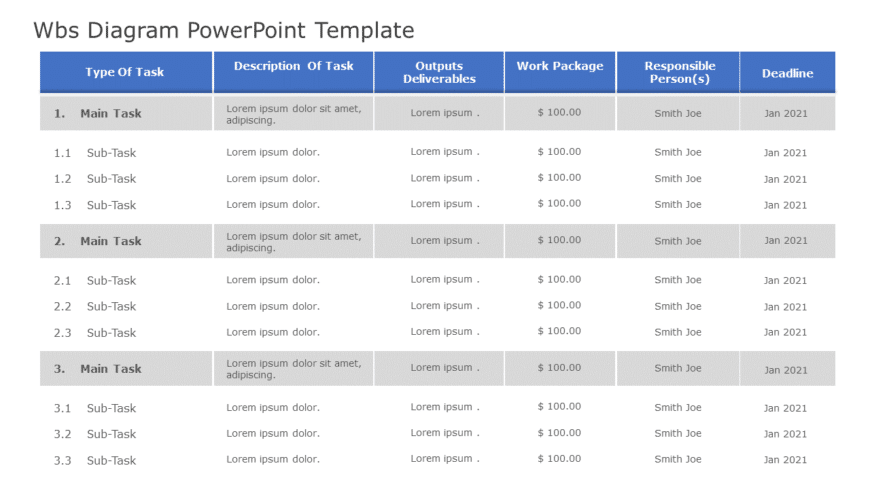
Enhance your meetings with this all WBS Diagram template! Tailored for project managers and team leaders alike this template streamlines the proc....
Related Presentations
-

Gantt Chart
56 templates>
-

Work Allocation
16 templates>
-

Agile
70 templates>
-

Project Management
1,634 templates>
-

Project Status
194 templates>
WBS Hierarchy Diagram Templates
Classic top-down WBS diagrams that visually decompose your project from the final deliverable into sub-deliverables and work packages. The tree-style layout makes scope relationships immediately clear, which is why hierarchy diagrams are the preferred format for stakeholder presentations, project kickoff decks, and PMO reporting. Use these when you need to communicate scope visually rather than track granular details.
WBS Table & Spreadsheet Templates
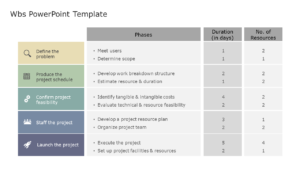
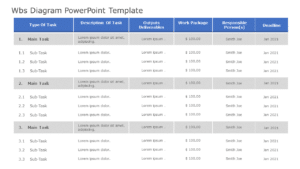
Tabular WBS layouts that organize project phases, activities, owners, and timelines in a structured grid. The table format works best when your audience needs to see detailed task assignments alongside the breakdown — think project planning meetings, budget reviews, or resource allocation sessions. These templates bridge the gap between a visual WBS and a full project plan.
WBS Project Management Slide Decks
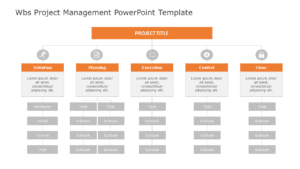
Complete project management slide sets that include a work breakdown structure alongside related planning tools like Gantt charts, milestone trackers, and RACI matrices. Ideal for comprehensive project presentations where you need to walk stakeholders through scope, schedule, and ownership in one deck.
Types of Work Breakdown Structure Templates
Not every WBS looks the same. The right format depends on your project type, audience, and how you plan to use the breakdown. Here are the three most common approaches:
Deliverable-Based WBS. Organized around the project’s tangible outputs. The top level is the final product or service, and each branch breaks it down into the physical or functional components required to deliver it. This is the format recommended by PMI’s PMBOK and is the default choice for construction, engineering, product launches, and any project where the end deliverables are well-defined. Use the hierarchy diagram templates above for this approach.
Phase-Based WBS. Organized by project lifecycle stages — initiation, planning, execution, monitoring, and closure. Each phase is then decomposed into the tasks and deliverables specific to that stage. This approach works well for software development projects, consulting engagements, and any waterfall-style workflow where work follows a sequential path. The project management slide decks above support this structure.
Tabular / Outline WBS. A spreadsheet-style format that lists every WBS element with its code, description, owner, estimated effort, and timeline. While less visual than a hierarchy diagram, it’s the most practical format for day-to-day project tracking and cost management. The WBS table templates above are built for this use case.
How to Create a WBS in PowerPoint Using a Template
Step 1: Define the project scope. Start with the final deliverable or project goal. This becomes Level 1 — the single top-level box in your WBS. Be specific: “Launch redesigned company website” is a clear Level 1; “Improve online presence” is not.
Step 2: Identify major deliverables. Break the project goal into 3–7 key deliverables or phases. These become Level 2 elements. For a website redesign, Level 2 might include brand guidelines, UX design, front-end development, content migration, and QA testing. Apply the 100% rule: Level 2 elements must collectively account for 100% of the project scope.
Step 3: Decompose into work packages. Break each Level 2 deliverable into the smallest units of work that can be estimated, assigned, and tracked. These are your work packages (Level 3 and below). Follow the 8/80 rule: each work package should require between 8 and 80 hours of effort. If it takes less than 8 hours, you’ve over-decomposed; more than 80, break it down further.
Step 4: Choose a template format. Pick a hierarchy diagram for executive presentations and stakeholder reviews. Choose a table layout for detailed planning documentation with owners and timelines. Use a full project management deck when you need to present scope alongside schedule and resources.
Step 5: Customize and present. Download the template in PowerPoint or Google Slides format. Replace placeholder text with your project data, adjust the number of levels and branches, and update colors to match your brand. All SlideUpLift WBS templates are fully editable — add, remove, or rearrange elements as your project requires.
WBS Templates for Every Project Type
Project Management. General-purpose WBS templates that work across industries. Use hierarchy diagrams for executive-level presentations where you need to communicate scope at a glance, or table layouts for detailed planning sessions where owners, timelines, and budgets need to be visible alongside the breakdown.
Software Development. Phase-based WBS covering requirements gathering, system design, development sprints, testing, and deployment. Particularly useful for waterfall projects and hybrid Agile teams that need to map sprint deliverables back to a structured scope document.
Construction & Engineering. Deliverable-based WBS organized by physical systems and trade phases — foundation, structural work, electrical, plumbing, HVAC, and finishing. The tabular format is especially valuable here for linking WBS elements to cost estimates and contractor assignments.
Marketing Campaigns. WBS is organized by channels and creative assets: content strategy, paid media, social campaigns, event logistics, and performance reporting. Hierarchy diagrams are ideal for presenting campaign plans to leadership during kickoff meetings.
Event Planning. WBS covering venue selection, logistics, catering, entertainment, communications, and post-event analysis. A deliverable-based structure ensures every detail is accounted for, from vendor contracts to day-of execution checklists.
What is a work breakdown structure?
A work breakdown structure (WBS) is a hierarchical decomposition of the total scope of work needed to complete a project. It organizes the project’s final deliverable into progressively smaller components — major deliverables, sub-deliverables, and work packages — until every piece of work is defined, estimable, and assignable. The Project Management Institute (PMI) defines it as a “deliverable-oriented hierarchical decomposition of the work to be executed by the project team.”
What should a WBS template include?
A complete WBS template includes the project name or final deliverable at Level 1, major deliverables or phases at Level 2, and detailed work packages at Level 3 and below. Each element should have a unique WBS code (e.g., 1.2.3) for tracking purposes. The structure must follow the 100% rule — all child elements must collectively represent 100% of the work in their parent element, with no gaps and no overlaps.
What is the difference between a WBS and a Gantt chart?
A WBS defines the scope of work by breaking the project into deliverables and work packages, answering “what needs to be done.” A Gantt chart defines the schedule by placing those tasks on a timeline with durations and dependencies, answering “when will it be done.” They are complementary tools: project managers typically create the WBS first, then use it as the foundation for building the Gantt chart.
How do I create a WBS in PowerPoint?
Start by defining your project’s final deliverable (Level 1), then break it into 3–7 major deliverables (Level 2), and decompose those into work packages (Level 3). Download a pre-built WBS template to save time — choose a hierarchy diagram for visual presentations or a table layout for detailed documentation. Replace the placeholder content with your project data, add or remove branches as needed, and adjust the design to fit your brand.
What are the two main types of WBS?
The two primary types are deliverable-based and phase-based. A deliverable-based WBS organizes work around tangible outputs (the final product and its components), while a phase-based WBS organizes work by project lifecycle stages (initiation, planning, execution, closure). PMI recommends the deliverable-based approach as the default because it focuses on outcomes rather than activities.
How many levels should a WBS have?
Most projects use 3 to 4 levels, though complex projects may need 5 or more in certain branches. The PMI guideline is to stop decomposing when each work package can be estimated within 8 to 80 hours of effort. Over-decomposing creates unnecessary management overhead, while under-decomposing leaves tasks too vague to estimate or assign accurately.
Can I edit these WBS templates in Google Slides?
Yes. Every SlideUpLift WBS template is compatible with both Microsoft PowerPoint and Google Slides. Download the template in your preferred format, open it directly, and customize the text, colors, levels, and layout to match your project. No design skills required
What is the 100% rule in WBS?
The 100% rule states that the WBS must include 100% of the work defined by the project scope and capture all deliverables — internal, external, and interim. At every level of the hierarchy, child elements must collectively equal 100% of the work in their parent element. This rule prevents scope gaps (missing work) and scope creep (extra work not defined in the WBS).