
 Flat 4


30 60 90 Day Sales Plan: How to Create One + Examples & Templates
Starting a new sales role is equal parts exciting and overwhelming. You have targets to hit, a CRM to learn, prospects to reach, and a team to prove yourself to — all within the first quarter. Without a clear roadmap, even experienced sales professionals can waste their first 90 days on low-impact activities.
That is where the 30 60 90 day sales plan comes in. It is a structured strategy that breaks your first three months into focused phases — learning, implementing, and executing — so you ramp faster, build the right habits, and start delivering revenue sooner.
In this guide, you will learn exactly how to build a 30 60 90 day sales plan with real examples for sales reps, managers, and new territories, along with the specific KPIs to track in each phase and ready-to-use 30 60 90 day plan templates for your presentations. For a broader overview of 30-60-90 day planning across all roles, see our ultimate guide to 30 60 90 day plans.
What Is a 30 60 90 Day Sales Plan?
A 30 60 90 day sales plan is a three-month strategy that outlines what a sales professional should learn, execute, and achieve during their first 90 days in a new role, company, or territory. The plan divides the quarter into three distinct phases:
- Days 1–30 (Learning): Absorb everything about the company, product, sales process, CRM, and customers.
- Days 31–60 (Implementing): Begin prospecting, booking meetings, building pipeline, and applying what you have learned.
- Days 61–90 (Executing): Close deals, hit quota targets, optimize your process, and operate independently.
Unlike a general onboarding checklist, a sales-specific 30 60 90 plan ties every activity back to revenue metrics — pipeline value, meetings booked, deals closed, and quota attainment. That specificity is what makes it effective.
Sales managers use it to onboard new hires consistently. New reps use it to demonstrate initiative and earn trust quickly.
Why You Need a 30 60 90 Day Sales Plan
The average sales rep takes over three months to reach full productivity. A structured 90 day plan compresses that timeline by eliminating guesswork about what to focus on and when.
- Faster ramp time. Companies with structured sales onboarding programs see new hires reach quota attainment 30–40 days faster than those without. When every week has a clear goal, new reps stop spinning their wheels on low-value tasks.
- Clear expectations between rep and manager. A written plan creates alignment. Both sides know what success looks like at day 30, day 60, and day 90 — no ambiguity, no surprises at the first performance review.
- Early course correction. When you track specific metrics at 30-day checkpoints, problems surface early. A rep who has booked zero meetings by day 45 needs intervention. Without the plan, that gap often goes unnoticed until the quarter is already lost.
- Proof of value. For new hires, the plan creates a documented record of progress that you can reference in performance reviews and conversations with leadership.
- Scalable onboarding. For sales managers building a team, a 30 60 90 day plan becomes a repeatable playbook. Every new hire follows the same structure, ensuring consistency regardless of who joins.
How to Create a 30 60 90 Day Sales Plan (Step by Step)
A good sales plan is not a list of vague aspirations. Every goal should be specific, measurable, and tied to a timeline. Here is the framework — use this as your quick-start template, then read the detailed breakdowns below.
| Phase | Focus | Key Priorities | Goals | Success Metrics |
| Days 1–30 | Learning | Product knowledge, CRM setup, team relationships, territory research | Complete training, shadow calls, map accounts | Certification passed, 20 accounts mapped, 5 stakeholder meetings |
| Days 31–60 | Implementing | Prospecting, pipeline building, pitch refinement | Launch outreach, book meetings, build pipeline | 12 meetings booked, $75K pipeline created, 2 pitch tests run |
| Days 61–90 | Executing | Closing, optimizing, planning ahead | Close deals, hit quota %, draft Q2 plan | 3 deals closed, 75% quota, Q2 plan delivered |
Now let us break down each phase in detail.
Days 1–30: The Learning Phase
The first month is about absorption, not action. Resist the urge to start selling immediately. Reps who skip the learning phase consistently underperform in months two and three because they lack the foundation to sell effectively.
- Product and market knowledge. Study the product inside out — features, pricing, competitive positioning, and the top three objections prospects raise. Review case studies, watch recorded demos, and read competitor websites. Set a goal to pass any internal product certification by day 21.
- Sales process and tools. Learn the company’s sales methodology (MEDDIC, SPIN, Challenger, Sandler, or whatever framework is used). Get fully set up in the CRM — custom fields, pipeline stages, activity logging. Shadow at least five live sales calls or demos with top-performing reps.
- Customer and territory research. Identify who the ideal customer is. Review the top 20 existing accounts in your territory. Understand the buying process, typical deal cycle length, and average deal size. If you are covering a geographic territory, map the key accounts by location and prioritize the highest-potential clusters.
- Internal relationships. Schedule one-on-one meetings with your manager, sales enablement, marketing, customer success, and product teams. Understanding how leads flow from marketing to sales and how deals hand off to customer success will make you far more effective.
- Day 30 checkpoint deliverable: Present a one-page territory assessment or account prioritization plan to your manager. This proves you have absorbed the essentials and are ready to execute.
| Day 1–30 Goal | Target | How to Measure |
| Complete product training | Pass certification with 90%+ score | Internal LMS or quiz |
| Shadow sales calls | 5 calls minimum | Calendar log |
| CRM setup | 100% profile completion, pipeline configured | CRM audit |
| Territory/account research | Top 20 accounts identified and prioritized | Written account list |
| Stakeholder meetings | Meet 5+ cross-functional partners | Calendar log |
Days 31–60: The Implementation Phase
With the foundation built, month two shifts to action. You are not expected to close deals yet, but you should be generating pipeline and developing your selling rhythm.
- Prospecting and outreach. Launch your outreach cadence — cold calls, emails, LinkedIn messages, and in-person visits if you are in field sales. Set a specific daily activity target. For example: 30 calls, 15 personalized emails, and 5 LinkedIn touches per day. Track everything in the CRM.
- Booking meetings and building pipeline. Aim to book 10–15 qualified discovery meetings during this phase. Begin building your sales pipeline with a target of generating $50,000–$100,000 in pipeline value (adjust based on your company’s average deal size and sales cycle). The goal is not to close yet — it is to fill the funnel so month three has deals to work.
- Refine your pitch. After your first 10 discovery calls, review what worked and what did not. Which objections keep coming up? Where do prospects lose interest? Work with your manager or a mentor to refine your messaging. Test two different pitch variations and track which one gets more second meetings.
- Attend deal reviews. Sit in on pipeline reviews and forecast meetings. Observe how senior reps qualify opportunities, handle stalls, and close. This accelerates your learning faster than any training video.
- Day 60 checkpoint deliverable: Pipeline review with your manager — total pipeline value, number of active opportunities, conversion rates from outreach to meeting.
| Day 31–60 Goal | Target | How to Measure |
| Discovery meetings booked | 10–15 meetings | CRM activity report |
| Pipeline value created | $50K–$100K | CRM pipeline dashboard |
| Daily outreach activity | 30 calls + 15 emails/day | Activity tracker |
| Pitch iterations tested | 2 variations A/B tested | Meeting notes log |
| Deal reviews attended | 3+ sessions | Calendar log |
Days 61–90: The Execution Phase
Month three is about converting pipeline to revenue. You should be operating with minimal hand-holding and demonstrating that you can manage a full sales cycle independently.
- Close your first deals. Focus on the highest-probability opportunities in your pipeline. Identify the 5–10 deals closest to closing and create specific action plans for each — next steps, decision-maker access, timeline, and any blockers. Set a realistic target: if your monthly quota is $100K, aim to hit 70–80% by day 90.
- Optimize and iterate. Analyze your conversion rates at every stage — outreach to meeting, meeting to proposal, proposal to close. Identify where deals are stalling and address the bottleneck. If you are getting meetings but not advancing to proposals, your qualification criteria may need tightening. If proposals are not closing, your negotiation or pricing approach may need work.
- Expand your territory. Begin prospecting beyond your initial target list. Identify adjacent accounts, upsell opportunities within existing customers, or referral sources. By day 90, you should have a self-sustaining pipeline that extends well beyond the current quarter.
- Plan the next quarter. Draft your Q2 sales plan with revenue targets, account priorities, and skill development goals. Share it with your manager during your 90-day review. This signals long-term commitment and strategic thinking.
- Day 90 checkpoint deliverable: Full performance review — deals closed, pipeline health, quota attainment percentage, and a Q2 plan.
| Day 61–90 Goal | Target | How to Measure |
| Deals closed | 2–4 deals | CRM closed-won report |
| Revenue generated | 70–80% of monthly quota | Revenue dashboard |
| Active pipeline maintained | 3x quota coverage | Pipeline-to-quota ratio |
| Win rate | 15–25% of qualified opportunities | CRM win/loss analysis |
| Q2 plan drafted | Complete document | Manager review |
30 60 90 Day Sales Plan Examples and Templates
Below are three detailed examples for different sales roles. Each one shows what the plan looks like in practice — with specific goals, not generic statements — along with a professionally designed PowerPoint template you can download and customize.
Example 1: 30 60 90 Day Plan for a New Sales Rep (SaaS Inside Sales)
Context: A BDR/AE joining a mid-market SaaS company with a $30K average deal size and a 45-day sales cycle.
Days 1–30: Learning
- Complete the 2-week product bootcamp and pass certification (score 90%+).
- Shadow 8 demo calls with senior AEs — document the top 5 objections heard.
- Set up Salesforce with customized views, email templates, and activity dashboards.
- Study the company’s ICP: mid-market companies (200–2,000 employees) in fintech and healthcare verticals.
- Meet with marketing to understand the lead scoring model and MQL handoff process.
Days 31–60: Implementing
- Begin outbound prospecting: 40 calls + 20 personalized emails per day.
- Book 12 qualified discovery meetings (3 per week target).
- Build $120K in pipeline (4x monthly quota of $30K).
- Run first 3 solo demos with manager observing and providing feedback.
- Attend weekly pipeline review and contribute one deal analysis.
Days 61–90: Executing
- Close 2–3 deals for $60K–$90K in closed-won revenue.
- Maintain pipeline coverage of 3x quota ($90K+ active pipeline).
- Achieve 20%+ conversion rate from discovery meeting to closed-won.
- Independently manage full sales cycle on all active deals.
- Present Q2 territory plan to manager.

Get the template: Use our 30 60 90 Day Sales Plan Template to present this plan to your manager. A clean three-column layout showing key priorities and action items for each 30-day phase — fully editable in PowerPoint and Google Slides.
Example 2: 30 60 90 Day Plan for a New Sales Manager
Context: A front-line sales manager taking over a team of 8 reps at a B2B company.
Days 1–30: Assessment
- Conduct 1:1 meetings with every rep to understand their pipeline, strengths, challenges, and career goals.
- Review the team’s last 2 quarters of performance data: quota attainment, win rates, average deal size, and sales cycle length.
- Shadow 2 sales calls per rep (16 total) to assess selling skills and identify coaching opportunities.
- Map the team’s pipeline: total value, stage distribution, aging deals, and forecast accuracy.
- Meet with VP of Sales to align on team targets, priorities, and any personnel concerns.
Days 31–60: Strategy
- Implement weekly pipeline reviews with a standardized deal qualification framework (e.g., MEDDIC criteria).
- Identify the top 3 coaching priorities for the team and begin structured coaching sessions (1 per rep per week).
- Establish a team meeting cadence: Monday forecast huddle (15 min), Wednesday skill-building (30 min), Friday wins review (15 min).
- Address any underperforming reps with documented improvement plans that include specific, measurable targets.
- Collaborate with marketing and sales enablement on content or tool gaps the team has flagged.
Days 61–90: Execution
- Target: team hits 90%+ of collective monthly quota.
- Improve team’s average win rate by 5 percentage points through targeted coaching.
- Complete first performance reviews for all 8 reps with documented feedback and growth plans.
- Implement one process improvement (e.g., better lead routing, revised discovery call framework, or updated competitive battle cards).
- Present a team growth plan to leadership: hiring needs, territory adjustments, and Q2 targets.
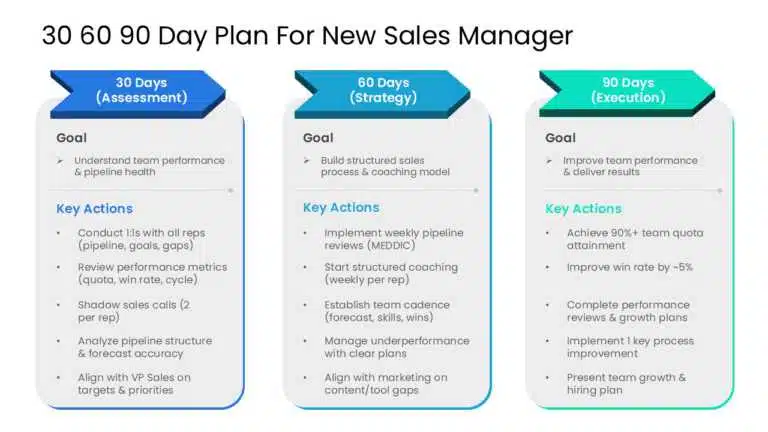
Get the template: Use our 30 60 90 Day Sales Plan for Managers Template to structure your team strategy. Designed for sales managers with sections for team assessment, process optimization, and performance targets.
Example 3: 30 60 90 Day Plan for a New Sales Territory
Context: An experienced field sales rep assigned to a new geographic territory (Southeast US) for an enterprise software company.
Days 1–30: Territory Research
- Analyze the territory data: total addressable market, number of target accounts, existing customer base, and competitive presence.
- Build a tiered account list: Tier 1 (10 must-win accounts), Tier 2 (25 high-potential accounts), Tier 3 (40 nurture accounts).
- Research each Tier 1 account: identify decision-makers, map the org chart, understand their current tech stack, and find trigger events (funding rounds, leadership changes, expansion news).
- Plan your route coverage: which cities/regions to visit first based on account density and revenue potential.
- Connect with any existing customers in the territory — schedule intro calls or visits to build referral relationships.
Days 31–60: Market Entry
- Launch outreach to Tier 1 and Tier 2 accounts: personalized email sequences, LinkedIn outreach, and phone calls.
- Conduct 8–10 in-person client meetings in the top 3 metro areas.
- Attend 1–2 local industry events or trade shows to build your network.
- Generate $200K+ in qualified pipeline from the new territory.
- Identify the top 3 local competitors and document their positioning, pricing, and weaknesses.
Days 61–90: Revenue Generation
- Close first 1–2 deals from the new territory for $75K+ in revenue.
- Expand outreach to Tier 3 accounts as Tier 1/2 pipeline matures.
- Build 3+ referral relationships with existing customers or channel partners in the region.
- Establish a repeatable monthly rhythm: Week 1 prospecting blitz, Week 2–3 meetings and demos, Week 4 closing and admin.
- Present territory performance report to leadership: pipeline, revenue, win/loss analysis, and adjusted territory plan for Q2.

Get the template: Use our 30 60 90 Day Medical Sales Plan Template for territory and field sales plans. Tailored for pharmaceutical, medical device, and field sales professionals with sections for territory mapping, account tiering, and HCP relationship building.
For the full collection of sales-specific layouts, browse all 30 60 90 day sales plan PowerPoint templates.
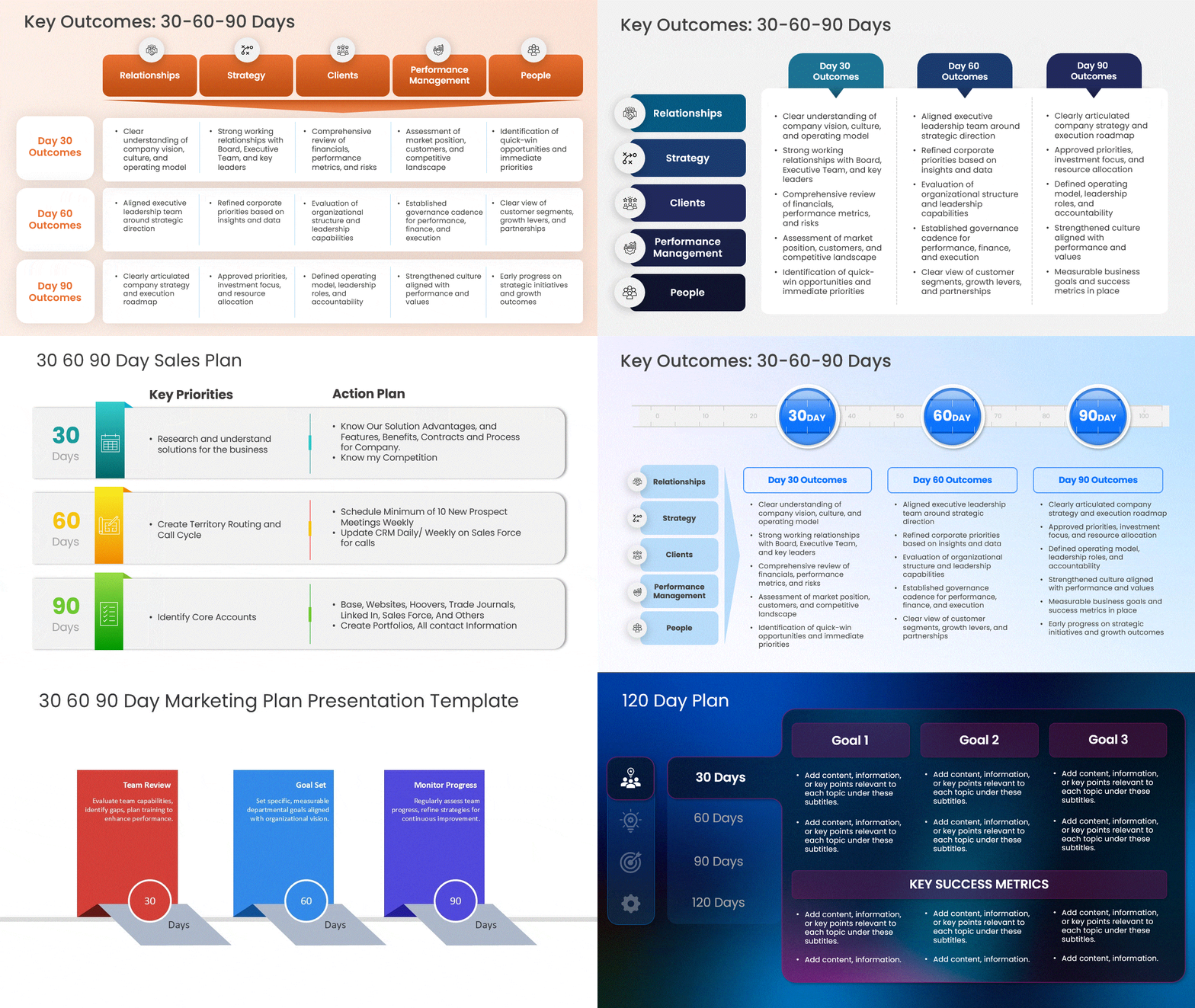
Sales KPIs to Track in Your 30 60 90 Day Plan
Setting goals without tracking them is just wishful thinking. Here are the specific metrics to monitor during each phase of your sales plan.
Days 1–30 Metrics (Learning Phase)
In the first month, your KPIs are activity-based and knowledge-based — not revenue-based. You are building the foundation.
| Metric | What It Measures | Target Example |
| Product certification score | Depth of product knowledge | 90%+ on internal assessment |
| Sales calls shadowed | Exposure to real selling scenarios | 5–10 calls |
| CRM setup completion | Readiness to track and manage pipeline | 100% profile, views, templates configured |
| Accounts researched and mapped | Territory preparation | 20+ accounts with key contacts identified |
| Stakeholder meetings completed | Internal relationship building | 5+ cross-functional meetings |
Days 31–60 Metrics (Implementation Phase)
Month two shifts to activity volume and early pipeline indicators.
| Metric | What It Measures | Target Example |
| Daily outreach volume | Prospecting effort | 30 calls + 15 emails/day |
| Discovery meetings booked | Outreach-to-meeting conversion | 10–15 meetings |
| Pipeline value created | Revenue potential being built | $50K–$100K |
| Outreach-to-meeting conversion rate | Effectiveness of messaging | 5–10% |
| Proposals or demos delivered | Advancement of opportunities | 3–5 |
Days 61–90 Metrics (Execution Phase)
Month three is about results. These are the numbers your manager — and their manager — will care about.
| Metric | What It Measures | Target Example |
| Deals closed | Revenue contribution | 2–4 closed-won deals |
| Revenue generated | Dollar impact | 70–80% of monthly quota |
| Pipeline-to-quota ratio | Future pipeline health | 3x or greater |
| Win rate | Deal closing efficiency | 15–25% |
| Average sales cycle length | Process efficiency | Within company benchmark |
| Forecast accuracy | Pipeline management maturity | Within 15% of actual |
Pro tip: Build a simple weekly scorecard that tracks 3–5 of these metrics. Review it every Friday and share it with your manager at your weekly one-on-one. This level of self-management is rare in new hires and will set you apart fast.
Common Mistakes in Sales 30 60 90 Day Plans
Avoid these pitfalls that derail even well-intentioned plans.
Setting Vague Goals Without Numbers
“Build pipeline” is not a goal. “Generate $75K in qualified pipeline by booking 12 discovery meetings through a daily cadence of 30 calls and 15 emails” is a goal. Every objective in your plan should have a specific number, a deadline, and a way to measure it. If you cannot quantify it, it should not be in your plan.
Ignoring Territory and Market Analysis
Many new reps dive straight into prospecting without understanding who they should be targeting. Spending 3–5 days on territory research — account mapping, competitive landscape, ICP definition — during your first month pays massive dividends in months two and three. Reps who skip this step end up chasing low-fit accounts and wondering why their conversion rates are abysmal.
Not Aligning With the Sales Cycle Length
If your company’s average sales cycle is 6 months, expecting to close multiple deals by day 90 is unrealistic. Adjust your plan to match the sales cycle. For longer cycles, your day 61–90 goals should focus on pipeline value and advancing opportunities to the proposal/negotiation stage rather than closed-won revenue. For shorter cycles (30 days or less), you can and should set aggressive close targets starting in month two.
Skipping Checkpoint Reviews
Your 30 60 90 plan is not a “set it and forget it” document. Schedule formal checkpoint meetings with your manager at day 30, day 60, and day 90. Review what is on track and what is not. Adjust goals if market conditions have changed or if new priorities have emerged. The most successful sales professionals treat their 90-day plan as a living document — not a static PDF they created on day one and never looked at again.
Trying to Sell Before You Understand the Product
Enthusiasm is great, but jumping into prospecting before you truly understand the product, competitive landscape, and customer pain points leads to poor discovery calls, weak demos, and lost opportunities you cannot get back. The first 30 days exist for a reason. Use them fully.
Working in Isolation
Not seeking feedback is one of the fastest ways to plateau. Share your plan with your manager, ask senior reps to critique your pitch, request ride-alongs, and attend deal reviews. The reps who ramp fastest are the ones who actively seek input from everyone around them.
Conclusion
A 30 60 90 day sales plan is more than an onboarding document — it is the difference between a new hire who ramps in 60 days and one who is still finding their footing at month six. The structure is simple: learn in month one, implement in month two, execute in month three. But the execution requires specificity — concrete goals, measurable KPIs, and regular checkpoints.
Whether you are a new sales rep, a first-time sales manager, or an experienced rep moving into a new territory, the plan should reflect your unique situation. Use the examples and templates in this guide as starting points, then customize them with real numbers that match your company, territory, and quota.
Start building your plan today. Present it with confidence. And use it to prove — to yourself and your organization — that you are someone who delivers results from day one.
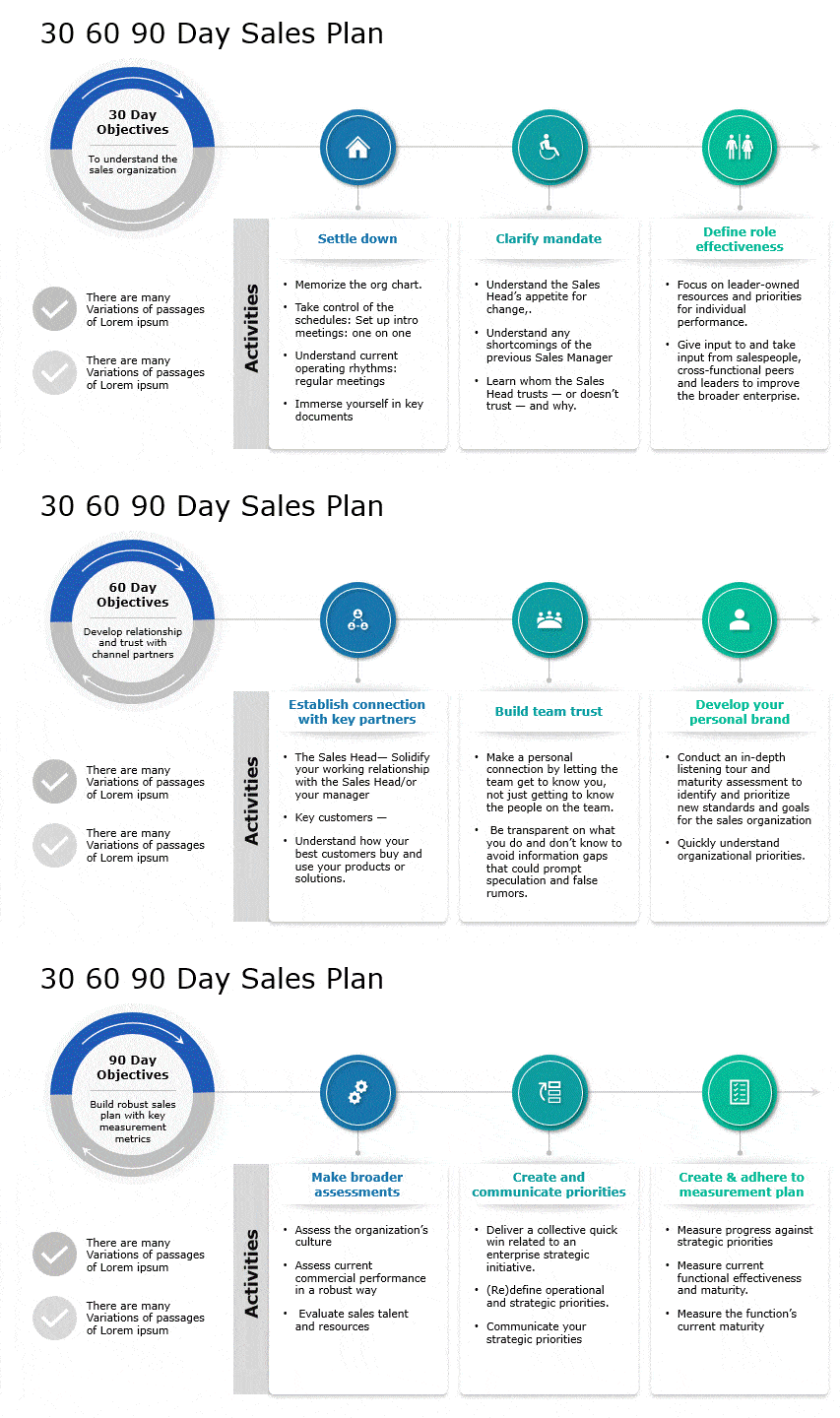
Explore our full collection of 30 60 90 day plan templates to present your sales plan professionally.
FAQs
-
What is the difference between a 30 60 90 sales plan and a general 30 60 90 day plan?
A general 30 60 90 day plan can apply to any role — marketing, engineering, HR, or management. A sales-specific plan ties every goal to revenue outcomes: pipeline value, meetings booked, deals closed, and quota attainment. It also incorporates sales-specific activities like prospecting cadences, CRM management, territory planning, and competitive analysis that would not appear in a plan for other roles.
-
How long should a 30 60 90 day sales plan be?
Keep it to one or two pages. The plan should be scannable — your manager should be able to understand your priorities and targets for each phase in under 2 minutes. Use tables, bullet points, and clear phase headers. Avoid long paragraphs of text.
-
Who creates the 30 60 90 day sales plan — the rep or the manager?
Ideally, both. Many companies have a manager-created onboarding framework that covers the first month’s training milestones. The rep should then build on that framework by adding their own pipeline targets, territory plan, and development goals for months two and three. The best plans are collaborative — the rep drafts it, the manager reviews and adjusts, and both agree on the checkpoints.
-
What if my sales cycle is longer than 90 days?
Adjust your expectations for the execution phase. If your average deal takes 6–9 months to close, your day 61–90 goals should focus on pipeline quality and deal progression rather than closed revenue. Target metrics like: number of opportunities advanced to the proposal stage, pipeline value exceeding 4x quota, and at least one deal entering the negotiation or contract stage. The 30-60-90 framework still works — the milestones just shift toward leading indicators rather than lagging ones.
-
What is the best format for a 30 60 90 day sales plan presentation?
A clean, structured slide deck with one slide per phase works best for formal presentations to leadership. Each slide should show: the phase focus, 3–5 key priorities, specific targets, and the metrics you will track. For a polished, professional layout you can customize in minutes, browse our 30 60 90 day sales plan PowerPoint templates.
Table Of Content


Related posts from the same category

20 Oct, 2023 | SlideUpLift
30 60 90 Day Marketing Plan
Nеw marketing managers, еspеcially thosе stеpping into lеadеrship rolеs, already know that 30-60-90 day marketing plans arе invaluablе. A 90-day markеting strategy not only provides a clear direction and focus
![30 60 90 Day Plan for Executives: How to Create One [+ Examples]](https://slideuplift.com/wp-content/uploads/2023/10/Blog-38.png "30 60 90 Day Plan for Executives: How to Create One [+ Examples]")
27 Oct, 2023 | SlideUpLift
30 60 90 Day Plan for Executives: How to Create One [+ Examples]
The first 90 days in an executive role are disproportionately consequential. Research consistently shows that leadership transitions carry a failure rate between 30-40%, with most derailments traceable to what happened

28 Oct, 2024 | SlideUpLift
The Ideal 30 60 90 Day Plan For Managers (+ Examples!)
Navigate your new managerial role with confidence using a leadership 30 60 90 day plan for managers. This plan helps you outline your tasks in three sections, each 30 days

6 Nov, 2024 | SlideUpLift
30 60 90 Day Plan: Templates, Examples, and How to Write One
A 30-60-90 day plan divides the first three months in a new role into three practical phases. Days 1-30 are usually focused on learning the company, role, team, tools, and

20 Oct, 2023 | SlideUpLift
“What is Your 30 60 90 Day Plan” Interview Question: How to Answer?
Hiring manager grills you heavily during a job interview in order to discover your qualifications and desires for your new employment. It can be a strеssful moment, but holds paramount

3 Mar, 2021 | SlideUpLift
30-60-90 Day Plan for Interview: Examples, Templates & Sample Answers
A 30-60-90 day plan for an interview is a short presentation or one-page document that outlines what you will accomplish in your first 30, 60, and 90 days in the

27 Oct, 2023 | SlideUpLift
30 60 90 Day Onboarding Plan for New Hire/Employee
Employee onboarding is thе final stеp in thе hiring procеss, еncompassing thе dеlivеry of thе offеr lеttеr, еmploymеnt background chеcks, papеrwork, and thе initial activitiеs on thе first day. However,
![Best Work Plan Templates For Easy Task Organization [With Examples]](https://slideuplift.com/wp-content/uploads/2024/03/Best-Work-Plan-Templates.jpg "Best Work Plan Templates For Easy Task Organization [With Examples]")
6 Mar, 2024 | SlideUpLift
Best Work Plan Templates For Easy Task Organization [With Examples]
A project's success depends on having a detailed task plan. How can you perform tasks without having a plan for them? You and your team can produce the ideal work

13 Aug, 2025 | SlideUpLift
How To Create Infographics In PowerPoint For Smarter Visual Storytelling?
As a professional, you might have to host meetings and deliver presentations to your stakeholders and team members. As a host, it's crucial to deliver presentations in a way that
![How To Create Puzzle Pieces In PowerPoint [+Templates]](https://slideuplift.com/wp-content/uploads/2022/10/How-To-Create-Puzzle-Piece-In-PPT.jpg "How To Create Puzzle Pieces In PowerPoint [+Templates]")
11 Sep, 2024 | SlideUpLift
How To Create Puzzle Pieces In PowerPoint [+Templates]
The jigsaw puzzle is the perfect design element that you can use for your strategy presentations; it helps with the storytelling aspect of your presentation by showing how the pieces