
 Flat 4


Agile vs Traditional Project Management: Key Differences and Which Is Better
Agile project management is an iterative, flexible approach that delivers work in short cycles and adapts to change as it goes. Traditional (Waterfall) project management is a linear, plan-driven approach that moves through fixed phases in sequence. Agile fits projects with evolving requirements and frequent feedback; traditional fits projects with a stable, well-defined scope where predictability matters most.
If you are weighing an Agile methodology against a traditional approach, the honest answer is that neither one “wins” outright — the right choice depends on your project, your team, and how much your requirements are likely to change. This guide breaks down what each approach is, the concrete differences between them, where Agile and Waterfall each shine, how PMP fits into the picture, and how to decide (or blend both).
What Is Traditional Project Management?
Traditional project management — most often called the Waterfall model — is a linear, sequential approach. Each phase is completed and signed off before the next begins, with heavy emphasis on upfront planning, documentation, and control. Well-known traditional frameworks include Waterfall, the PMI/PMBOK process groups, and PRINCE2.
A traditional project typically moves through five phases: Initiation, Planning, Execution, Monitoring & Control, and Closure.
Benefits of traditional project management
- Clearly defined objectives and scope from the outset
- Predictable, controllable process with defined stage gates
- Thorough documentation and a clear audit trail
- Strong accountability and a single point of ownership
Limitations
Because the plan is fixed early, traditional methods struggle when requirements change mid-project. They are best suited to work with stable, well-understood requirements and less suited to complex, fast-changing initiatives — see our roundup of common project management mistakes for how this plays out in practice.
What Is Agile Project Management?
Agile project management is an iterative approach in which work is broken into short cycles (sprints), with frequent reassessment and adaptation. It grew out of software development and was formalized by the Agile Manifesto in 2001, which prioritizes four values: individuals and interactions over processes and tools; working software over comprehensive documentation; customer collaboration over contract negotiation; and responding to change over following a plan.
Agile is delivered through frameworks such as Scrum, Kanban, Extreme Programming (XP), and Lean. If you want a breakdown of each, see our guide to the 5 most popular Agile frameworks.
Benefits of Agile project management
- Flexible prioritization as needs evolve
- Early and frequent delivery of working output
- Continuous feedback and higher customer involvement
- Improved quality through iterative testing
- More transparency across the team
Flexible prioritization as needs evolve — including knowing when to say no to lower-value work; see our piece on deprioritization for Agile teams.
Difference Between Agile and Traditional Project Management
The core difference: traditional project management plans the whole project upfront and follows that plan in sequence, while Agile plans in short iterations and adapts continuously based on feedback. The table below compares them across the dimensions that matter most.
| Dimension | Agile Project Management | Traditional (Waterfall) |
| Planning | Iterative and adaptive; reassessed each sprint | Comprehensive and fixed at the start |
| Structure | Small, incremental sprints | Linear, sequential phases |
| Handling change | Welcomes change even late in the project | Change is difficult once underway |
| Customer involvement | Continuous, throughout delivery | Mainly at the start and the end |
| Delivery | Increments at the end of each iteration | Full product at project end |
| Risk management | Addressed continuously across cycles | Handled mainly in the planning phase |
| Roles | Scrum Master facilitates; team estimates | Project manager owns estimates and approvals |
| Best fit | Evolving requirements, uncertainty, speed | Stable, well-defined, predictable scope |
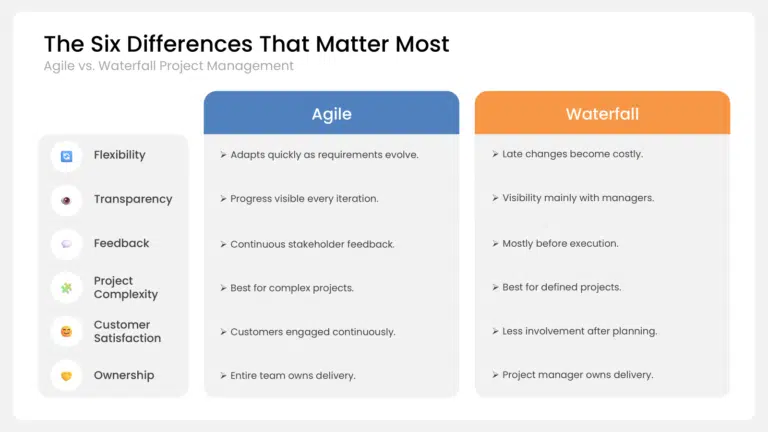
The six differences that matter most
- Flexibility. Agile adapts as new information arrives; Waterfall’s top-down plan makes late changes costly.
- Transparency. Agile makes progress visible to the whole team each iteration; in traditional PM, decisions and visibility sit with the manager and a few seniors.
- Scope for feedback. Agile builds in regular stakeholder feedback; Waterfall’s rigid structure leaves little room for it once the plan is set.
- Project complexity. Agile suits complex, interdependent work; Waterfall suits simpler, well-scoped projects.
- Customer satisfaction. Agile keeps customers engaged after every iteration; traditional PM involves them early, then less so during execution.
- Ownership. In Agile the whole team owns delivery; in traditional PM, the project manager typically owns it.
Agile vs PMP: What’s the Difference?
This is a common point of confusion, so it is worth being precise. PMP (Project Management Professional) is a certification, not a methodology. Offered by PMI, it has historically been associated with traditional, plan-driven (predictive) project management, though the current exam also covers Agile and hybrid approaches.
So when people search “Agile vs PMP,” they usually mean one of two things:
- Methodology vs methodology: Agile (adaptive) vs the traditional/predictive approach a PMP has classically represented — that comparison is the whole table above.
- Certification vs certification: PMP vs PMI-ACP (Agile Certified Practitioner). PMP is broader and predictive-leaning; PMI-ACP is Agile-specific. Many project managers now hold both.
Agile-Waterfall Hybrid: Do You Have to Choose?
Many teams don’t pick one — they blend both. A hybrid (sometimes called “Agile-Waterfall”) uses traditional, plan-driven structure for phases with fixed requirements (procurement, compliance, hardware) and Agile iterations for phases where requirements evolve (design, software build). Hybrid works well when different parts of the same project have very different levels of certainty, or when an organization is transitioning from traditional to Agile and wants to de-risk the change.
Similarities Between Agile and Traditional Project Management
Despite the contrasts, both approaches share a lot:
- Both aim for successful outcomes aligned with stakeholder expectations
- Both require efficient allocation of people, time, and budget, and both prioritize managing risk
- Both emphasize clear communication and a high-quality end product
- Both follow a lifecycle of initiation, planning, execution, monitoring, and closing
- Both ultimately strive for customer satisfaction and team collaboration
How to Choose Between Agile and Traditional Project Management
There is no one-size-fits-all answer. Weigh these factors:
- Requirement stability: fixed and clear → traditional; evolving → Agile.
- Complexity and uncertainty: high → Agile; low → traditional.
- Stakeholder involvement: continuous → Agile; front-loaded → traditional.
- Team and culture: empowered, self-organizing teams favor Agile; hierarchical, control-oriented settings suit traditional.
- Predictability needs: if fixed timelines/budgets are non-negotiable, traditional offers more upfront certainty; if speed and responsiveness matter more, Agile wins.
Choosing the method is only half the job — communicating the plan is the other half. If you need to present your approach to stakeholders, our project management presentation templates and project management presentation topics can help, along with our guide on how to create a project presentation.
FAQs
-
What is the main difference between Agile and traditional project management?
Agile is iterative and adaptive, delivering work in short cycles and welcoming change. Traditional (Waterfall) is linear and sequential, with detailed upfront planning and fixed phases.
-
Which is better, Agile or traditional project management?
Neither is universally better. Agile suits projects with evolving requirements and a need for speed and feedback; traditional suits projects with stable, well-defined scope where predictability is critical.
-
Can you use both Agile and traditional in the same project?
Yes. A hybrid (“Agile-Waterfall”) approach uses traditional structure for fixed-requirement phases and Agile iterations for phases that evolve — common during a transition to Agile.
-
Is Agile replacing traditional project management?
Agile has grown quickly, but traditional methods remain widely used where requirements are stable and predictability matters. Most mature organizations run a mix.
-
What is the difference between Agile and Waterfall?
Waterfall is the best-known traditional method: fixed, sequential phases. Agile is iterative and flexible. “Agile vs Waterfall” is essentially “Agile vs traditional” with Waterfall as the specific traditional model.
-
Is PMP Agile or traditional?
PMP is a certification, not a methodology. It has historically emphasized traditional/predictive project management, though the current exam also covers Agile and hybrid. For an Agile-specific credential, see PMI-ACP.
-
What are the five phases of traditional project management?
Initiation, Planning, Execution, Monitoring & Control, and Closure.
Table Of Content


Related posts from the same category

15 Apr, 2021 | SlideUpLift
5 Most Popular Agile Project Management Frameworks
Agile frameworks strongly emphasize collaboration and open communication within project teams. Regular events such as daily meetings, sprint planning, and retrospective sessions facilitate ongoing discussions and ensure everyone is on
12 Sep, 2025 | SlideUpLift
What is KPI? Step-by-Step Guide with KPIs Examples That Work
Is it hard for you to know if your business is getting to the level it should be? That's where key performance indicators (KPIs) come into play. KPIs indicate how

8 Jul, 2021 | SlideUpLift
Avoid Making These 7 Project Management Mistakes
Making mistakes is not a bad thing; tons of lessons can be learned from them. And in the field of Project Management, lessons abound. Projects, unfortunately, seldom go smoothly. There

24 Apr, 2024 | SlideUpLift
How to Create a Project Timeline: Steps, Types & Examples
A project timeline is a visual schedule that lays out a project's phases, tasks, milestones, and deadlines in chronological order, so your team can see what is due and when.
21 Dec, 2023 | SlideUpLift
25+ Project Management Presentation Topics for 2026
Project management presentation topics span everything it takes to deliver work successfully — planning methods, team collaboration, risk management, leadership, and the trends reshaping how projects get done. Whether you're
10 Oct, 2025 | SlideUpLift
What Is A Project Charter? Definition, Examples & Best Practices
Launching a project without adequate planning can result in confusion, delays, and misaligned expectations. A project charter is a key document in the project documentation process that lays the groundwork

31 Oct, 2022 | SlideUpLift
The Savvy Project Manager Series: 5 Steps To Successful Project Planning
We encounter projects in our everyday lives. You might be building or contributing to a deliverable like a report, a website, a tool, or a product. These are real projects
20 Dec, 2021 | SlideUpLift
Why Is Deprioritization Important For An Agile Team? – The Power Of Saying No To Projects
Most of us have felt the sting of an unmanageable workload. We're at work, and the emails aren't stopping. Urgent requests are piling up, deadlines are looming, feedback is due,
28 Sep, 2022 | SlideUpLift
Project Initiation Phase: Definition, Process & Key Documents
This blog explains the project initiation phase in project management and why it’s critical for defining goals, scope, and feasibility. It covers key initiation documents like the project charter and

16 Dec, 2021 | SlideUpLift
Breaking Down Work Breakdown Structure in Easy Steps : Must Have Resource For Project Managers
Project management is complex. It necessitates keeping track of multiple – sometimes geographically dispersed – teams, coordinating tasks, and holding everyone accountable to a common goal. Fortunately, there are a