

 Flat 1


How to Do Hanging Indent on Google Slides: 4 Easy Methods (Complete Guide)
Have you ever tried to format citations or multi-line bullet points in Google Slides, only to end up with text that wraps messily back to the left edge? You are not alone. It is one of the most common formatting frustrations among students, educators, researchers, and presentation designers — yet a clear, all-in-one answer is surprisingly hard to find.
Here is the core problem: unlike Microsoft Word or Google Docs, Google Slides has no dedicated one-click button for this in plain view on the toolbar. That single missing button causes an enormous amount of confusion. The good news is that knowing how to do a hanging indent on Google Slides is entirely achievable, and there are four distinct methods to do it — each suited to a different device, skill level, or workflow. This guide covers every method available in 2026, including the desktop browser workaround for iPad users.
Whether you need to format APA references for an academic presentation, clean up a bulleted list that runs to two or more lines, or simply want clear step-by-step instructions without digging through menus, this guide has you covered. You will find four methods, exact APA and MLA citation values, troubleshooting fixes, and a dedicated section for iPad and mobile users. By the end, you will have a reliable approach for every situation — no guesswork required.
Quick Answer: How to Do a Hanging Indent in Google Slides (Format Options Method)
- Click inside your text box and select the text you want to format.
- Click Format in the top menu, then select Format options.
- In the sidebar, click Text fitting to expand it.
- Under Special indent, choose Hanging and set the By value to 0.5 inches.
- Close the sidebar. Your text now has a hanging indent.
What Is a Hanging Indent and Why Does It Matter in Google Slides?
A hanging indent is a paragraph formatting style in which the first line of a paragraph aligns with the left margin, while every subsequent line is indented inward. It is the visual opposite of a standard first-line indent, which is why it is also sometimes called a reverse indent or a second-line indent.
The visual result is that the opening word of each entry — an author name in a citation, a key term in a list, or the first word of a bullet point — visually “hangs” to the left of the indented text block below it, making it the natural anchor point for the reader’s eye.
Hanging Indent vs. Regular Indent — What Is the Difference?
| Indent Type | First Line | All Subsequent Lines |
|---|---|---|
| No Indent | Left margin | Left margin |
| First-Line Indent | Indented to the right | Left margin |
| Hanging Indent | Left margin | Indented to the right |
Understanding this distinction is crucial because the two are easy to confuse in Google Slides — if you accidentally apply a first-line indent instead of a hanging indent, your references will look backwards from the style guide requirements.
When Should You Use Hanging Indentation in Google Slides?
Applying hanging indentation in Google Slides is most useful in the following situations:
- Academic citation slides — APA, MLA, and Chicago style all require a 0.5-inch hanging indent for every entry on a reference, works cited, or bibliography slide.
- Multi-line bullet points — When a bullet runs longer than one line, a hanging indent keeps the text aligned under the first word rather than wrapping back under the bullet symbol itself.
- Reference or credits slides — Any presentation that lists data sources, image credits, or bibliography entries benefits significantly from the visual separation hanging indents provide.
- Formal agenda items or legal disclaimers — Numbered or lettered multi-line items in policy or legal presentations are far easier to scan with proper hanging indents applied.
If all of your slide text fits on a single line per bullet, hanging indents are unnecessary. But as soon as text wraps, the difference between formatted and unformatted slides becomes immediately visible.
Method 1 — Using the Format Options Menu (Best for Beginners)
The Format Options menu is the most reliable and precise way to add a hanging indent in Google Slides. It allows you to enter an exact numerical value, works consistently in all desktop browsers, and produces results that are easy to replicate across multiple text boxes.
This is the recommended starting method for anyone learning how to add a hanging indent in Google Slides for the first time.
Step-by-Step Instructions for Windows and Mac
- Open your Google Slides presentation and navigate to the slide containing the text you want to format.
- Click inside the text box to activate it, then click and drag to select the specific paragraph or paragraphs you want to indent. To select all text in a box at once, press Ctrl+A (Windows) or Cmd+A (Mac).
- In the top navigation menu, click Format.
- In the dropdown that appears, select Format options. A sidebar will open on the right side of your screen.
- In the Format Options sidebar, click on Text fitting to expand that section.
- Scroll down until you see the Indentation area.
- Under Special indent, click the dropdown menu and select Hanging.
- A By input field will appear. Type your desired indent value. For academic citations (APA 7th edition, MLA 9th edition), this value should be 0.5 inches or its metric equivalent, 1.27 cm.
- Close the sidebar by clicking the X. Your selected text will now display a proper hanging indent.

Choosing the Right Indent Value
For academic citations (APA, MLA, Chicago), the universally accepted standard is 0.5 inches. This is the value specified by the American Psychological Association for APA 7th edition and by the Modern Language Association for MLA 9th edition.
For non-academic use — such as a formatted agenda, a project outline, or a multi-line bullet list — values between 0.3 and 0.5 inches tend to look the cleanest. The right value also depends on your font size: larger fonts (20pt or above) may benefit from a slightly deeper indent to clearly distinguish the hanging structure.
Pro Tip — The Format Options Method Is the Most Consistent
Unlike the ruler (which requires manual dragging and is prone to small alignment errors), the Format Options method applies exactly the number you type. If you are working on a presentation with multiple citation slides and need every hanging indent to match precisely, always use Format Options rather than the ruler.
Method 2 — Using the Ruler Tool (Best for Visual, Hands-On Control)
If you prefer a drag-and-drop approach, the Ruler tool is the way to go. It gives you real-time visual feedback as you move the markers, which makes it easy to see the effect of the indent as you apply it.
This is the method most people try first when searching for how to do hanging indent Google Slides style — and with the right technique, it works very well.
How to Enable the Ruler in Google Slides
The ruler is not always visible by default. If you do not see a horizontal bar with measurement marks across the top of your slide editing area:
- Click View in the top navigation menu.
- Select Show ruler. The ruler will appear immediately above the slide canvas.
Note: The ruler is only available in the desktop browser version of Google Slides. It does not appear in the mobile app.
Understanding the Two Blue Ruler Markers
When you click inside a text box and select your text, two small blue markers appear on the ruler:
- Blue rectangle — This is the First Line Indent marker. It controls where the very first line of your paragraph starts.
- Blue triangle (pointing down) — This is the Left Indent marker (also called the hanging indent marker). It controls where all subsequent lines in the paragraph start.
To create a hanging indent, the triangle must sit to the right of the rectangle — this is the opposite of their natural default positions when text starts from the left margin.
Step-by-Step Ruler Method
- Click inside your text box and select the text you want to format.
- Confirm the ruler is visible (View → Show ruler if needed).
- On the ruler, locate the blue triangle (Left Indent marker). Click and drag it to the right — approximately 0.5 inches from the left edge of the text box. This sets where your wrapped lines will align.
- Now, locate the blue rectangle (First Line Indent marker) and drag it back to the left margin (position 0 on the ruler). This ensures the first line stays flush left.
- Release the mouse. Your text should now show the first line at the margin with all subsequent lines indented at the triangle’s position.

Common Mistake With the Ruler
The most frequent error is accidentally grabbing and moving both markers at the same time instead of independently. If your entire paragraph shifts to the right rather than forming a hanging indent, you have moved the wrong marker. Press Ctrl+Z (Windows) or Cmd+Z (Mac) to undo, zoom into your slide (View → Zoom → 150%), and try again with greater precision.
Method 3 — Keyboard Shortcut Workaround (Best for Speed)
Why Google Slides Has No Official Keyboard Shortcut for Hanging Indents
Unlike Microsoft Word, where Ctrl+T applies a hanging indent instantly, Google Slides has no dedicated one-keystroke shortcut for this formatting. This surprises many users who are accustomed to Word or Google Docs.
However, there is a widely used workaround using Shift+Enter and Tab that produces the same visual result quickly — and is the fastest option when you want to know how to hang indent on Google Slides without opening any menus. If you want to get faster at formatting in general, check out our complete guide on Google Slides keyboard shortcuts.
Step-by-Step Keyboard Workaround
- Place your cursor at the very beginning of the second line of your paragraph (not the first line — the first line stays at the left margin by default).
- Press Shift + Enter (Windows) or Shift + Return (Mac). This inserts a soft line break without starting a new paragraph.
- Immediately press Tab. The current line will indent to the right.
- Move your cursor to the beginning of the next line (the third line, if present) and repeat the same sequence: Shift+Enter, then Tab.
- Continue this for each subsequent line in the paragraph.

The resulting text visually mirrors a true hanging indent: the first line sits at the left margin while all other lines are indented.
Tab vs. Shift+Enter+Tab — Which One to Use?
| Situation | Best Method |
|---|---|
| Bulleted list item running to multiple lines | Tab key at the start of the new bullet line |
| Citation or non-bulleted paragraph | Shift+Enter, then Tab |
| Already inside a bulleted list | Tab to increase indent level; Shift+Tab to decrease |
For APA and MLA citations specifically, always use the Shift+Enter then Tab combination. Pressing Tab alone at the start of a fresh paragraph may trigger a bullet indent level increase rather than creating a hanging indent within the existing paragraph.
The Trade-Off of the Keyboard Method
The keyboard method is the fastest to apply, but it is also the hardest to undo cleanly. Because it inserts actual line breaks and tab characters into your text, you have to remove them manually, line by line, if you ever need to reformat. For long reference lists, the Format Options method (Method 1) is a much cleaner long-term choice.
Method 4 — How to Do Hanging Indent on Google Slides on iPad and Mobile
To do a hanging indent on Google Slides on an iPad, open your presentation in Safari or Chrome and switch to Desktop Mode — this loads the full desktop interface, including Format Options and the Ruler. The Google Slides app for iOS does not support hanging indents directly.
Why the Google Slides App Does Not Support Hanging Indents
This is the single most frustrating situation mobile users encounter. The native Google Slides app for iOS and Android does not include the Format Options sidebar or the ruler tool. If you are trying to figure out how to do hanging indent on Google Slides on iPad through the app, you will not find it — the feature simply does not exist in the app interface as of 2026.
Google’s mobile app is intentionally streamlined, and paragraph-level indent controls fall outside what the app currently supports. This is a known limitation that many users report running into during academic presentations created on iPads.
The Desktop Browser Workaround for iPad
The most reliable workaround for iPad users is to access Google Slides through a browser in Desktop Mode, which loads the full desktop version of the interface — ruler, Format Options sidebar, and all.
- Open Safari or Chrome on your iPad.
- Go to slides.google.com and sign in if prompted.
- Open the presentation you want to edit.
- In Safari: Tap the aA icon in the address bar and select Request Desktop Website. In Chrome: Tap the three-dot menu (⋮) in the top-right corner and select Request Desktop Site.
- The page will reload and display the full desktop interface, including the top menu bar with Format options and the ruler.
- From here, follow Method 1 (Format Options) or Method 2 (Ruler) exactly as described above.
The Keyboard Shortcut Workaround for iPad (No Browser Switch Required)
If switching to desktop view is inconvenient, you can still use the keyboard workaround with a Bluetooth keyboard connected to your iPad:
- Connect your Bluetooth keyboard to the iPad.
- Open the Google Slides app and navigate to your slide.
- Tap inside your text box to position your cursor at the beginning of the second line.
- Press Shift + Return, then Tab.
- Repeat for each subsequent line.
This is currently the only path to hanging indent formatting directly within the Google Slides iOS app, and it requires a physical keyboard.
Formatting APA, MLA, and Chicago Citations with a Hanging Indent in Google Slides
Academic presentations regularly include a references or works cited slide, and citation style guides are precise about how hanging indents should be applied. Here is what you need to know to add a hanging indent on Google Slides correctly for each major style.
APA Style (7th Edition)
APA 7th edition requires a 0.5-inch hanging indent for every entry on the reference list. Using the Format Options method (Method 1):
- Special indent: Hanging
- By value: 0.5 inches (1.27 cm)
Example of a correctly formatted APA entry in Google Slides:
Smith, J. A. (2022). Foundations of visual communication in academic presentations. University Press.
The author’s surname “Smith” aligns with the left margin. Every line below the first indents 0.5 inches to the right.
MLA Style (9th Edition)
MLA’s Works Cited page uses identical 0.5-inch hanging indent settings. MLA also requires double-spacing between all entries — in Google Slides, apply this via Format → Paragraph styles → Line & paragraph spacing → Double.
Chicago Style
Chicago style bibliography entries (Notes-Bibliography system) and reference list entries (Author-Date system) both use the same 0.5-inch hanging indent. The settings in Format Options are identical to APA and MLA.
Practical Note for Long Reference Lists
Google Slides is a presentation tool, not a word processor, and managing ten or more citations across multiple slides can become unwieldy. A widely recommended workflow is to format the citations in Google Docs first — where hanging indents apply in seconds via Format → Align & indent → Indentation options — and then copy the formatted text into a Google Slides text box. In most cases, the formatting transfers correctly and saves significant time compared to formatting directly in Slides. If your citations also include footnotes or scientific notation, learn how to add superscript and subscript in Google Slides to handle those formatting needs, too.
How to Apply a Hanging Indent to Bullet Points in Google Slides
Applying a hanging indent specifically to bulleted lists requires understanding the difference between the bullet symbol position and the text wrap position — two separate controls on the ruler. If you want to learn more about working with bulleted lists in Google Slides, check out our complete guide on how to add bullet points in Google Slides.
When you want to know how to make a hanging indent in Google Slides specifically for bullet lists, here is the key principle: the bullet symbol (•) should sit at or near the left margin (controlled by the rectangle / First Line marker), while the text that wraps to a second line should align under the first word of text — not under the bullet symbol (controlled by the triangle / Left Indent marker).
Steps for Bullet Point Hanging Indents
- Click inside your bulleted list text box and select all bullet items you want to format.
- Make sure the ruler is visible (View → Show ruler).
- On the ruler, locate the blue rectangle and the blue triangle. For a bulleted list with correct hanging indent formatting:
- Triangle (Left Indent): Drag to the right to the position where you want wrapped text to align (e.g., 0.5 inches). This is where the second and subsequent lines will start.
- Rectangle (First Line / Bullet position): Keep at the left margin or at whatever position aligns your bullet symbol where you want it.
- Check the result: the bullet symbol should sit to the left, and wrapped text should align under the first word, not under the bullet.
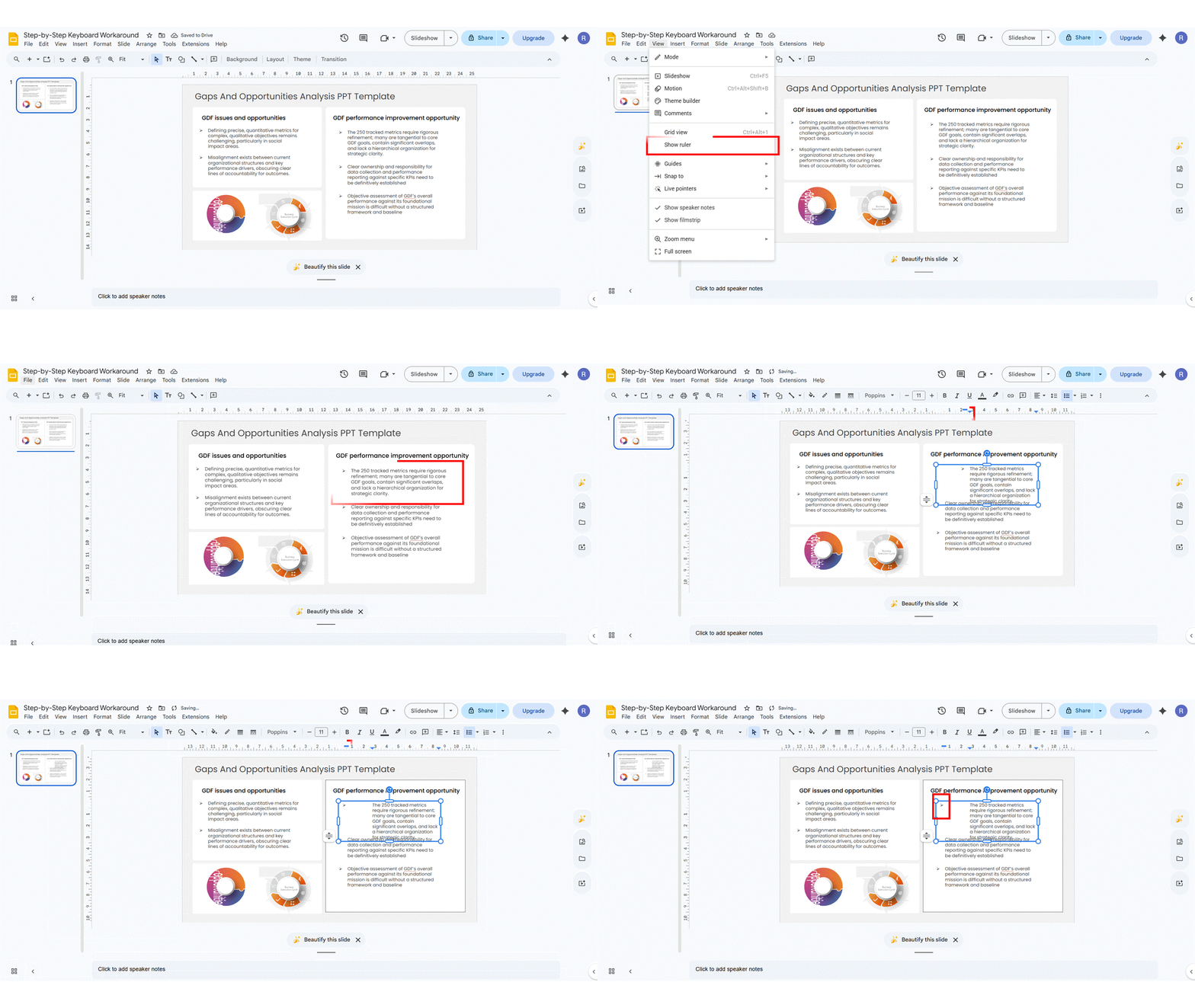
If using Format Options (Method 1) instead of the ruler: applying a Hanging indent of 0.5 inches to a bulleted list will produce the same result — the wrapped lines align 0.5 inches in from the margin while the bullet symbol and first word stay at the margin.
How to Remove a Hanging Indent in Google Slides
To remove a hanging indent in Google Slides, select the indented text, go to Format → Format options → Text fitting, change the Special indent dropdown from Hanging to None, and set the By value to 0. Alternatively, drag the blue triangle marker on the ruler back to align with the left margin.
Removing via Format Options (Cleanest Method)
- Select the text with the hanging indent you want to remove.
- Click Format → Format options to open the sidebar.
- Click Text fitting to expand the indentation settings.
- Under Special indent, change the dropdown back to None.
- Set the By value to 0.
- Close the sidebar. The hanging indent is removed.

Removing via Ruler
- Select the text.
- On the ruler, drag the blue triangle back to the left until it aligns with the blue rectangle at position 0 (or at whatever your base left indent position is).
- Both markers should sit at the same position at the left edge.

Removing a Keyboard-Method Hanging Indent
If your hanging indent was created using the Shift+Enter+Tab keyboard workaround, removing it is the most tedious path. You must manually place your cursor before each indented line, delete the Tab character, then delete the Shift+Enter line break. This is the primary reason the keyboard method is not recommended for long-form citation lists — editing and reformatting later is time-consuming.
Hanging Indent Not Working in Google Slides? Fix These 6 Issues
If your hanging indent is not working in Google Slides, the most common causes are: using the mobile app (which does not support this feature), pasting text with conflicting formatting, pressing Enter instead of Shift+Enter in the keyboard method, or entering a value in the Left indent field instead of the Special indent Hanging dropdown in Format Options.
Fix 1 — Your Pasted Text Has Conflicting Formatting
Text pasted from a Word document, Google Docs, a website, or a PDF often carries hidden formatting that overrides or conflicts with indentation settings applied in Google Slides. When you apply a hanging indent, and the text does not respond correctly, this is the first thing to check.
Solution: Paste your text using Ctrl+Shift+V (Windows) or Cmd+Shift+V (Mac) to paste as plain, unformatted text. Then reapply the hanging indent from scratch using Format Options.
Fix 2 — You Are Using the Google Slides Mobile App
The mobile app for iOS and Android does not support Format Options or the ruler. No amount of menu navigation will find a hanging indent option in the app.
Solution: Switch to the desktop browser version of Google Slides, either on a computer or via the Desktop Mode workaround on iPad described in Method 4.
Fix 3 — You Pressed Enter Instead of Shift+Enter (Keyboard Method)
If you are using the keyboard workaround and pressing the regular Enter key to move to the next line, you are starting a brand new paragraph. A new paragraph resets all paragraph-level indent formatting. The Tab key applied to a new paragraph will increase the bullet indent level, not create a hanging indent within the current paragraph.
Solution: Always use Shift+Enter (a soft line break) before pressing Tab when using the keyboard method.
Fix 4 — The Ruler Markers Are Overlapping and Hard to Grab
If the blue triangle and rectangle appear stacked right on top of each other, it is very difficult to grab and move one without the other.
Solution: Zoom in to your slide by going to View → Zoom → 150% (or higher). The ruler markers will appear larger and easier to manipulate independently.
Fix 5 — Your Text Box Is Too Narrow to Show the Effect
A hanging indent only produces a visible effect when at least one line of text wraps to a second line. If your text box is narrow enough that every line of text fits on a single line, there are no wrapped lines to indent, and the formatting appears to do nothing.
Solution: Widen your text box by dragging its right edge to the right so that at least one long entry wraps to a second line. Then the hanging indent will be clearly visible. Want to learn more about how text behaves inside text boxes? Read our full guide on how to wrap text in Google Slides.
Fix 6 — You Set a Left Indent Instead of a Hanging Indent
In the Format Options sidebar, there is both a Left indent field and a Special indent dropdown. A very common mistake is entering a value in the Left indent field, which indents the entire paragraph, including the first line — the opposite of a hanging indent.
Solution: Leave the Left indent field at 0. Only use the Special indent → Hanging dropdown, and enter your value (0.5 inches) in the By field that appears after selecting Hanging.
Google Slides Hanging Indent vs. Google Docs — Key Differences
Many users work in both Google applications and assume the process of how to add a hanging indent on Google Slides will be identical to Google Docs. It is not, and understanding the differences prevents a lot of frustration.
| Feature | Google Docs | Google Slides |
|---|---|---|
| Dedicated “Hanging” option in the menu | ✅ Format → Align & indent → Indentation options | ✅ Format → Format options → Text fitting |
| Ruler method | ✅ Yes | ✅ Yes (desktop only) |
| One-click/shortcut | ✅ Ctrl+T (in some versions) | ❌ No official shortcut |
| Mobile app support | ⚠️ Limited (workaround exists) | ❌ Not supported in app |
| Apply to the whole document at once | ✅ Yes (select all, apply once) | ❌ Must apply per text box |
| Format transfers when copy-pasting | ✅ Mostly yes | ⚠️ Inconsistent |
| Best for long reference lists | ✅ Yes | ❌ Use Docs → copy to Slides |
The most important practical difference: Google Docs applies a hanging indent to an entire reference list in one action — select all, open Indentation options, choose Hanging, click Apply. Google Slides requires you to apply the indent text box to each text box. For presentations with many citation entries, formatting in Google Docs first and copying the formatted text to Slides saves considerable time.
When considering how to make a hanging indent on Google Slides versus Google Docs, the simple rule is: use Docs for formatting, use Slides for presenting.
Pro Tips for Polished, Professional Hanging Indents in Google Slides
These tips will help you move beyond just getting the feature to work, toward making your formatted slides look genuinely clean and professional. Anyone who wants to know how to add hanging indent on Google Slides at a high standard should keep these in mind:
- Use exact values, not drag-and-drop, for consistency. The Format Options method is always more precise than the ruler. If you have multiple citation slides or multiple text boxes that all need matching indents, type the exact value (0.5 inches) in Format Options rather than eyeballing the ruler.
- Use Paint Format to copy indent settings between text boxes. After formatting one text box correctly, click inside the formatted text, select all, then click the Paint format roller icon in the toolbar. Click inside another text box to apply the same formatting instantly. This is far faster than going into Format Options for every box.
- Match your indent depth to your font size. At 12pt, 0.5 inches looks correct. At 20pt or 24pt (common in presentations), consider 0.5 to 0.6 inches. At very large display sizes (36pt+), 0.75 inches may look more proportionally balanced.
- Double-space citation entries for APA and MLA. Select your reference text and go to Format → Paragraph styles → Line & paragraph spacing → Double. Hanging indents combined with double-spacing match both APA and MLA formatting requirements.
- Do not apply hanging indents to single-line text items. If a bullet or citation entry fits on one line, a hanging indent has no visible effect and adds no value. Only apply it where text wraps to two or more lines.
- Preview on a projected screen or larger display. Formatting details that look correct on a 13-inch laptop screen may appear differently when projected in a room. Always preview at full-screen (View → Present) and — if possible — on the actual display device before your presentation.
- Limit the number of citation entries per slide. A reference slide with 12 entries in 11pt text is difficult to read from a distance, regardless of formatting. For long reference lists, split across multiple slides and use a clear header like “References (1 of 2)” so your audience knows more entries follow.
Before wrapping up, don’t forget that the right presentation design can strengthen your message and improve audience engagement. Our Google Slides templates are designed to help you create impactful slides quickly and effortlessly.

Conclusion
Proper indentation is one of those small formatting details that makes an outsized difference in how polished and readable a presentation looks — and once you have it working, it is easy to replicate across your entire deck using Paint Format.
Despite the absence of a dedicated one-click button, Google Slides gives you four solid paths to get there: the Format Options sidebar, the Ruler tool, the keyboard Shift+Enter+Tab workaround, and the Desktop Mode workaround for iPad users. Each one covers a different scenario, device, or skill level. For most users, Method 1 (Format Options) is the right default — precise, consistent, and easy to undo on Windows, Mac, and Chromebook alike. The Ruler method suits those who prefer visual control. The keyboard method works best for quick one-off edits. And Desktop Mode solves what is otherwise a genuinely frustrating gap in Google’s mobile app.
Whatever brings you here — a references slide, a bibliography, a multi-line bullet list, or general formatting polish — apply the right method once, use Paint Format to carry it across your slides, and your audience will notice the result even if they cannot name exactly why your presentation feels cleaner. Want to go further? Check out our guide on how to make Google Slides look good for more tips on creating polished, professional presentations.
FAQs
-
What is the fastest way to do a hanging indent on Google Slides?
The fastest method is the keyboard workaround. Place your cursor at the start of the second line of your paragraph, press Shift+Enter (Windows) or Shift+Return (Mac), then press Tab. Repeat for each subsequent line. It requires no menu navigation and works immediately. However, for citation-heavy slides where you may need to edit later, the Format Options method (Format → Format options → Text fitting → Special indent → Hanging → 0.5 inches) is more efficient overall because it is easier to undo and apply consistently.
-
How do I make a hanging indent in Google Slides using Format Options?
Click inside your text box and select the text you want to format. Click Format in the top menu, then select Format options. In the sidebar that opens, click Text fitting, locate the Special indent dropdown, and choose Hanging. Enter 0.5 in the By field and close the sidebar. Your selected text will now display a properly formatted hanging indent with the first line at the left margin, and all subsequent lines indented 0.5 inches.
-
Is there an official keyboard shortcut for hanging indents in Google Slides?
No, Google Slides does not have an official single-keystroke shortcut for hanging indents the way Microsoft Word has Ctrl+T. The workaround is to place your cursor before each wrapped line, press Shift+Enter to insert a soft line break, then press Tab to indent that line. While this produces the same visual result, it is not a true formatting shortcut — it inserts actual tab and line-break characters into your text, which makes editing later more difficult.
-
How to do hanging indent on Google Slides on iPad?
The Google Slides app for iPad does not support hanging indents. The best solution is to open Google Slides in Safari or Chrome on your iPad and enable Desktop Mode — in Safari, tap the aA icon in the address bar and select Request Desktop Website; in Chrome, tap the three-dot menu and select Request Desktop Site. The full desktop version of Google Slides will load, including Format Options and the ruler, and you can apply a hanging indent exactly as you would on a computer.
-
How to do a hanging indent on Google Slides for APA citations?
Select all your reference entries in the text box. Click Format → Format options → Text fitting. Under Special indent, select Hanging and set the By value to 0.5 inches (the standard APA 7th edition requirement). Close the sidebar. For full APA compliance, also apply double-spacing by going to Format → Paragraph styles → Line & paragraph spacing → Double.
-
Why is my hanging indent not working in Google Slides?
The six most common causes are: (1) you are using the mobile app, which does not support this feature; (2) pasted text is carrying conflicting formatting — repaste using Ctrl+Shift+V to paste as plain text; (3) you are pressing Enter instead of Shift+Enter when using the keyboard method, which starts a new paragraph and resets formatting; (4) ruler markers are overlapping and hard to move independently — zoom in to separate them; (5) your text box is too narrow for text to wrap, so the hanging indent has no lines to act on; or (6) you entered a value in the Left indent field instead of the Special indent → Hanging field in Format Options.
-
How to add a hanging indent in Google Slides for bullet points?
For bulleted lists, enable the ruler (View → Show ruler). Select your bullet text. On the ruler, drag the blue triangle (Left Indent marker) to the right to the position where wrapped text should align (0.5 inches is a common value). Keep the blue rectangle (First Line marker) at the left margin where the bullet symbol sits. The result is that any bullet text that runs beyond one line wraps back to align under the first word, not under the bullet symbol.
-
Can I apply a hanging indent to all slides in Google Slides at once?
Google Slides does not have a “select all text boxes across all slides” command. You must apply hanging indents to each text box individually. The most efficient workflow for a multi-slide presentation is to format one text box perfectly, then use the Paint Format roller tool (click the formatted text → click the Paint Format icon in the toolbar → click another text box) to apply the same formatting to other boxes. This is faster than reopening Format Options for every individual text box.
-
How do I remove a hanging indent in Google Slides?
Select the indented text, then click Format → Format options → Text fitting. Under Special indent, change the dropdown from Hanging back to None and set the By value to 0. Close the sidebar. Alternatively, using the ruler, drag the blue triangle back to align with the blue rectangle at the left margin. If the hanging indent was created using the keyboard shortcut workaround, you will need to manually delete the line-break and tab characters at the start of each indented line.
-
How to do hanging indents on Google Slides for MLA formatting?
Select your Works Cited entries. Click Format → Format options → Text fitting → Special indent → Hanging, and set the value to 0.5 inches — identical to APA settings. MLA 9th edition additionally requires double-spacing between entries: go to Format → Paragraph styles → Line & paragraph spacing → Double. Entries should be listed alphabetically by the author’s last name, which should appear at the left margin, while any continuation of that entry indents 0.5 inches below.
Table Of Content



Related posts from the same category

5 Aug, 2022 | SlideUpLift
How To Hyperlink In Google Slides Presentation?
A hyperlink is described as a word, phrase, or picture that, when clicked, directs the user to a pre-selected document, webpage, or even a portion within the Google Slides presentation

18 Nov, 2022 | SlideUpLift
Learn How To Add Bullet Points In Google Slides
In today’s dynamic world, people have very less attention span to read and absorb information. Be it blogs, posts, or presentations, people generally scan through the information. To get people

20 Nov, 2023 | SlideUpLift
How to Add Superscript and Subscript in Google Slides
Quick Answer: To add a superscript in Google Slides: Click inside a text box and type your full expression (e.g., x2). Highlight only the character to raise (e.g., the 2).

24 Mar, 2026 | SlideUpLift
How to Wrap Text in Google Slides — 4 Methods That Actually Work
Learn how to wrap text in Google Slides with simple step-by-step methods to align text around images and create clean, professional layouts. This guide explains practical workarounds since Google Slides

15 Mar, 2023 | SlideUpLift
How to Add Fonts to Google Slides Presentations?
Fonts wield a subtle yet powerful influence on perceptions, impacting trust, credibility, and the audience's journey toward their objectives. Just as different music genres evoke distinct emotions, varied fonts can

12 Jan, 2023 | SlideUpLift
How to do a Voiceover on Google Slides?
Adding a professional voiceover to your presentations can make your content more engaging and captivating for your audience. Whether you are a student or a professional delivering a presentation or

29 Dec, 2023 | SlideUpLift
How to Make Checkboxes in Google Slides?
Google Slides is one of the most widely used presentation tools today. It is used for creating simple text and picture presentations and complex presentations. You can create surveys and

30 Apr, 2026 | SlideUpLift
How to Add a Border in Google Slides (7 Easy Methods)
To add a border in Google Slides, insert a rectangle shape, set its fill to transparent, and customize the border color and weight from the toolbar. You can apply borders

23 Sep, 2022 | SlideUpLift
How To Add Drop Shadows In Google Slides
Google Slides provide effects like drop shadows, which is an effective feature for presentation design. They can assist in making a flat image, text, or object more interesting by making

24 Jan, 2024 | SlideUpLift
How To Insert A Fraction in Google Slides?
Google Slides is not just a versatile tool for conveying ideas and strategies but also numbers and complex data. Some numbers and data are part of advanced equations, including fractions.