

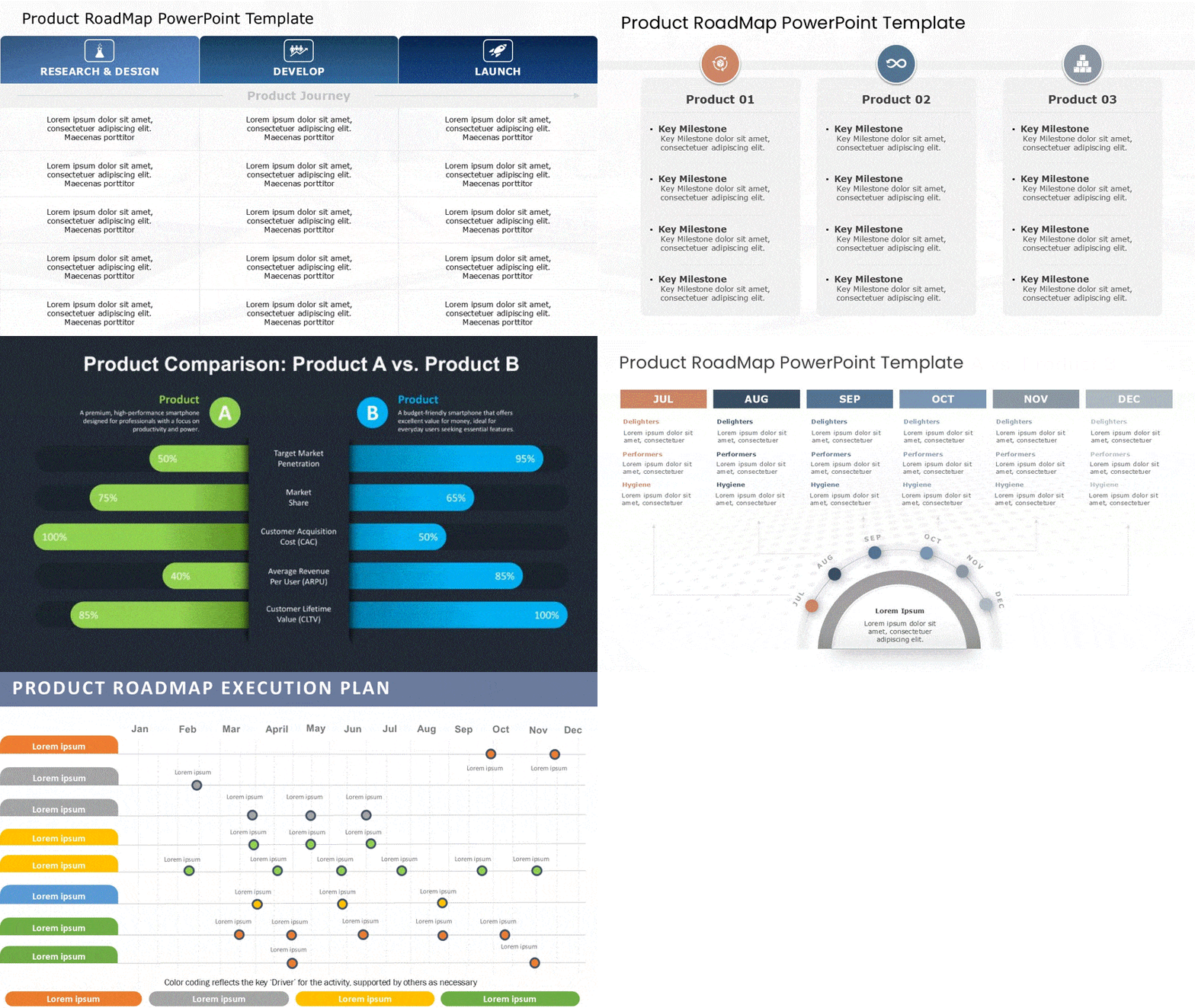
 Flat 4


What Is a Product Roadmap? A Complete Guide With Types, Examples, and Templates
A product roadmap is a high-level strategic document that communicates a product’s vision, direction, priorities, and planned progress over time. It shows the product team and stakeholders what is being built, why it is being built, and roughly when key outcomes are expected — without prescribing every task or committing to exact delivery dates.
Product managers use roadmaps to align engineering, design, marketing, and leadership around a shared understanding of where the product is going. Unlike a sprint backlog (which lists what to build next) or a project plan (which tracks task-level execution), a product roadmap operates at the strategic level — it connects features and releases to business goals and customer outcomes.
What Is a Product Roadmap?
A product roadmap is a strategic planning document that outlines a product’s vision, direction, priorities, and planned progress over a defined time horizon.
It shows what you are building, why you are building it, and roughly when it is expected to be delivered. It connects individual features and releases to higher-level business goals, giving everyone — from engineers to executives — a clear picture of where the product is heading.
A product roadmap is NOT:
- A feature wishlist — it prioritizes, not just lists.
- A project plan — it operates at a strategic level, not a task level.
- A commitment contract — it sets direction, but timelines may shift.
- A one-time document — it should be updated regularly as the product evolves.
Why Is a Product Roadmap Important?
- Communicates your product vision and strategy. The roadmap is the single source of truth for anyone who needs to understand where the product is going.
- Aligns teams around shared priorities. When engineering, design, marketing, and sales are all looking at the same roadmap, everyone moves in the same direction.
- Helps prioritize what to build next. A roadmap forces deliberate prioritization — what delivers the most value relative to effort?
- Earns stakeholder buy-in. A clear, well-structured product roadmap builds confidence with executives and investors.
- Connects daily work to business outcomes. The roadmap ties each initiative to a strategic objective, keeping motivation and focus high.
- Facilitates resource allocation. By laying out what is planned and when, a roadmap helps leadership allocate budgets, headcount, and tools effectively.
What to Include in a Product Roadmap
- Product Vision: The overarching purpose of the product — who it serves, what problem it solves, and where it is heading long-term.
- Goals and Objectives: Measurable targets the product team is working toward, often structured as OKRs.
- Themes or Initiatives: High-level work categories that group related features, e.g. “User Onboarding Improvements” or “Platform Scalability.”
- Features and Epics: The specific capabilities being built, grouped under themes.
- Timeline: The planned sequence and time horizon for delivery — exact dates, quarters, or “Now / Next / Later.”
- Milestones and Releases: Significant markers such as beta launches, GA releases, regulatory approvals, or conference demos.
- Status Indicators: Visual markers showing whether each initiative is on track, at risk, or complete.
- User Stories: Descriptions of product capabilities from the end user’s perspective.
Want to build a clear, professional roadmap slide? Follow our step-by-step guide on how to create a roadmap in PowerPoint.
Types of Product Roadmaps
Here are the most popular types of product roadmaps you can use for planning and execution:
| Type | Description | Best For |
| Goals-Based | Organized around strategic objectives; each goal has initiatives and success metrics. | C-suite, board updates, investor presentations |
| Features-Based | Centers on specific features being developed, with timelines. | Development teams, sprint planning |
| Timeline | Initiatives along a chronological axis (months/quarters). | Communicating a release schedule to stakeholders |
| Now / Next / Later | Three priority buckets without specific dates. | Agile teams, early-stage products |
| Agile / Sprint | Epics, sprints, and releases over a 2–4 sprint horizon. | Scrum teams, rapid iteration |
| Portfolio | Multiple products or initiatives shown together by phase (e.g. Growth, Maintenance, Sunset). | Product leaders, investment and resource decisions |
| Release | Upcoming releases and the features included in each. | Customer communication, sales teams |

How to Create a Product Roadmap (Step by Step)
Step 1: Define Your Product Vision and Strategy
Articulate the product’s long-term vision and the strategy for getting there. What market are you serving? What differentiates your product? What are your 12-month priorities?
Step 2: Gather Input From Stakeholders
Talk to engineering about technical constraints, sales and support about customer pain points, marketing about competitive positioning, and leadership about business priorities.
Step 3: Identify and Prioritize Themes
Group related work into themes. Prioritize using frameworks like RICE (Reach, Impact, Confidence, Effort) or MoSCoW (Must / Should / Could / Won’t have).
Step 4: Choose the Right Roadmap Format
Goals-based for executives, features-based for dev teams, timeline for stakeholders who need dates, Now/Next/Later for agile teams.
Step 5: Build the Visual Roadmap
Include goals, themes, features, timeline, and status indicators. Keep it scannable.
Step 6: Share, Collect Feedback, and Iterate
Present to stakeholders, adjust priorities, and commit to a monthly or quarterly review cadence.
Step 7: Maintain as a Living Document
A product roadmap is never “done.” Update it as market conditions change and customers provide feedback.
For visual design inspiration and layout options, see our guide to 11 best visual roadmap ideas & design examples. When you’re ready, get our Product Roadmap Templates.
Product Roadmap vs Project Roadmap
| Aspect | Product Roadmap | Project Roadmap |
| Scope | Entire product lifecycle — ongoing | Single project with defined start/end |
| Time horizon | Long-term (quarters to years) | Short to medium-term (weeks to months) |
| Focus | What to build and why (strategy) | How to deliver an initiative (execution) |
| Owner | Product manager | Project manager |
| End date | No fixed end | Ends when the project is delivered |
Learn more about effective project planning in our detailed guide: What Is a Project Roadmap?.
Product Roadmap vs Product Backlog
A product roadmap sets strategic direction; a backlog and sprint plan handle execution. Here is how the three relate:
| Product Roadmap | Product Backlog | Sprint Plan | |
| Purpose | Strategic direction and outcomes | All work to be done | What to build this sprint |
| Time horizon | Quarters to years | Rolling / ongoing | 1–2 weeks |
| Level of detail | Themes and outcomes | Feature and story level | Task and story level |
| Primary audience | Leadership, stakeholders | Development team | Engineering team |
| Who owns it | Product Manager | Product Owner | Scrum Master + team |
| How often updated | Quarterly | Every sprint | Per sprint |
In short: the backlog feeds the roadmap, not the other way around. The roadmap communicates direction and outcomes; the backlog and sprint plan turn that direction into executable work.
Product Roadmap Examples
Below are ten product roadmap examples across formats and product types. Each shows how the format adapts to a different audience and stage.
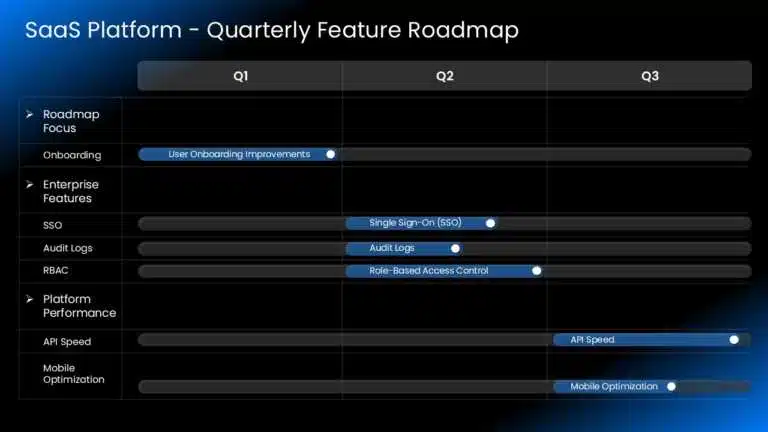
SaaS Platform — Quarterly Feature Roadmap (Timeline Format)
A B2B software roadmap showing three quarters of planned releases. Q1: User Onboarding Improvements. Q2: Enterprise Features (SSO, audit logs, RBAC). Q3: Platform Performance (API speed, mobile optimization). A classic product roadmap timeline format.
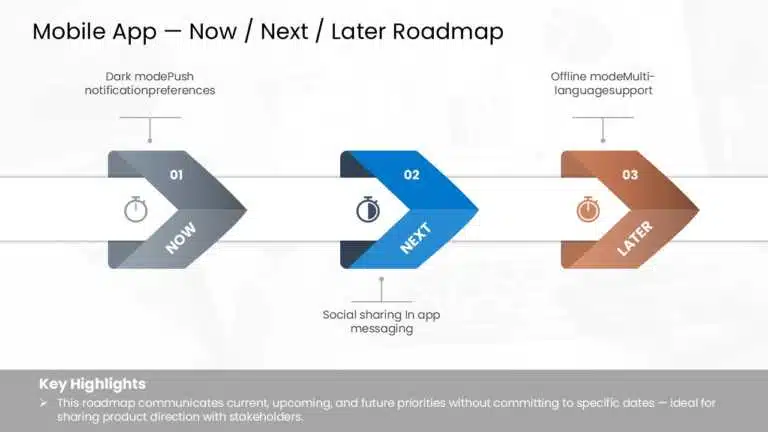
Mobile App — Now / Next / Later Roadmap
Now: dark mode, push notification preferences. Next: social sharing, in-app messaging. Later: offline mode, multi-language support. Communicates priorities without committing to dates.
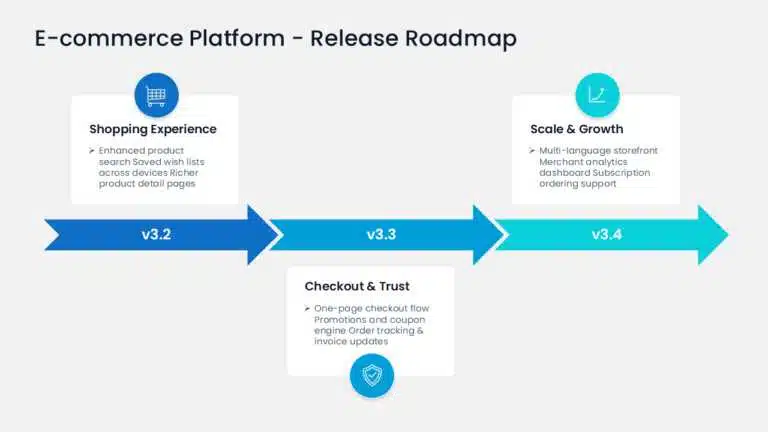
E-commerce Platform — Release Roadmap
Each release defined by version number (v3.2, v3.3, v3.4) with the features included. Sales can tell customers exactly what is shipping and when — a common approach for external audiences.
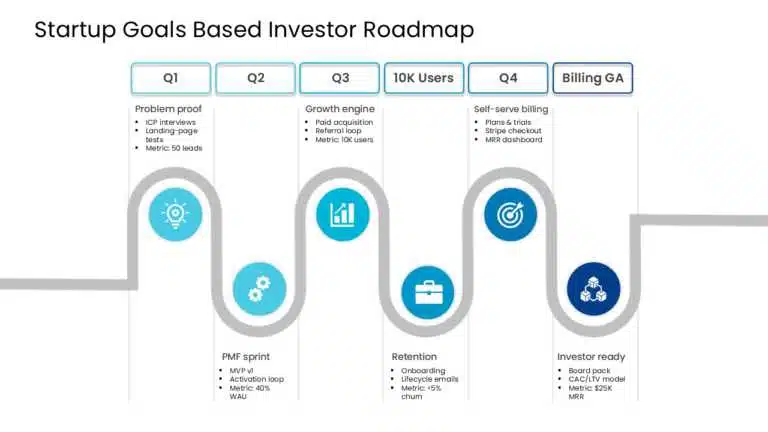
Startup — Goals-Based Investor Roadmap
Goals: “Reach product-market fit” (Q1–Q2), “Scale to 10K users” (Q3), “Launch self-serve billing” (Q4). Each goal has 2–3 supporting initiatives and key metrics — a format that earns investor confidence.
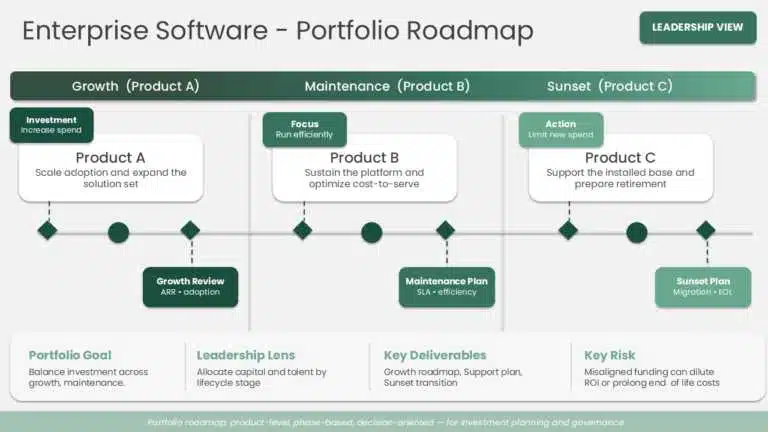
Enterprise Software — Portfolio Roadmap
Multiple products shown by phase: Product A in “Growth,” Product B in “Maintenance,” Product C in “Sunset.” Helps leadership make investment decisions.
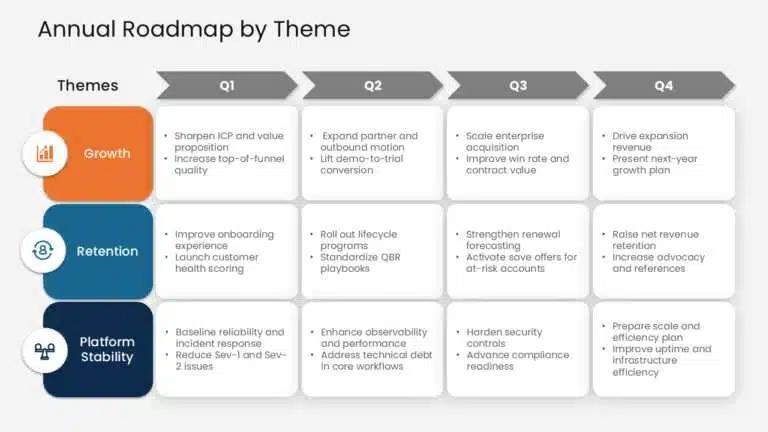
B2B SaaS — Annual Roadmap by Theme (Goal-Based Format)
Annual priorities presented to the board, with no specific dates — organized by strategic themes (Growth, Retention, Platform Stability) across four quarters. Best for executive audiences where outcomes matter more than feature lists.
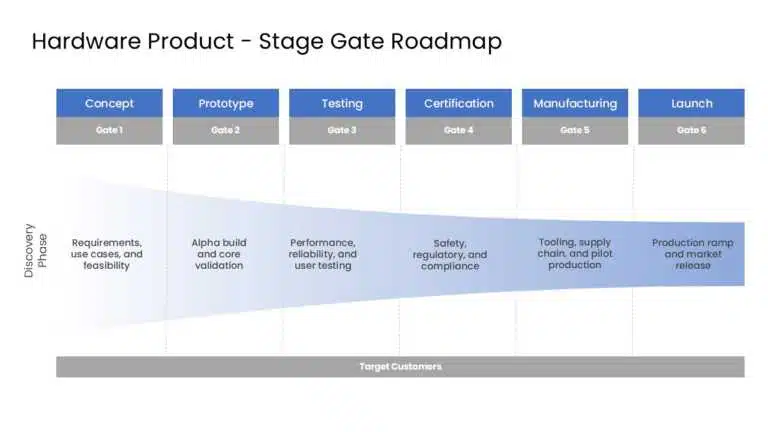
Hardware Product — Stage-Gate Roadmap
A hardware product moving through defined gates — Concept, Prototype, Testing, Certification, Manufacturing, Launch — each with a go/no-go decision point. Best for physical-product teams where regulatory and supply-chain dependencies create hard sequential constraints.
Internal Tool — Swimlane Roadmap by Team
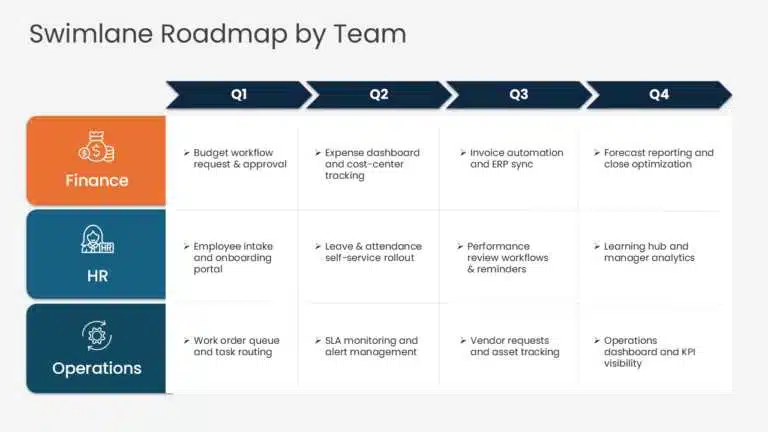
An internal tool built for three departments at once. Swimlane rows = Finance, HR, Operations; columns = Q1–Q4; each cell shows the capability delivered for that team that quarter. Best for when multiple groups need to see their own workstream without everyone else’s detail.
Consumer App — Release-Based Roadmap
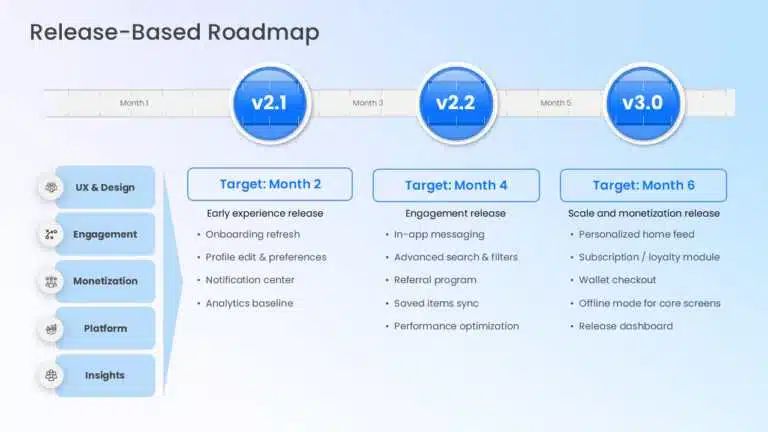
Three version releases (v2.1, v2.2, v3.0) over six months. Each release card holds the 3–5 features in that release and the target month. Best for teams with a predictable release cadence and leads who plan resourcing per release.
Early-Stage Startup — Investor Roadmap (12-Month)
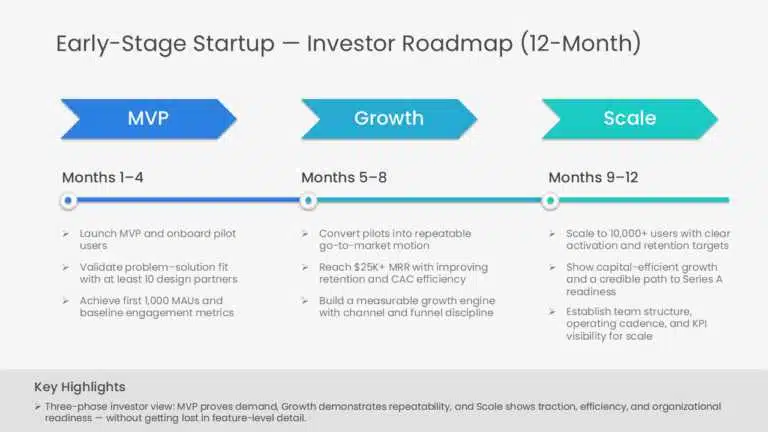
A seed-stage startup presenting to investors: three phases (MVP, Growth, Scale) with 2–3 key outcomes per phase. Deliberately avoids feature lists — focuses on business outcomes and metrics. Best for fundraising contexts.
Best Practices for Product Roadmaps
- Focus on outcomes, not outputs. Organize around goals (“Improve retention by 15%”) rather than feature lists.
- Tailor for your audience. Dev teams need feature detail; executives need strategic themes; customers need benefits and approximate dates.
- Keep it flexible. A product roadmap is a plan, not a promise. Use flexible time horizons.
- Update regularly. Review monthly or quarterly.
- Make it visual and accessible. If it takes more than 30 seconds to understand, simplify.
- Include the “why.” Every item should be tied to a strategic goal or customer need.
How to Present a Product Roadmap
Building the roadmap and presenting it are two different skills. Tailor your product roadmap presentation to each audience:
- To executives and the board: lead with business outcomes, not features. Use a Now/Next/Later or theme-based view — no dates, no feature lists. Answer the question they’re actually asking: “Are we investing in the right things?” Keep it to one slide.
- To the engineering team: use a timeline or swimlane format with enough detail to plan sprints. Show dependencies and sequencing, and be explicit about what is in scope and what is not.
- To sales and customer success: focus on releases and customer-facing outcomes; avoid internal technical milestones. Frame everything in terms of customer problems being solved.
- To customers: share a simplified version with directional themes and rough timeframes. Never commit to specific dates.
For the complete delivery playbook — structuring the narrative, handling questions, and managing pushback on timelines — see How to Make a Roadmap Presentation That Wins Buy-In. To build the slide itself, browse SlideUpLift’s product roadmap templates, editable in PowerPoint and Google Slides.
FAQs
-
What is a product roadmap in simple terms?
A visual plan showing what a product team is building, why, and when it is expected to be delivered.
-
Who creates a product roadmap?
The product manager typically owns it, with input from engineering, design, marketing, sales, and leadership.
-
How far ahead should a product roadmap plan?
Most cover 3–12 months. Some enterprise products roadmap 12–18 months ahead.
-
What is included in a product roadmap?
Product vision, goals, themes/initiatives, features, timeline, milestones, status indicators, and user stories.
-
What does a product roadmap look like?
A product roadmap is typically a visual slide showing themes, features, or initiatives plotted against a timeline or priority horizon. Common formats: Now/Next/Later (three columns, no dates), timeline (quarters across the top, features in rows), swimlane (rows per team or area), and release plan (features grouped by version). See the examples above for each.
-
What is a product roadmap timeline?
A format that plots planned features, themes, or releases against a calendar — typically quarters or months across the horizontal axis. Use date ranges (e.g. “Q3 2026”) rather than specific days to avoid over-committing.
-
What is the difference between a product roadmap and a product backlog?
A product backlog is a prioritized list of all the work to be done — detailed, granular, owned by the team. A product roadmap is a strategic visual showing direction and outcomes over a longer horizon — high-level, audience-facing, owned by the product manager. The backlog feeds the roadmap, not the other way around.
-
How do you present a product roadmap?
Tailor the format and detail to your audience: executives want outcomes and themes, engineers want sequencing and scope, customers want to know which problems are being solved. Lead with the strategic “why” before the “what and when.” For a detailed guide, see How to Make a Roadmap Presentation.
Table Of Content
Related Presentations


Related posts from the same category
24 Jan, 2024 | SlideUpLift
What Is a Project Roadmap? A Complete Guide With Examples and Free Templates
A project roadmap is a high-level visual plan that shows a project’s goals, major milestones, key deliverables, and timeline at a glance. Unlike a detailed project plan that tracks tasks

22 Nov, 2024 | SlideUpLift
Personal Timeline Examples: 15+ Ideas to Map Your Life Story
A personal timeline is a visual map of the key moments in your life — births, milestones, achievements, and turning points — arranged in chronological order. People use them for

27 May, 2025 | SlideUpLift
How to Create a Roadmap Diagram in PowerPoint? (Step-by-Step Guide)
Need to build a professional roadmap slide for your next presentation? You are in the right place. This tutorial walks you through every method for creating a roadmap diagram in

24 Jan, 2024 | SlideUpLift
The Leadership Roadmap You Need To Follow This Year!
If you're looking to take your business leadership skills to the next level, you've come to the right place. In this blog, we'll be discussing the essential elements of effective

15 Apr, 2021 | SlideUpLift
11 Best Visual Roadmap Ideas & Design Trends for 2026
This blog shares the best roadmap examples and PowerPoint roadmap templates for presenting plans, timelines, and goals clearly. It explains different roadmap styles and when to use them. The guide

24 Jan, 2024 | SlideUpLift
How to Make a Roadmap Presentation That Wins Buy-In
Quick answer: To make a roadmap presentation that lands, tailor it to your audience, build it around a narrative instead of a list of dates, present at the right level

14 Feb, 2023 | SlideUpLift
How to Make a Presentation: A Step-by-Step Guide
Quick answer: To make a presentation, work in this order — (1) write your one-sentence takeaway before you open any software, (2) outline your slides as plain text, (3) set
5 Mar, 2026 | SlideUpLift
Quarterly Business Review (QBR): What It Is, Examples & How to Present One
A QBR, or quarterly business review, is a strategic meeting held every three months to evaluate business performance, review key metrics, and align on goals for the next quarter. QBRs

17 Apr, 2025 | SlideUpLift
Personal SWOT Analysis: A Comprehensive Guide With Examples and Templates
Key Highlights A personal SWOT analysis is a great way to understand yourself better and grow. It helps you identify your strengths, weaknesses, opportunities, and threats. This tool gives you

20 Feb, 2024 | SlideUpLift
Start Stop Continue Retrospective: A Complete Guide With Examples, Templates & Exercises
A Start Stop Continue retrospective is a team reflection exercise where each member names one thing the team should start doing, one it should stop, and one it should continue.