
 Flat 4


Gardner’s Theory of Multiple Intelligences: All 8 Types Explained
Quick Answer: Gardner’s Theory of Multiple Intelligences proposes that intelligence is not one fixed ability but a set of at least eight distinct types — linguistic, logical-mathematical, spatial, bodily-kinesthetic, musical, interpersonal, intrapersonal, and naturalistic. Introduced by Howard Gardner in his 1983 book Frames of Mind, the theory argues that each person has a unique profile of strengths, and that teaching works best when it nurtures those differences.
Introduction
What if much of what you were taught about intelligence was only part of the story?
For decades, intelligence was defined narrowly — an IQ score, a math grade, a reading level. In 1983, Harvard psychologist Howard Gardner challenged that view with a framework that has since shaped classrooms, career counselling, leadership development, and psychology worldwide.
His core idea is simple but radical: people are not just “smart” or “not smart” — we are each smart in different ways. A musician, an athlete, a naturalist, and a poet are all exercising real, distinct forms of intelligence. This guide walks through all eight types (plus a proposed ninth), how the theory works, where it’s applied, and what critics say.
What Is Gardner’s Theory of Multiple Intelligences?
Gardner’s Theory of Multiple Intelligences is a framework in cognitive psychology first proposed by Howard Gardner, a psychologist and professor at the Harvard Graduate School of Education, in his 1983 book Frames of Mind. It emerged as a direct challenge to IQ-centric views that measured human potential through a single number.
Gardner argued that traditional definitions — focused mainly on linguistic and logical-mathematical ability — fail to capture the full range of human cognitive potential. Instead, he proposed that people possess multiple, relatively independent intelligences, each a distinct way of processing information and solving problems.
Rather than a single measure of “smartness,” the theory describes a profile of intelligences that varies from person to person. It was developed through research under Harvard Project Zero, drawing on neuropsychology, developmental psychology, anthropology, and cultural studies.
Why Is the Theory Still Relevant Today?
In a world increasingly focused on personalized learning, the theory pushes educators beyond a one-size-fits-all approach and toward recognizing that each student brings unique strengths. By applying these principles, teachers can build tailored strategies that engage students more effectively and foster belonging and motivation.
Beyond the classroom, the framework continues to inform leadership development, career counselling, organizational psychology, and marketing — evidence of its broad reach across professional and personal contexts.
Multiple Intelligences vs. Learning Styles
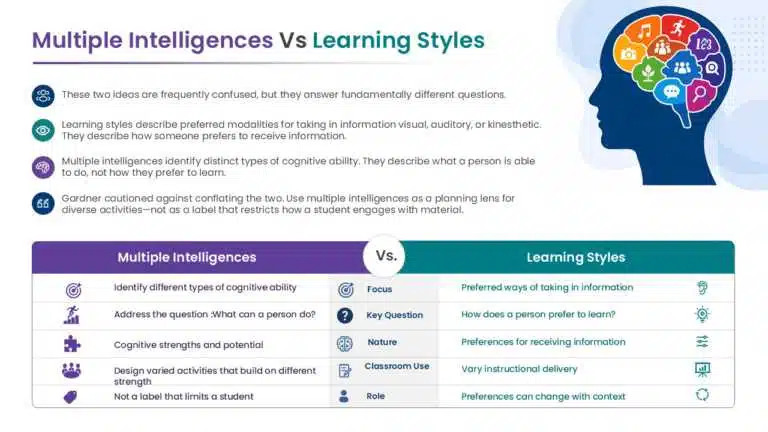
These two ideas are frequently confused, but they answer fundamentally different questions.
- Learning styles describe the preferred modalities through which people take in information — visual, auditory, or kinesthetic. They describe how someone prefers to receive information.
- Multiple intelligences identify distinct types of cognitive ability. They describe what a person is able to do, not how they prefer to learn.
Gardner himself cautioned against conflating the two. As he argued in his Washington Post piece on the distinction, a student with strong visual-spatial intelligence won’t necessarily prefer to receive all information visually. The practical takeaway: use multiple intelligences as a planning lens for designing diverse activities, not as a label that restricts how a student engages with material.
How Does Multiple Intelligences Theory Work?
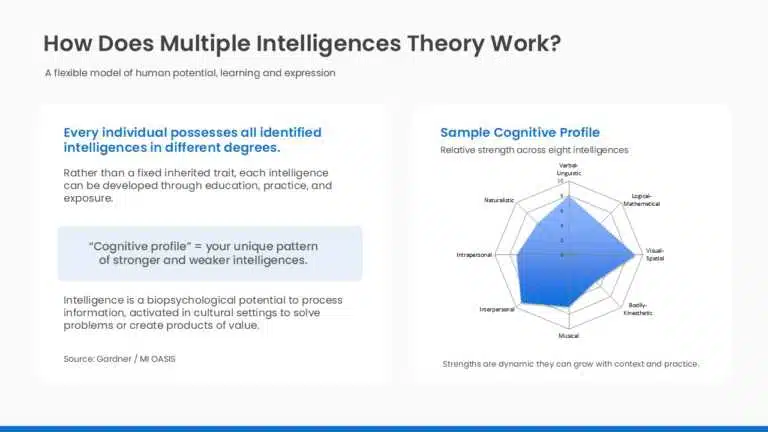
Every individual possesses all of the identified intelligences to varying degrees. Rather than a fixed, inherited trait, each intelligence can be developed through education, practice, and exposure.
Everyone has a unique “cognitive profile” — a personal pattern of stronger and weaker intelligences that shapes how they learn and express themselves. As Gardner defines it, intelligence is a biopsychological potential to process information that can be activated in a cultural setting to solve problems or create products of value (MI OASIS, the official MI resource).
The 8 Types of Intelligence Explained (Plus the Proposed 9th)
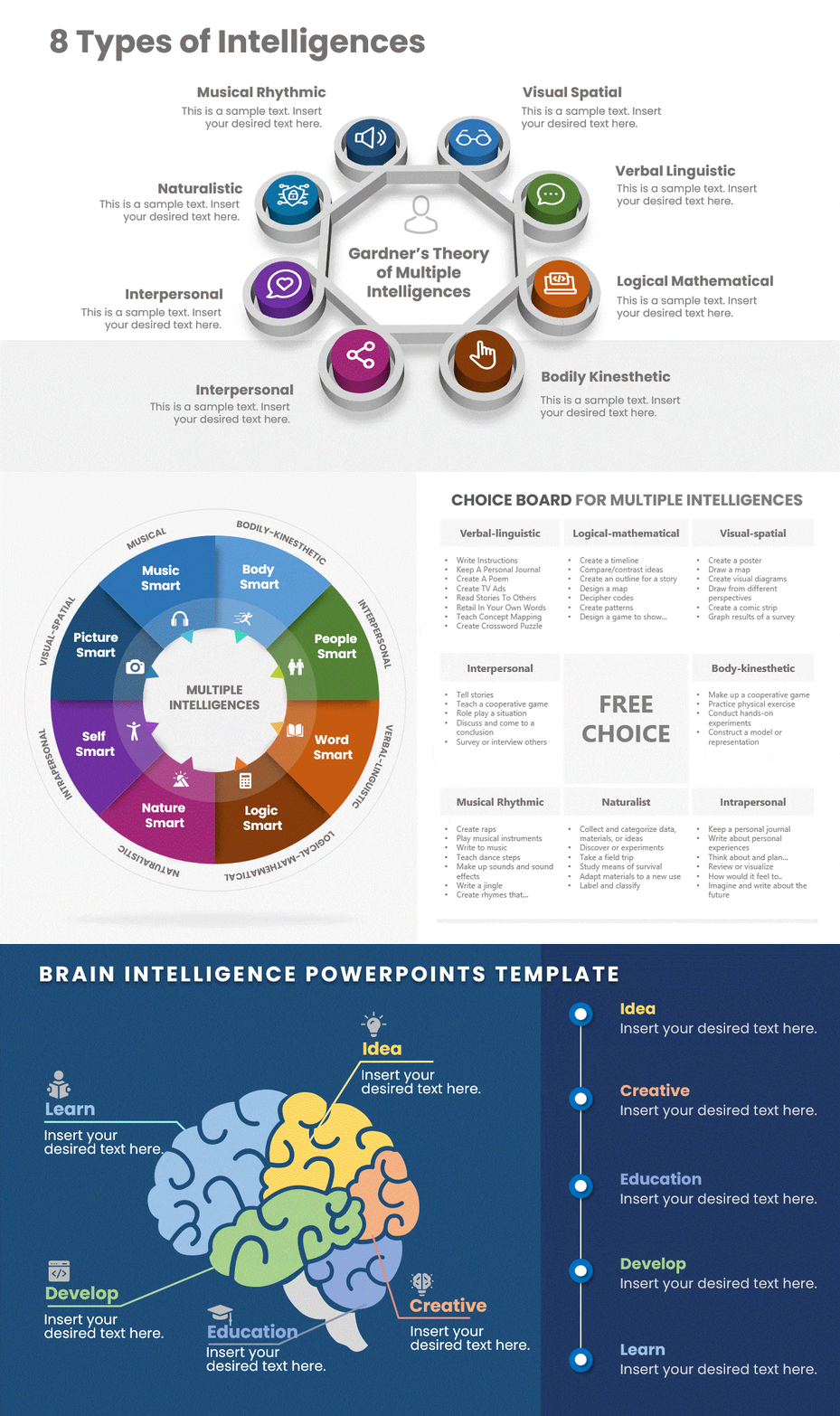
Gardner’s framework identifies eight primary intelligences — with a proposed ninth at the end of this section. The theory does not rank these types; it treats each as equally valid and developable.
1. Verbal-Linguistic Intelligence
The capacity to understand and use language effectively, both written and spoken. Strong communicators who enjoy reading, writing, and explaining ideas through words and storytelling.
Examples: Authors, poets, journalists, public speakers, lawyers, and teachers.
2. Logical-Mathematical Intelligence
The ability to think logically, grasp abstract concepts, and perform mathematical reasoning. People strong here analyze information, spot patterns, and work through systematic problem-solving.
Examples: Scientists, mathematicians, engineers, accountants, and programmers.
3. Visual-Spatial Intelligence
The ability to think in images, visualize objects in three dimensions, and navigate spatial relationships accurately. Excels at design, navigation, and illustration.
Examples: Architects, artists, surgeons, pilots, engineers, and graphic designers.
4. Bodily-Kinesthetic Intelligence
The ability to control physical movement with precision and learn through touch and physical engagement. Covers timing, coordination, and fine motor control.
Examples: Athletes, dancers, surgeons, actors, artisans, and physical therapists.
5. Musical Intelligence
The ability to perceive, create, and reproduce music — including sensitivity to rhythm, pitch, melody, and harmony, and an instinct for musical structure.
Examples: Musicians, composers, conductors, sound engineers, and music educators.
6. Interpersonal Intelligence
The ability to understand and interact effectively with others. Includes empathy, social awareness, and the capacity to read emotions, intentions, and motivations.
Examples: Leaders, teachers, therapists, counselors, salespeople, and politicians.
7. Intrapersonal Intelligence
The ability to understand one’s own emotions, motivations, strengths, and limitations. Involves deep self-awareness, introspection, and thoughtful decision-making.
Examples: Philosophers, writers, psychologists, spiritual leaders, and entrepreneurs.
8. Naturalistic Intelligence
The ability to recognize, classify, and connect with the natural world. Gardner added this intelligence in 1995, noting it reflects a deep sensitivity to the natural environment.
Examples: Farmers, biologists, environmentalists, gardeners, park rangers, and naturalists.
9. Existential Intelligence (Proposed)
Existential intelligence is the candidate most often cited as a potential ninth type — the sensitivity and capacity to tackle deep questions about human existence: the meaning of life, why we die, how we came to be here. Gardner has not formally added it the way he did naturalistic intelligence, but it is widely discussed as a meaningful extension.
Examples: Philosophers, theologians, and spiritual leaders who engage with life’s biggest questions.
Gardner’s Theory of Multiple Intelligences in Education
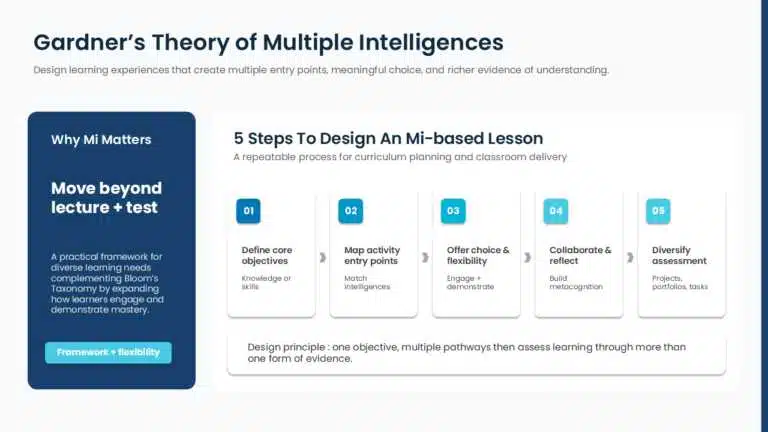
The theory is widely applied as a framework for understanding diverse learning needs. It encourages educators to move beyond lecture-and-test formats and build experiences that engage multiple intelligences. It pairs naturally with other classroom frameworks; if you map learning objectives, it complements models like Bloom’s Taxonomy for structuring cognitive goals.
Curriculum Design and Practical Tips for MI-Based Lessons
- Identify core objectives. Define the knowledge or skills you want students to achieve, then consider how different intelligences can serve as entry points.
- Map activities to intelligences. For a historical event, students might build a visual timeline (spatial), write a diary entry (linguistic), compose a song (musical), or run a debate (interpersonal).
- Provide choice and flexibility. Let students choose how they engage with material and how they demonstrate understanding.
- Encourage collaboration and reflection. Pair collaboration with structured reflection so students build metacognition and a growth mindset.
- Diversify assessment. Add project-based assessments, portfolios, presentations, and performance tasks alongside traditional tests.
How to Identify Your Own Dominant Intelligence
No single standardized test is officially endorsed. Gardner suggests the best way to identify your strengths is to experience them in action, through observation and reflection over time.
- Observe what comes naturally. Notice which tasks feel energizing and effortless versus draining.
- Reflect on childhood strengths. Early preferences for music, building, storytelling, or nature are often reliable indicators.
- Take a structured self-assessment. Reflection tools (including those at MI OASIS) can help surface patterns across the eight domains.
- Notice where you lose track of time. Flow states tend to occur within your areas of strongest intelligence.
Multiple Intelligences in Career Counselling and Development
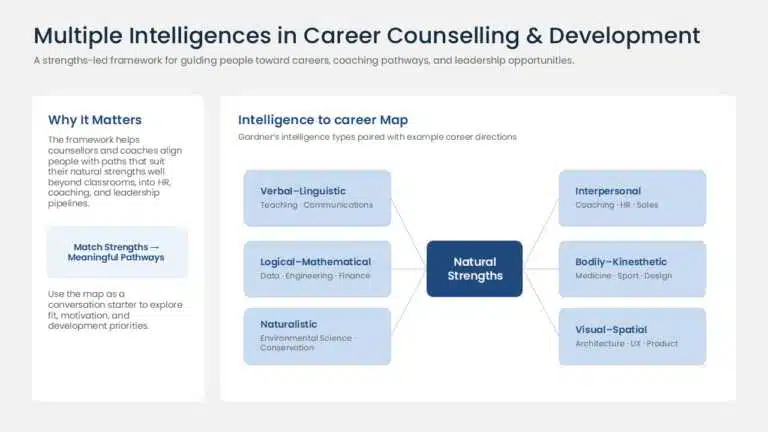
The framework helps counsellors and coaches align people with paths that suit their natural strengths, and it has moved well beyond classrooms into HR, coaching, and leadership pipelines. Someone with high interpersonal and verbal-linguistic intelligence may thrive in teaching or communications, while someone with strong bodily-kinesthetic and naturalistic intelligence may find satisfaction in medicine or environmental science.
Other Real-World Applications
- Organizational development: mapping team members’ diverse strengths and building an inclusive culture that values non-traditional competencies.
- Marketing: designing campaigns that appeal to different cognitive strengths — visual storytelling, music and sound, narrative.
- Psychology and therapy: tailoring therapeutic approaches to a client’s most natural modes of processing and expression.
Gardner’s Theory of Multiple Intelligences and Leadership
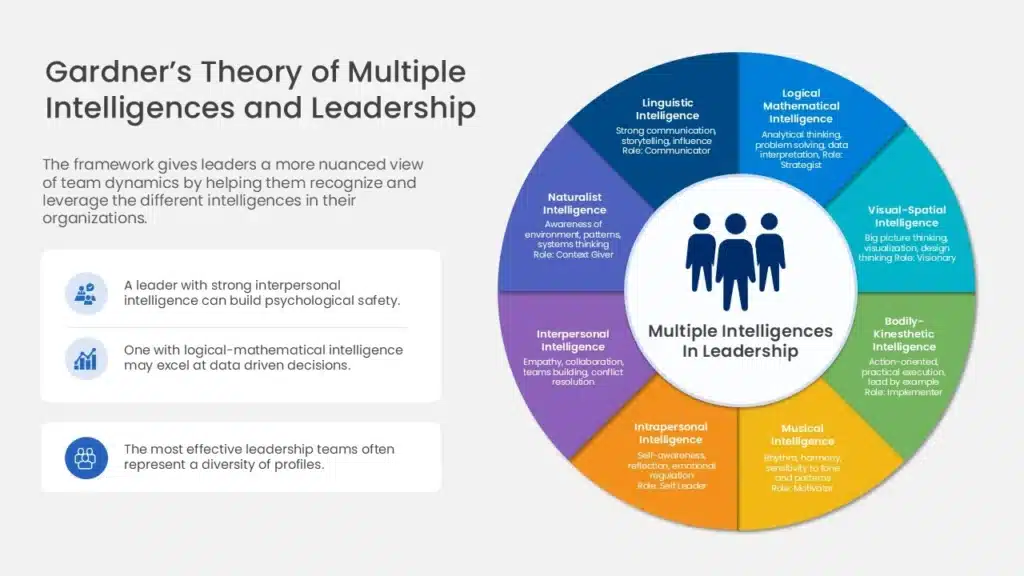
The framework gives leaders a more nuanced view of team dynamics by helping them recognize and leverage the different intelligences in their organizations. A leader with strong interpersonal intelligence can build psychological safety; one with logical-mathematical intelligence may excel at data-driven decisions. The most effective leadership teams often represent a diversity of profiles.
Assessing Intelligences: Tools and Methods
Assessing intelligences well requires methods tailored to capture nuance — standardized tests alone often fail. Educators can blend qualitative and quantitative techniques:
| Method | Description | Why it works |
| Observational assessments | Watch students during varied activities to spot preferred intelligences. | Low-cost; authentic; no testing pressure. |
| Self-assessment surveys | Prompt reflection on strengths, interests, and energizing activities. | Quick; builds self-awareness; works across ages. |
| Project-based assessments | Open-ended projects where students choose how to show understanding. | Shows depth; honors multiple profiles; less anxiety. |
| Portfolio reviews | Ongoing work samples that show growth across domains over time. | Captures progress; highlights strengths tests miss. |
Critical Evaluation of Gardner’s Theory
The theory has been enormously influential — and it has also attracted serious academic criticism. Responsible use means understanding both.
The most substantive challenge comes from psychometricians who argue the intelligences are not truly independent. Research on the general intelligence factor (g) suggests performance across cognitive domains tends to correlate. Critics such as Lynn Waterhouse have argued there is limited empirical evidence validating the intelligences as distinct entities (as summarized in overviews like Wikipedia’s entry on the theory).
A related critique is that what Gardner calls “intelligences” may be better described as talents or skills. Measuring them quantitatively remains difficult; a 2021 systematic review and meta-analysis in Intelligence concluded that methodological weaknesses in classroom intervention studies make a valid evaluation of the theory’s efficacy difficult so far.
For practical purposes — especially in education — the most balanced approach is to use it as an instructional planning tool and a lens for recognizing diverse strengths, while remaining aware that it describes a rich but not yet fully validated model of human cognition.
Conclusion
The theory Howard Gardner introduced in 1983 changed the conversation about what it means to be intelligent. It expanded the definition beyond IQ, giving educators, counselors, leaders, and individuals a richer way to understand human potential. Whether applied in the classroom, the boardroom, or in personal reflection, the core insight holds: people are smart in different ways, and honoring that diversity leads to better outcomes for everyone.
FAQs
-
What is Gardner's Theory of Multiple Intelligences?
A cognitive framework proposing that intelligence is not a single fixed ability but a collection of at least eight distinct types — linguistic, logical-mathematical, spatial, bodily-kinesthetic, musical, interpersonal, intrapersonal, and naturalistic — each a different way of processing information and solving problems.
-
What are the main types of intelligence in Gardner's theory?
Eight primary types, plus a proposed ninth (existential) that addresses deep philosophical questions about human existence.
-
How is it different from IQ?
Unlike traditional IQ models that prioritize linguistic and logical abilities, Gardner’s framework argues intelligence can’t be reduced to a single number, recognizing eight or more distinct cognitive profiles.
-
Who is Howard Gardner?
A psychologist and professor at the Harvard Graduate School of Education, best known for his 1983 book Frames of Mind. He developed the theory through work in developmental psychology, neuropsychology, and cultural anthropology.
-
What evidence supports or challenges the theory?
Support includes neuropsychological research showing distinct brain functions. Challenges include psychometric research suggesting the intelligences correlate, and the argument that they describe talents rather than biologically distinct intelligences.
-
How can educators apply it in the classroom?
Design lessons with multiple entry points — visual timelines, written reflections, collaborative discussion, musical activities, hands-on projects — and diversify assessments while offering student choice.
-
Has the theory changed over time?
Yes. Gardner originally proposed seven intelligences in 1983, added naturalistic intelligence in 1995, and has discussed existential intelligence as a potential ninth.
-
What's a common misconception?
That multiple intelligences are the same as learning styles. They aren’t — learning styles describe preferred ways of receiving information; multiple intelligences describe distinct cognitive abilities. Gardner explicitly rejected the conflation.





Related posts from the same category
![9 Box Talent Review Explained [Detailed 9 Box Matrix Guide]](https://slideuplift.com/wp-content/uploads/2024/01/9-Box-Talent-Review-Explained-and-detailed-guide.png "9 Box Talent Review Explained [Detailed 9 Box Matrix Guide]")
30 Jan, 2024 | SlideUpLift
9 Box Talent Review Explained [Detailed 9 Box Matrix Guide]
Quick Answer A 9 box talent review is a talent management tool that plots employees on a 3x3 grid across two dimensions: current performance and future potential. Managers use it

14 Sep, 2021 | SlideUpLift
Learn How To Give A Great Performance Review To Your Employees
This article defines what is a performance review, explains how to write and present a successful employee performance review. If you work in management or as a supervisor, you may

20 Feb, 2024 | SlideUpLift
Start Stop Continue Retrospective: A Complete Guide With Examples, Templates & Exercises
A Start Stop Continue retrospective is a team reflection exercise where each member names one thing the team should start doing, one it should stop, and one it should continue.

9 Oct, 2022 | SlideUpLift
5 Organizational Chart Archetypes for PowerPoint Presentations (including Templates)
When we think about organizational charts, we frequently think of top-down, pyramid-like charts represented visually. The fact remains, that this is only one of many different variants of business organizational
![Org Chart Examples: 12 Real Examples by Type & Industry [+ Free Templates]](https://slideuplift.com/wp-content/uploads/2024/08/COVER-PAGE_12-Org-Chart-Examples-You-Need-To-Check-Out-Templates_JULY26.jpg "Org Chart Examples: 12 Real Examples by Type & Industry [+ Free Templates]")
5 Aug, 2024 | SlideUpLift
Org Chart Examples: 12 Real Examples by Type & Industry [+ Free Templates]
An organizational chart (org chart) is a diagram that shows a company's internal structure — who reports to whom, how teams are grouped, and where each role sits in the

6 Jan, 2021 | SlideUpLift
7 Tips for Remote Employee Onboarding | (Plus Employee Onboarding Templates )
Virtual work setups are quickly rising in popularity amongst companies worldwide. A report by FlexJobs shows that remote work grew by 44% in the last five years. In the last

9 Dec, 2024 | SlideUpLift
OKR Meaning: Unlocking the Power of Goal-Setting for Business Success
As the legendary author and all-time celebrated management educator Peter Drucker says, “What gets measured, gets managed.” As an ambitious entrepreneur and professional, it is wise to understand that hitting your

20 Dec, 2021 | SlideUpLift
Why Is Deprioritization Important For An Agile Team? – The Power Of Saying No To Projects
Most of us have felt the sting of an unmanageable workload. We're at work, and the emails aren't stopping. Urgent requests are piling up, deadlines are looming, feedback is due,

1 Sep, 2021 | SlideUpLift
The Golden Rules of holding the audience attention in presentations
There are innumerable ways to structure PowerPoint presentations based on the context and the requirements. However, presentations, not unlike other forms of communication, do have some ground rules that are

30 Dec, 2020 | SlideUpLift
Crisis Management Framework For Businesses: How Should Businesses Respond In Wake Of Coronavirus (COVID-19)
The COVID-19 pandemic effect is far more significant than any other pandemic or epidemic in recent human history. It has affected the lives of billions, and the economic damage is