

 Flat 4


How to Write a Sales Pitch That Captures Attention and Converts Leads
This SlideUpLift guide explains how to write an effective sales pitch by identifying your target audience, highlighting your unique value, focusing on benefits over features, and structuring a persuasive presentation with testimonials, clear goals, and strong calls to action to help you close more deals.
Introduction
A sales pitch is more than just talking about what you sell. It’s how you connect with prospects, show clear value, and guide them toward action. In this guide, you’ll learn what a sales pitch is, how to write one, and how to create a pitch that captures attention and converts leads. We’ll also explore different types of sales pitches and how to build an effective sales pitch presentation. By the end, you’ll have a clear, practical approach to pitching with confidence and starting better sales conversations.
What Is A Sales Pitch?
A sales pitch is how you clearly explain what you’re offering and why it matters, all in a short time. If you’re wondering what a sales pitch is, think of it as a focused story that connects a real problem to a clear solution without sounding salesy. The best sales pitch feels natural, simple, and conversational, not scripted or pushy.
Most effective pitches last 30 seconds to 2 minutes, just enough to spark interest and start a conversation. Many teams support this with a sales pitch deck to visually guide the discussion and keep it on track. When done right, the pitch highlights real benefits, respects the listener’s time, and invites them to engage further rather than overwhelming them.
Why is it important to have a sales pitch?
- It helps you clearly explain your value without rambling or confusing the listener.
- It keeps your message consistent across calls, meetings, and presentations.
- It saves time by getting to the point fast, especially with busy decision-makers.
- It builds confidence because you know exactly what to say and when.
- It makes your solution easier to remember after the conversation ends.
- It increases your chances of action, whether that’s a follow-up, demo, or deal.
Sales Pitch Vs Sales Presentation: What’s the Difference?
A sales pitch and a sales presentation may seem similar, but they serve different purposes at different stages of the conversation. A pitch is meant to quickly capture attention, while a presentation is used to explain details once interest is established.
| Criteria | Sales Pitch | Presentation |
| Primary objective | Grab attention and communicate value fast | Provide clarity, details, and justification |
| Length & depth | Brief, high-level, and outcome-driven, usually 30 seconds to 2 minutes | Longer, structured, and information-rich, typically 10 to 30 minutes |
| Content focus | Customer pain points and key benefits | Features, process, data, and examples |
| Tone & delivery | Conversational, persuasive, and flexible | Formal, planned, and slide-led |
| Usage stage | Early outreach or first conversation | Sales meetings, demos, or reviews |
| Desired result | Move to the next step or follow-up | Enable understanding or decision-making |
In simple terms, a sales pitch opens the conversation, and a presentation helps close it.
What are the Types of Sales Pitches?
Not all sales pitches are created equal. The type you choose depends on your audience, context, and goal. Here’s a breakdown of the most common types of sales pitches:
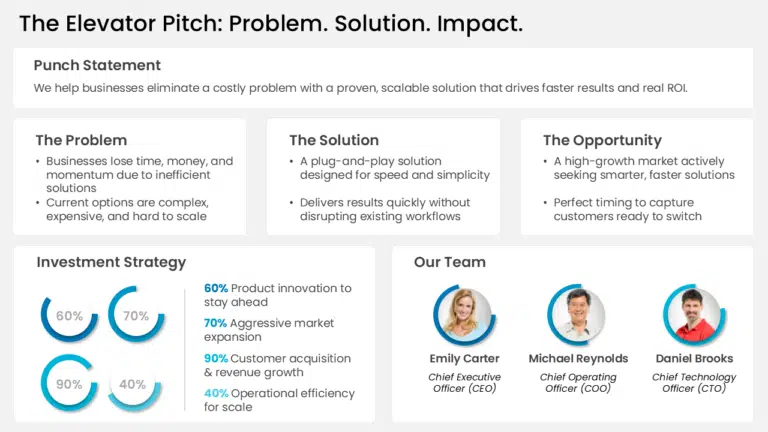
- The Elevator Pitch
- A short, snappy pitch designed to capture attention in 30–60 seconds.
- Perfect for networking events, quick introductions, or unexpected opportunities.
- Focuses on the problem, solution, and value in a concise way.
- The One-on-One Pitch
- Tailored for individual prospects or small meetings.
- Allows for personalization based on the prospect’s needs and background.
- Ideal for building relationships and engaging in a conversation.
- The Demo or Product Pitch
- Focuses on showing your product or service in action.
- Highlights features, functionality, and benefits visually.
- Works best for tech solutions, apps, or anything that requires hands-on experience.

- The Investor Pitch
- Used to convince investors to fund a business or idea.
- Focuses on market opportunity, business model, growth potential, and ROI.
- Usually includes a sales pitch deck with clear visuals and numbers.

- The Team or Group Pitch
- Presented to a team, committee, or panel of decision-makers.
- Requires addressing multiple perspectives and potential objections.
- Emphasizes collaboration and alignment with the organization’s goals.
- The Cold Call / Outreach Pitch
- Designed for reaching prospects who haven’t interacted with you before.
- Short, persuasive, and focused on grabbing attention quickly.
- Often delivered via phone, email, or social media messaging.
- The Consultative Pitch
- Focuses on understanding the prospect’s problems first, then offering solutions
- Positions you as a trusted advisor rather than just a seller
- Builds long-term relationships and trust.

- The Storytelling Pitch
- Uses a narrative or case study to illustrate the value of your product or service.
- Engages prospects emotionally while delivering facts and outcomes.
- Great for making your pitch memorable and relatable.

By understanding and utilizing these different types of sales pitches, sales professionals can tailor their approach to better connect with their audience and enhance their chances of success.
The primary components of a highly successful sales pitch
A great sales pitch isn’t about saying more — it’s about saying the right things in the right order. The strongest sale pitches follow a clear structure that keeps attention, builds trust, and moves the conversation forward.
- Hook
- Grab attention within the first few seconds.
- Use a question, insight, or statement your audience relates to.
- Make them curious enough to want the next line.
- Problem
- Clearly describe the challenge your audience is facing.
- Show you understand their pain, not just the symptoms.
- Make the problem feel real and worth solving now.
- Value Proposition
- Explain what makes your solution worth choosing.
- Focus on outcomes, not features or buzzwords.
- Highlight what sets you apart in a simple way.
- Solution
- Show how your product or service solves the problem.
- Keep it practical and easy to visualize.
- Tie the solution directly to the value promised.
- Social Proof
- Share quick examples of success or results.
- Mention customers, use cases, or measurable wins.
- Build confidence without overselling.
- Clear Call to Action
- End with one specific next step.
- Make it easy and low-effort to say yes.
- Guide the listener on what happens next.
When these elements are aligned, a great sales pitch feels natural, confident, and easy to act on.
How to Write a Sales Pitch That Is Clear, Persuasive, and Easy to Deliver?
Writing a sales pitch starts with clarity, not clever wording. You need to know who you’re speaking to and what problem they care about most.
- Start with the problem: Clearly state the challenge your prospect is facing. Make it relatable and specific.
- Present your solution simply: Explain how your product or service solves that problem. Avoid jargon or long explanations.
- Highlight the value: Focus on outcomes and benefits, not just features. Show what changes for them.
- Support it with proof: Add a short example, result, or client win to build trust.
- End with a clear next step: Tell them exactly what to do next, like booking a call or seeing a demo.
A good sales pitch is short, focused, and easy to remember. When it feels like a helpful conversation, it works better.
How to Create a Sales Pitch That Captures Attention and Converts Leads?
Creating a sales pitch is one thing, but creating a sales pitch that actually grabs attention and converts leads takes some strategy. It’s about understanding your audience, telling a story they care about, and guiding them toward the next step without sounding pushy. Along the way, applying the right presentation tips can make your message clearer, more persuasive, and easier to remember. Here’s a streamlined approach to get it right:
- Research Your Audience and Target Accounts
- Understand the companies and individuals you’ll be pitching to.
- Learn their challenges, goals, and decision-making style.
- The more insight you have, the more personal and relevant your pitch will be.
- Define Your Objective
- Be clear about what you want: a meeting, demo, or sale.
- Knowing your goal keeps your pitch focused and purposeful.
- Frame the Pitch Around the Prospect’s Needs
- Highlight solutions that address their specific pain points.
- Make it clear why your product or service matters to them.
- Craft Your Core Message
- Structure your pitch with a hook, problem, solution, and value proposition.
- Keep it simple, clear, and easy to remember.
- Tell a Story They’ll Actually Want to Hear
- Use real-world examples or short success stories.
- Storytelling makes your pitch relatable, memorable, and engaging.
- Add Personalized Touches
- Include relevant data, references, or insights unique to the prospect.
- Personalization shows you’ve done your homework and builds trust.
- Keep Pitch Length in Mind
- Be concise enough to spark interest, but not so long it drags.
- Aim for 2–3 minutes for the core message.
- Test Your Pitch and Presentation
- If using slides, make sure they’re clean, clear, and visually supportive.
- Review the flow, structure, and readability before delivering.
- Practice Your Delivery
- Rehearse aloud to build confidence and smooth transitions.
- Focus on natural, conversational tone and pacing.
- Anticipate Questions and Objections
- Prepare answers for common questions or concerns.
- Being ready shows professionalism and builds credibility.
- Follow-Up
- After the pitch, reach out with a thank-you, recap, or next steps.
- A strong follow-up keeps the conversation alive and boosts conversion chances.
By following these steps, you’ll know exactly how to create a sales pitch that’s not just informative, but engaging, persuasive, and action-oriented.
What are the Sales Pitch Examples for Different Industries?
Seeing real sales pitch examples makes it easier to understand what works and why. Each industry has different challenges, goals, and buyer expectations. A strong pitch speaks directly to those needs while clearly showing value. Below are practical examples of sales pitches that focus on clarity, relevance, and real outcomes.
- SaaS / Tech
- Identifies time loss caused by manual reporting and scattered tools
- Presents automation as the core solution
- Highlights faster decisions and improved efficiency
- Focuses on scalability and long-term growth
- Marketing Agency
- Addresses low conversion rates as a common pain point
- Emphasizes data-driven and measurable campaigns
- Shows focus on ROI, not vanity metrics
- Builds trust through accountability and results
- Healthcare
- Highlights patient wait times and staff workload issues
- Positions the solution as workflow-friendly
- Focuses on improved care quality and experience
- Builds credibility through outcomes, not promises
- Real Estate
- Moves beyond basic property listing services
- Emphasizes market insights and pricing strategy
- Focuses on attracting serious buyers
- Highlights faster closings and better deal value
- E-commerce
- Identifies missed opportunities after checkout
- Focuses on repeat purchases and retention
- Highlights customer lifetime value growth
- Connects engagement directly to revenue impact
- Finance / Consulting
- Addresses hidden costs and inefficiencies
- Emphasizes analysis and clarity
- Highlights quick, measurable improvements
- Positions the service as a profit-driven solution
These sales pitch examples show that effective pitches stay simple, audience-focused, and benefit-driven. When your message speaks directly to real problems, it becomes easier to connect and convert.
Mastering the Stages of a Sales Pitch: Beginning, Delivery, and Closing
A successful sales pitch isn’t just about what you say — it’s about how you start, deliver, and finish it. Strong presentation skills at each stage help you engage your audience, communicate value, and guide them toward action.
- How to Start a Sales Pitch?
- Start with a hook that grabs attention — a question, fact, or insight.
- Introduce yourself briefly and show empathy for the prospect’s challenges.
- Keep it conversational to spark curiosity and engagement.
- How to Do a Sales Pitch?
- Deliver your core message: problem → solution → value proposition.
- Use storytelling and real-world examples to make it memorable.
- Add personalized touches based on your research.
- Keep it concise, ideally 2–3 minutes for the main message.
- Maintain a natural tone and smooth flow throughout.
- How to End a Sales Pitch?
- Close with a clear call to action — define the next step.
- Summarize key benefits and reinforce why your solution matters.
- Follow up afterward with a thank-you or recap to maintain momentum.
Conclusion
A strong sales pitch is about clarity, relevance, and real connection, not pressure or scripted talk. When you understand your audience, your message feels more natural and convincing. A clear structure helps your ideas flow and keeps attention focused. Simple storytelling makes your pitch easier to remember and relate to. End with a confident next step that feels helpful, not pushy. With the right approach, every pitch becomes a meaningful conversation, not just a presentation.
FAQs
-
What are the key elements that make a sales pitch successful?
- A strong hook that captures attention immediately
- Clear understanding of the prospect’s problem
- A focused value proposition with real benefits
- Simple, relatable storytelling or examples
- Social proof to build trust and credibility
- A clear call to action that defines next steps
-
Can you give me examples of effective sales pitches for different industries?
- SaaS / Tech: Focuses on saving time through automation and better data visibility.
- Marketing Agency: Highlights improving conversions and delivering measurable ROI.
- Healthcare: Emphasizes better patient experience and smoother workflows.
- Real Estate: Centers on faster sales through smart pricing and targeting.
- E-commerce: Targets repeat purchases and higher customer lifetime value.
- Finance / Consulting: Addresses cost reduction and profit improvement through insights.
-
How do I structure a sales pitch to capture a prospect’s attention right away?
- Start with a strong hook, like a question or a surprising insight
- Clearly state the prospect’s main problem early
- Present your solution in simple, benefit-focused terms
- Highlight the value before diving into details
- Keep the opening concise and conversational
-
What best practices should I follow when creating a sales pitch presentation?
- Keep slides clean, simple, and visually focused
- Use clear headlines that highlight key benefits
- Support points with visuals, not long text
- Maintain a logical flow from problem to solution
- Practice delivery to match the slides with your message
-
How can storytelling improve my sales pitch?
- Makes your message more relatable and human
- Helps prospects understand real-world impact
- Keeps attention longer than facts alone
- Builds emotional connection and trust
- Makes your pitch easier to remember
-
What are some common mistakes to avoid in a sales pitch?
- Talking too much about features instead of benefits
- Not researching the prospect beforehand
- Making the pitch too long or unfocused
- Sounding scripted or overly salesy
- Ending without a clear next step
-
What are the differences between a sales pitch and a sales presentation?
Aspect Sales Pitch Sales Presentation Purpose Spark interest and start a conversation Provide detailed information and insights Length Short and focused Longer and more structured Format Verbal or brief visual support Slide-driven and formal Audience Individual prospects or small groups Larger teams or stakeholders Goal Get the next step or meeting Educate and persuade for a decision -
Can you recommend any sales pitch templates I can use?
Yes, using ready-made sales pitch templates can save time and improve clarity. Platforms like SlideUpLift offer professionally designed sales pitch templates that are easy to customize. These templates help structure your message, keep slides visually clean, and support a confident delivery. They’re especially useful for creating polished pitch decks without starting from scratch.
-
How do top sales professionals deliver their pitches effectively?
- They research prospects deeply before every pitch
- They keep the message clear, simple, and focused
- They speak conversationally, not from a script
- They listen actively and adapt in real time
- They close with a confident, clear next step
-
What strategies can I use to make my sales pitch stand out from competitors?
- Personalize your pitch for each prospect
- Focus on outcomes, not just features
- Share real results or quick success stories
- Keep your message simple and memorable
- Highlight what makes your solution different clearly
Table Of Content



Related posts from the same category

13 Oct, 2021 | SlideUpLift
7 Crucial Steps of a Highly Effective Sales Process
Every company, no matter how large or small, wish to increase product sales. This selling journey, however, is incomplete unless effective sales process steps are established. Without it, you'll have

30 Jan, 2026 | SlideUpLift
Sales Presentation: A Complete Guide to Structure, Examples, and Best Practices
This blog is a complete guide to building a high-impact sales presentation, covering everything from structure and slide selection to delivery and follow-up. It explains what makes sales presentations effective,

20 Sep, 2022 | SlideUpLift
Must Have Metrics to Conduct a Sales Review
A sales review is a crucial business evaluation process that provides an overview of how an organization is doing in terms of its sales performance. This review is intended to
20 Oct, 2022 | SlideUpLift
How To Write An Executive Summary Plus Examples & Best Practices
Nowadays, it is becoming challenging to grab the attention of business executives. With jam-packed schedules, quick decisions to make, and not much time to spare, the executives are always looking

9 Nov, 2022 | SlideUpLift
Best Marketing Plan Templates To Build A Winning Marketing Presentation
@media(max-width:767px){ .row.blog-background{ display: block !important; height: auto !important;} .blog-post-text {line-height: 21px !important; font-size: 14px !important;} .blog-post-text-1 {font-size: 12px !important;} .col-sm-3.click-btn{justify-content: center !important; margin: 12px 0;}a.blog-post-link {height: 38px !important; width: 120px

13 Sep, 2023 | SlideUpLift
How to Write a Presentation: Outline, Script & Examples
Quick Answer To write a presentation, work in this order: (1) write your message as one full sentence with a verb, (2) build an outline of 3–5 main points before

6 Feb, 2026 | SlideUpLift
How To Make A Professional PowerPoint Presentation With Practical Tips
This blog shows how to make professional presentations with clear structure, engaging visuals, and effective delivery. It highlights using AI tools like ChatGPT and Copilot with ready-made templates to quickly

5 Sep, 2024 | SlideUpLift
Case Study Presentation Templates To Tell Your Story Effectively
A strong business case study presentation usually follows a Challenge -> Solution -> Results structure. Begin with a short executive summary that explains the situation and the main outcome, then

22 Sep, 2020 | SlideUpLift
How To Make A Perfect Pitch Deck? Learn The Best Practices To Make One
If you’re raising money for your startup, having an impressive pitch deck is a key component in your fundraising toolkit. A great pitch deck gets potential investors excited about your
5 Mar, 2026 | SlideUpLift
Quarterly Business Review (QBR): What It Is, Examples & How to Present One
A QBR, or quarterly business review, is a strategic meeting held every three months to evaluate business performance, review key metrics, and align on goals for the next quarter. QBRs