

 Flat 1


SWOT Analysis Examples: Real-World Examples for Business, Projects & Products
The fastest way to understand a SWOT analysis is to see completed ones. Below are five detailed SWOT examples — two well-known companies, a small business, a project, and a product — each with a short strategic takeaway showing how the four quadrants turn into decisions. Use any one as a SWOT analysis sample you can adapt, then build your own with a ready-made template.
Quick Answer
A SWOT analysis example is a completed strengths-weaknesses-opportunities-threats grid for a specific company, project, or product. Strengths and weaknesses are internal factors the organization controls; opportunities and threats are external factors from the market. A good example doesn’t just list items in four boxes — it connects them, showing how a strength can capture an opportunity or offset a threat.
How to Read a SWOT Analysis Example
Every example below follows the same four-quadrant structure. Strengths and weaknesses sit on the internal row (things the business controls); opportunities and threats sit on the external row (market forces it responds to). The value isn’t in the lists themselves but in the connections between them — which is why each example ends with a strategic takeaway. For a fuller SWOT analysis definition and the full step-by-step method behind these examples, see our complete SWOT analysis guide.
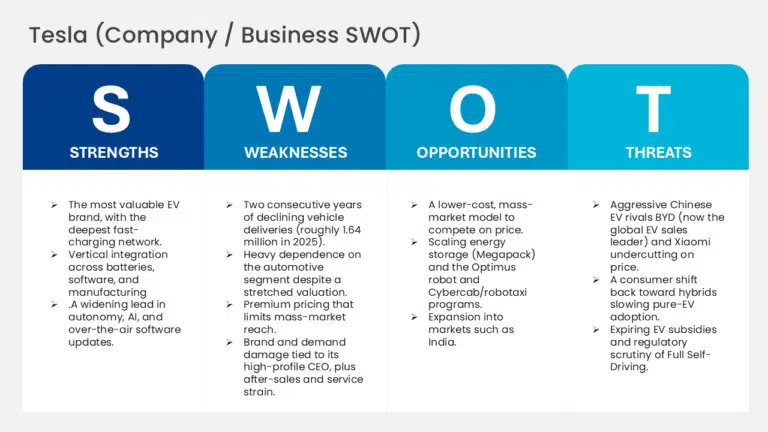
Example 1: Tesla (Company / Business SWOT)
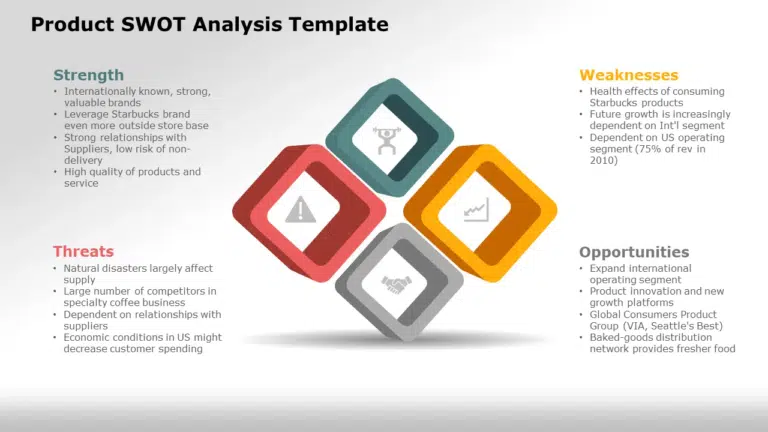
Tesla makes a strong company SWOT analysis example because in 2026 its strengths and pressures are both unusually sharp: it remains the most valuable EV brand but has lost the EV sales lead and is pivoting from carmaker toward an AI-and-energy company.
Strengths
- The most valuable EV brand, with the deepest fast-charging network.
- Vertical integration across batteries, software, and manufacturing.
- A widening lead in autonomy, AI, and over-the-air software updates.
Strong customer loyalty and a direct-to-consumer sales model.
Weaknesses
- Two consecutive years of declining vehicle deliveries (roughly 1.64 million in 2025).
- Heavy dependence on the automotive segment despite a stretched valuation.
- Premium pricing that limits mass-market reach.
- Brand and demand damage tied to its high-profile CEO, plus after-sales and service strain.
Opportunities
- A lower-cost, mass-market model to compete on price.
- Scaling energy storage (Megapack) and the Optimus robot and Cybercab/robotaxi programs.
- Expansion into markets such as India.
Threats
- Aggressive Chinese EV rivals — BYD (now the global EV sales leader) and Xiaomi — undercutting on price.
- A consumer shift back toward hybrids slowing pure-EV adoption.
- Expiring EV subsidies and regulatory scrutiny of Full Self-Driving.
Strategic takeaway: With deliveries falling and BYD ahead on volume, Tesla’s SWOT points away from “sell more cars” and toward proving its AI, autonomy, and energy bets — the strengths that now have to justify the valuation.
Example 2: Starbucks (Retail / Brand SWOT)
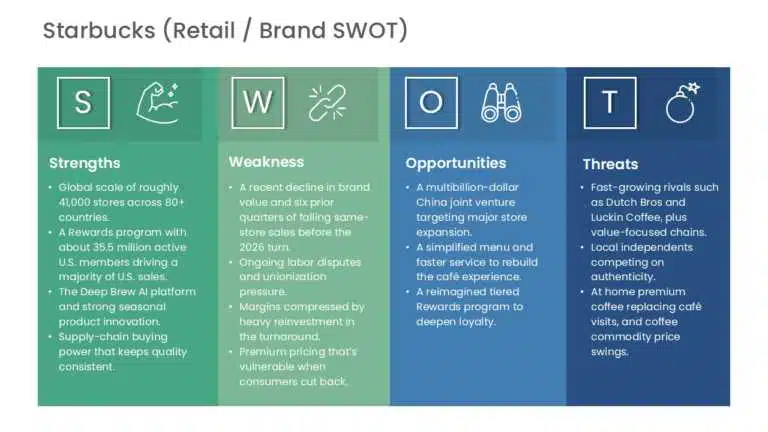
In 2026, Starbucks is a useful example of a turnaround in progress — the “Back to Starbucks” plan under CEO Brian Niccol showing early results after a run of weak quarters.
Strengths
- Global scale of roughly 41,000 stores across 80+ countries.
- A Rewards program with about 35.5 million active U.S. members driving a majority of U.S. sales.
- The Deep Brew AI platform and strong seasonal product innovation.
- Supply-chain buying power that keeps quality consistent.
Weaknesses
- A recent decline in brand value and six prior quarters of falling same-store sales before the 2026 turn.
- Ongoing labor disputes and unionization pressure.
- Margins compressed by heavy reinvestment in the turnaround.
- Premium pricing that’s vulnerable when consumers cut back.
Opportunities
- A multibillion-dollar China joint venture targeting major store expansion.
- A simplified menu and faster service to rebuild the café experience.
- A reimagined tiered Rewards program to deepen loyalty.
Threats
- Fast-growing rivals such as Dutch Bros and Luckin Coffee, plus value-focused chains.
- Local independents competing on authenticity.
- At-home premium coffee replacing café visits, and coffee commodity price swings.
Strategic takeaway: Starbucks’ scale and loyalty strengths are the engine of the “Back to Starbucks” recovery — the SWOT says to convert digital loyalty and China expansion into growth faster than Dutch Bros and value chains erode the base.
Example 3: A Small Business — Neighbourhood Coffee Shop (Business SWOT)
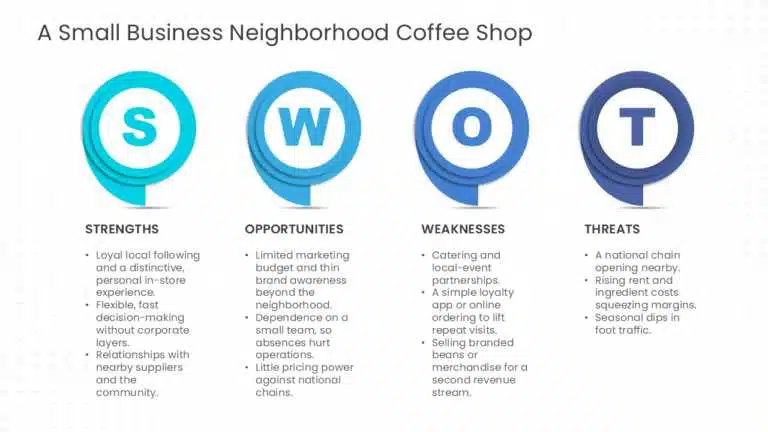
This illustrative small-business example is one of many SWOT analysis examples for business owners, showing the framework works at any scale — a small business finding its edge against bigger, better-funded competitors.
Strengths
- Loyal local following and a distinctive, personal in-store experience.
- Flexible, fast decision-making without corporate layers.
- Relationships with nearby suppliers and the community.
Weaknesses
- Limited marketing budget and thin brand awareness beyond the neighbourhood.
- Dependence on a small team, so absences hurt operations.
- Little pricing power against national chains.
Opportunities
- Catering and local-event partnerships.
- A simple loyalty app or online ordering to lift repeat visits.
- Selling branded beans or merchandise for a second revenue stream.
Threats
- A national chain opening nearby.
- Rising rent and ingredient costs squeezing margins.
- Seasonal dips in foot traffic.
Strategic takeaway: The shop’s community strength is its best defence against a chain competitor — investing in loyalty and local partnerships protects the base a big brand can’t easily copy, which is why business owners can borrow this SWOT analysis example directly.
Example 4: A Project — New CRM Implementation (Project SWOT)
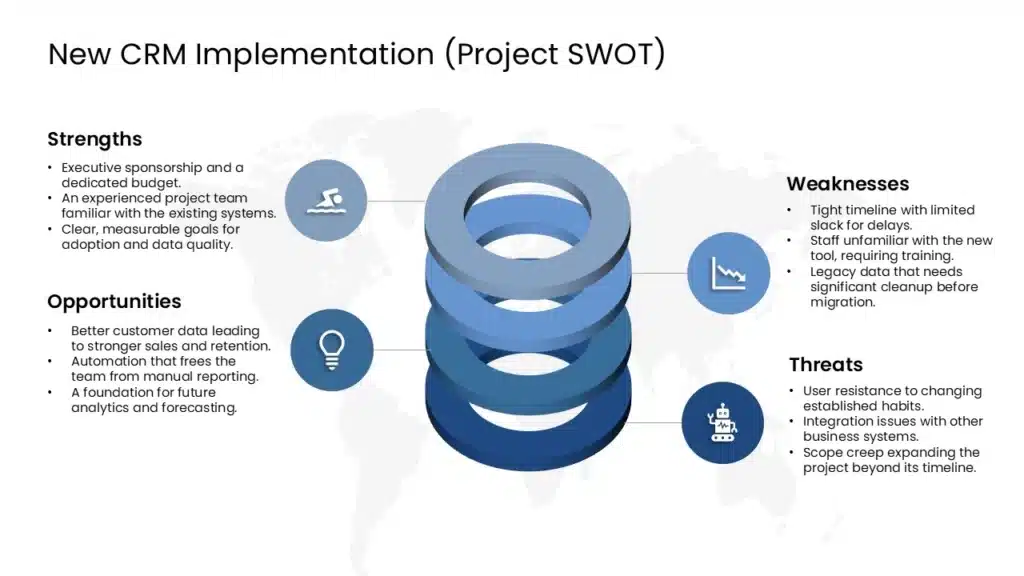
A project SWOT assesses a specific initiative rather than a whole company — a practical SWOT analysis example outside a typical business context.
Strengths
- Executive sponsorship and a dedicated budget.
- An experienced project team familiar with the existing systems.
- Clear, measurable goals for adoption and data quality.
Weaknesses
- Tight timeline with limited slack for delays.
- Staff unfamiliar with the new tool, requiring training.
- Legacy data that needs significant cleanup before migration.
Opportunities
- Better customer data leading to stronger sales and retention.
- Automation that frees the team from manual reporting.
- A foundation for future analytics and forecasting.
Threats
- User resistance to changing established habits.
- Integration issues with other business systems.
- Scope creep expanding the project beyond its timeline.
Strategic takeaway: The biggest risk isn’t the software — it’s adoption. The SWOT points to front-loading training and change management to convert an internal weakness into a successful rollout.
Example 5: A Product Launch (Product SWOT)
This scenario doubles as a marketing SWOT analysis example, for launch teams weighing a new feature against the competition.
Strengths
- A differentiated feature competitors don’t currently offer.
- Backing from an established parent brand and its customer base.
- A strong launch marketing budget.
Weaknesses
- Unproven in-market with no customer reviews yet.
- Higher price point than existing alternatives.
- Reliance on a single manufacturing partner.
Opportunities
- An underserved customer segment actively seeking the feature.
- Bundling with the company’s existing products.
- Early-adopter feedback to guide fast iteration.
Threats
- Fast-following competitors copying the feature.
- Supply constraints at launch.
- Shifting demand if the economy tightens.
Strategic takeaway: The differentiated feature is a strength with a short shelf life — the SWOT argues for a fast, high-visibility launch to build reviews and loyalty before competitors respond.
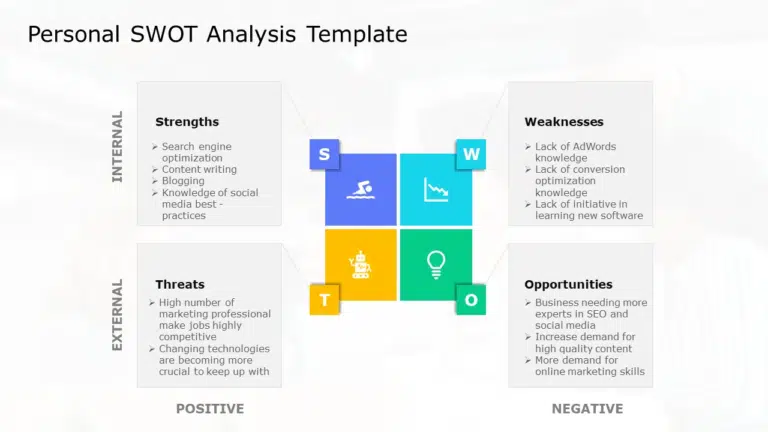
Looking for a Personal SWOT Analysis Example?
If you want an example of a personal SWOT analysis rather than a company one, a personal SWOT works the same way, applied to your skills, gaps, goals, and market — and the approach holds up at any career stage. See our dedicated guide to personal SWOT analysis examples, including a sample personal SWOT you can copy directly.
Types of SWOT Analysis Examples
The same four-quadrant structure adapts to almost any subject: business, product, project, competitor, customer, financial, industry, and personal analyses. Whichever type you need — even a straightforward business SWOT analysis example — the method is identical; only the subject changes. For a breakdown of each type and how to run one, see the complete SWOT analysis guide.
SWOT Analysis Templates Collection
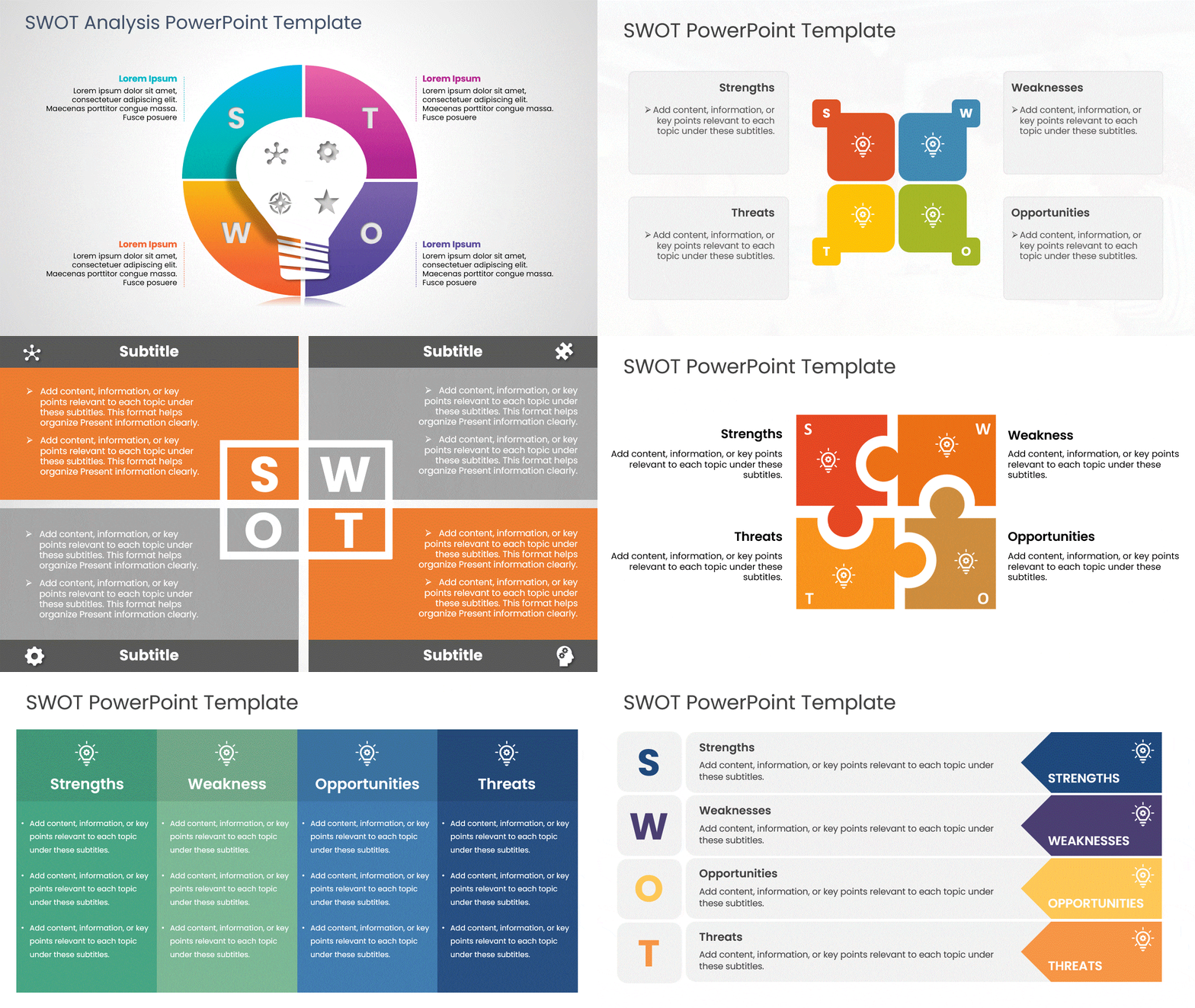
Once you’ve seen how a completed SWOT reads, the fastest way to build your own is to start from a sample SWOT analysis template. SlideUpLift offers a full range of editable SWOT analysis templates for PowerPoint and Google Slides, including:
- A complete SWOT templates collection covering business, product, project, and strategic layouts.
- A SWOT infographic template for presentation-ready visuals.
- A hexagon SWOT layout for a more design-forward look.
- An animated SWOT template for building the quadrants up one at a time during a presentation.
Each filled template also works as an example of SWOT chart formatting you can study before building your own. Drop your own strengths, weaknesses, opportunities, and threats into any of these, and you have a finished, presentation-ready analysis in minutes — pairing the grid with a filled-matrix graphic turns it into one of the more polished SWOT diagram examples you can present.
Conclusion
SWOT analysis is a fundamental component of strategic planning that provides information on an organization’s possibilities, threats, and internal and external strengths and weaknesses. We discussed various SWOT analysis examples, covering project management, corporate strategy, and personal growth. We demonstrated how to organize these studies efficiently by utilizing SlideUpLift’s PowerPoint templates, providing a road map for well-informed decision-making and plan building. The extensive library of SWOT analysis templates on SlideUpLift is a success accelerator, helping teams, businesses, and individuals overcome obstacles and seize chances.
FAQs
-
What is an example of a SWOT analysis?
A SWOT analysis example is a completed grid for a specific subject — like the Tesla or small-business examples above — showing its Strengths and Weaknesses (internal factors) alongside its Opportunities and Threats (external factors), then connecting them into strategy. In short, these are examples of a SWOT analysis in action.
-
What are good examples of strengths, weaknesses, opportunities, and threats?
Strengths might include a strong brand or loyal customers; weaknesses, a thin marketing budget or limited product range; opportunities, a new market or emerging trend; threats, a new competitor or rising costs. You can see fuller examples of SWOT analysis — including more opportunities and threats examples — in the five completed grids above. The right items depend entirely on the specific business or project.
-
How do you write a SWOT analysis with an example?
Choose your subject, list internal strengths and weaknesses, then external opportunities and threats, using a completed example as a model. Finish by drawing connections — how a strength captures an opportunity or offsets a threat — rather than leaving four separate lists.
-
Where can I find a SWOT analysis example for a project or business?
The examples above cover business, small-business, project, and product scenarios. For personal or career use, see the personal SWOT analysis guide; for the full method and more formats, see the complete SWOT analysis guide.
-
What are some swot analysis of a company example?
swot analysis of a company example evaluates its strengths, weaknesses, opportunities, and threats, providing insights into its strategic position and potential challenges.
-
What’s the difference between a SWOT example and a SWOT template?
An example is a completed analysis for a specific subject; a template is the blank, editable layout you fill in with your own points.
Table Of Content
Related Presentations


Related posts from the same category

27 Dec, 2023 | SlideUpLift
How to Explain SWOT Analysis in Presentation?
Research has shown that 85% of people are more likely to buy what you are saying if presented with visual content in the form of a presentation. PowerPoint presentations have

24 Jul, 2024 | SlideUpLift
SWOT Analysis: The Complete Guide to Strengths, Weaknesses, Opportunities & Threats
One of the biggest challenges professionals face is a lack of structured thinking when strategizing plans, conducting competitor analysis, or evaluating current strategies. This often leads to wasted time, inconsistent

17 Apr, 2025 | SlideUpLift
Personal SWOT Analysis: A Comprehensive Guide With Examples and Templates
Key Highlights A personal SWOT analysis is a great way to understand yourself better and grow. It helps you identify your strengths, weaknesses, opportunities, and threats. This tool gives you

25 Jul, 2023 | SlideUpLift
How to Create a SWOT Analysis Presentation in PowerPoint and Google Slides?
Creating SWOT in PowerPoint and Google Slides is much easier than it looks. SWOT analysis is an effective tool that can be applied across various domains and is necessary for

20 Feb, 2024 | SlideUpLift
Start Stop Continue Retrospective: A Complete Guide With Examples, Templates & Exercises
A Start Stop Continue retrospective is a team reflection exercise where each member names one thing the team should start doing, one it should stop, and one it should continue.

29 Jul, 2024 | SlideUpLift
Best Pros And Cons Lists For Effective Decision-Making [With Templates]
Ever found yourself staring at two options while making any decision, each with its own set of shiny perks and potential pitfalls? You’re not alone. It can be a real

9 May, 2023 | SlideUpLift
6 Steps For Designing A Mind Map Presentation (With Templates)
Have you ever been tasked with creating a presentation, only to find yourself struggling with organizing your ideas? Many of us have experienced this situation, and it can feel overwhelming.

30 Jan, 2024 | SlideUpLift
9 Box Talent Review Explained [Detailed 9 Box Matrix Guide]
Quick Answer A 9 box talent review is a talent management tool that plots employees on a 3x3 grid across two dimensions: current performance and future potential. Managers use it
6 Mar, 2024 | SlideUpLift
Best Work Plan Templates For Easy Task Organization [With Examples]
A project's success depends on having a detailed task plan. How can you perform tasks without having a plan for them? You and your team can produce the ideal work

24 Mar, 2023 | SlideUpLift
SOAR Analysis: Make Strategic and Impactful Business Decisions
Have you ever found yourself at a crossroads in your business, wondering which direction to take? You may have faced a tough decision, but you're still determining which option will significantly