

 Flat 1


5 Whys Root Cause Analysis: How It Works (With Examples)
Quick Answer
5 Whys root cause analysis is a problem-solving technique developed at Toyota that asks “why” repeatedly (typically five times) to trace a problem from its symptoms back to its true root cause. Each answer becomes the basis for the next “why,” and you stop once you reach a specific, actionable cause. It works best for straightforward, single-cause problems and is often paired with a fishbone diagram for more complex, multi-factor issues.
Introduction
Have you ever run into never-ending problems in your professional or personal life? On any continuous-improvement journey, teams hit challenges that need real investigation to reach their root cause. Sometimes the leading cause of an inefficient process is hard to spot. The 5 Whys is one of the most effective techniques for exactly this: guided by systematic inquiry, it lets teams dig into a problem at root level and uncover the underlying cause, paving the way for a lasting fix.
In this blog, let’s explore what root cause analysis is, how the 5 Whys works, and how it’s applied across industries — along with real 5 Whys examples and templates you can use right away.
What Are the 5 Whys?
The 5 Whys is a structured problem-solving approach developed by Toyota as part of the continuous-improvement practices within the Toyota Production System.
Sakichi Toyoda — the father of the Japanese industrial revolution and founder of Toyota Industries — introduced the idea of asking one simple question, “Why?”, to solve business problems. The managerial problem-solving tool he developed is now known simply as the 5 Whys. You’ll also see it written as a 5 Whys root analysis or, hyphenated, a 5-Whys root cause analysis — and some teams call it a why-why analysis. They all point to the same technique.
It’s a simple but powerful tool: you ask “why” about a problem until its root cause is found. The name comes from the idea that it usually takes about five rounds of “why” to reach the root — but the number isn’t fixed. Simpler problems may need fewer; complex ones may need more.
Owing to its effectiveness and lean nature, this Root Cause Failure Analysis (RCFA) tool has become widely popular. Now that you know what the 5 Whys are, let’s look at the benefits.
The 5 Whys Diagram
At its simplest, a 5 Whys analysis is a single chain: you start with the problem, ask “why” it happened, then ask “why” of each answer until you reach a cause you can act on. For problems with more than one contributing cause, the chain can branch — each branch explored separately.
What Are the Benefits of 5 Whys Analysis?
The 5 Whys method offers several benefits to any team that wants to understand the real reason behind a problem:
1. Identifying Root Causes
By systematically asking “why” several times, teams get past surface-level symptoms and uncover the fundamental cause of a problem.
2. Improved Decision-Making
It produces insight that’s useful for decision-making and planning. Clear causes help an organization design effective interventions and direct resources to priority areas.
3. Simple and Time-Saving
It needs very little training, so it’s accessible at any level. Its simplicity encourages even beginners to use it and get back on track quickly.
4. Cost-Effective Solutions
Addressing root causes directly is more efficient than repeatedly treating symptoms, so you stop paying for the same problem again and again.
5. Future Problem Prevention
By fixing root causes, you avoid repeating the same problem — a proactive approach that builds resilience against future failures.
6. Fosters a Problem-Solving Culture
The method promotes questioning, learning, and innovation. Involving employees also builds ownership, accountability, and collaboration.
When to Use Root Cause Analysis
A 5 Whys analysis is commonly used to understand the role of human and system factors when an error occurs, so similar issues don’t recur. Use it for:
- Repetitive issues — frequent problems in a process or system.
- Complex problems — where multiple factors are involved.
- Quality control — to find defects, errors, or failures so they don’t recur.
- Safety incidents — to uncover gaps in safety procedures.
- Process improvement — to find inefficiencies or bottlenecks.
- Project failure — to identify why a project missed its objectives.
The 5 Whys works best on focused, single-cause problems where the team can draw on real operational data rather than guesswork. Many teams run it as a lightweight tool with no special software.
Common Mistakes When Using the 5 Whys Technique
Several pitfalls can undermine a 5 Whys analysis. The most frequent is accepting vague answers too quickly — settling for “lack of training” or “poor communication” without digging further. Those aren’t actionable root causes; they’re broad categories that need deeper inquiry.
Another is not verifying answers with data. The process relies on factual evidence at each step; skipping it risks decisions built on assumption. A lack of training in the method can also cause teams to misapply it. To get the most from the 5 Whys, keep a disciplined question-and-answer process and push past the first easy answer.
How Do You Conduct a 5 Whys Analysis?
Here’s the step-by-step process for getting to the root cause of a recurring business issue. Applying it well comes down to discipline at each step..
1. Form and Assemble the Team
Team selection is the first and most critical step. Involve everyone affected by the problem — across shifts, departments, or regions — and include a facilitator to steer the discussion.
2. Brief the Team
Share the agenda and the purpose of the exercise. The original method recommends a whiteboard over a computer. Write the problem where everyone can see it and agree on a clear problem statement — defining the problem well is often half the solution.
3. Ask Whys
The facilitator asks the first “why,” encouraging fact-based answers rather than assumptions or blame. Keep answers specific — a word or short phrase — and remember there may be more than one root cause.
4. Repeat Four Times
Reframe each answer into the next question. For example, “the reminder email wasn’t sent to the client” becomes “Why wasn’t the reminder email sent?” Repeat until you reach the root cause. Because the approach searches for solutions rather than blame, it protects team sentiment while preventing recurrence.
5. Verify the Causes
Check for common themes that, if corrected, would stop the problem recurring. Confirm each root cause is a genuine contributing factor — further data analysis may be needed.
6. Define Solutions
Brainstorm solutions or action plans with the team, implement them, and track their effectiveness.
7. Follow Up and Continuously Improve
Reassess your solutions, watch for recurrence, and use the insights to keep improving processes and build a lasting learning culture.
Handling Multiple Answers in the 5 Whys Process
One “why” often produces several valid answers. Document each branch separately so the team can explore every potential cause. Then prioritize by impact — if one branch accounts for most occurrences, address it first. And recognize when to switch tools: if the problem is too complex for a single chain, move to a fishbone diagram or fault tree analysis to map interrelated causes.
5 Whys Examples
Now that you understand the process, let’s walk through several examples. Whatever term brought you here — a 5 Whys example, a 5 why analysis example, or examples for training new hires — the walkthroughs below apply the same five-question process to different situations.
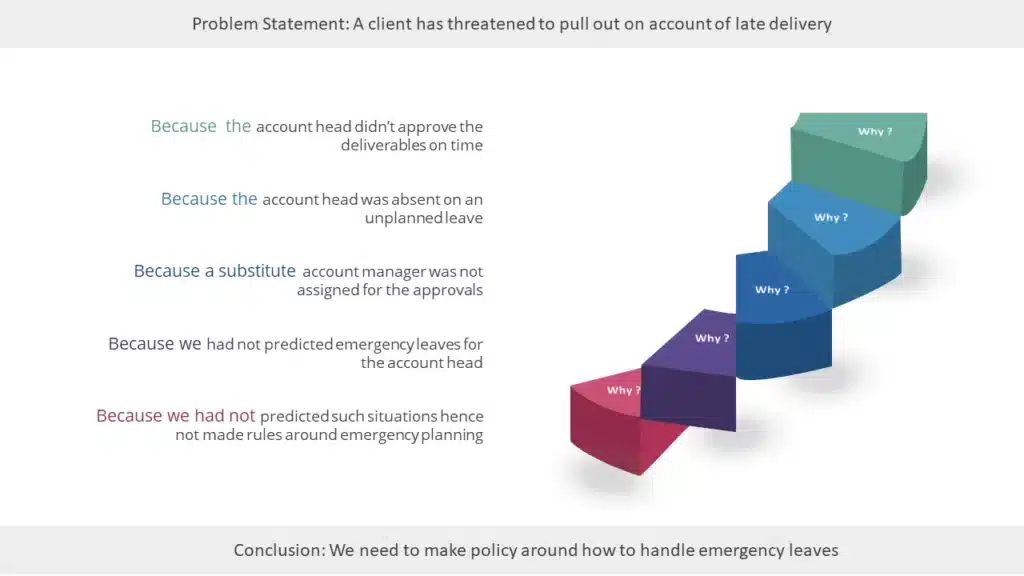
Example 1: Advertising Agency — Late Deliverables
A client threatens to leave a well-known agency over repeated late deliverables. The agency gathers the responsible managers.
- Why did the client raise late deliveries? — There was an instance of late delivery.
- Why the delay? — The creatives weren’t approved by the Creative Head on schedule.
- Why weren’t they approved in time? — The Creative Head was on sick leave for two days.
- Why weren’t those duties delegated? — No substitute for the Creative Head has been appointed.
- Why hasn’t a substitute been appointed? — The situation wasn’t anticipated, and clients are increasingly strict on deadlines.
Solution: Designate a substitute for the Creative Head and other critical roles.
Example 2: Manufacturing — Equipment Breakdown
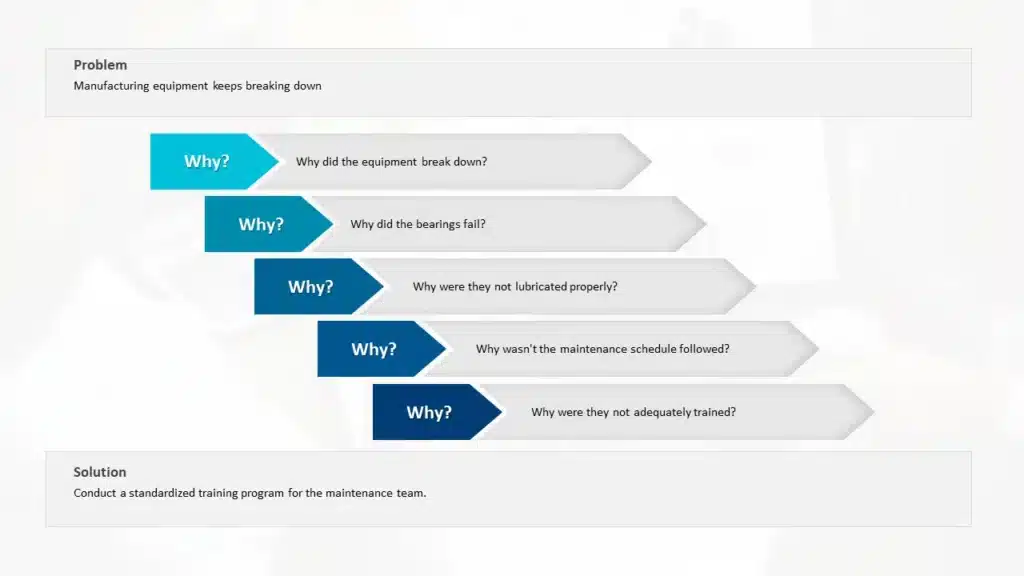
Manufacturing equipment keeps breaking down.
- Why did the equipment break down? — The bearings failed.
- Why did the bearings fail? — They weren’t lubricated properly.
- Why weren’t they lubricated? — The maintenance schedule wasn’t followed.
- Why wasn’t it followed? — The maintenance team wasn’t adequately trained.
- Why weren’t they trained? — There was no standardized training program.
Root Cause: No standardized training program for the maintenance team.
Solution: Run a standardized training program for the maintenance team.
Example 3: Personal Productivity — Feeling Overwhelmed
“I feel stressed and overwhelmed most of the time.”
- Why am I stressed and overwhelmed? — I have too many tasks.
- Why so many tasks? — I struggle with time management and prioritization.
- Why do I struggle? — I don’t set clear goals or deadlines.
- Why not? — I procrastinate and avoid planning.
- Why do I procrastinate? — I feel overwhelmed and don’t know where to start.
Root Cause: No clear goal-setting, deadlines, or time-management strategy.
Solution: Set clear goals with deadlines.
Example 4: A Fun Training Example — The Surprise Party
For workshops and new-hire training, a light scenario lands better than a factory-floor one. Try this icebreaker:
- Why did the surprise party flop? — The guest of honor already knew about it.
- Why did they know? — Someone mentioned it in a group chat.
- Why was it in the group chat? — The guest of honor was accidentally left in the group.
- Why were they left in? — No one checked the member list before planning.
- Why did no one check? — There was no agreed way to plan surprises privately.
Root Cause: No agreed process for keeping surprise planning off shared channels.
This kind of relatable, slightly humorous example is ideal for teaching beginners — it shows how the same five questions reveal a process gap, not a person to blame.
Validating Answers in 5 Whys Analysis
Validation ensures each cause holds up against evidence. For every answer, ask: is it specific, causal, and supported by data (logs, records, direct observation)? If it’s vague or assumption-based, refine it before moving on. Rigorous validation makes the analysis reliable and the solutions sustainable.
5 Whys Templates for Root Cause Analysis Presentations
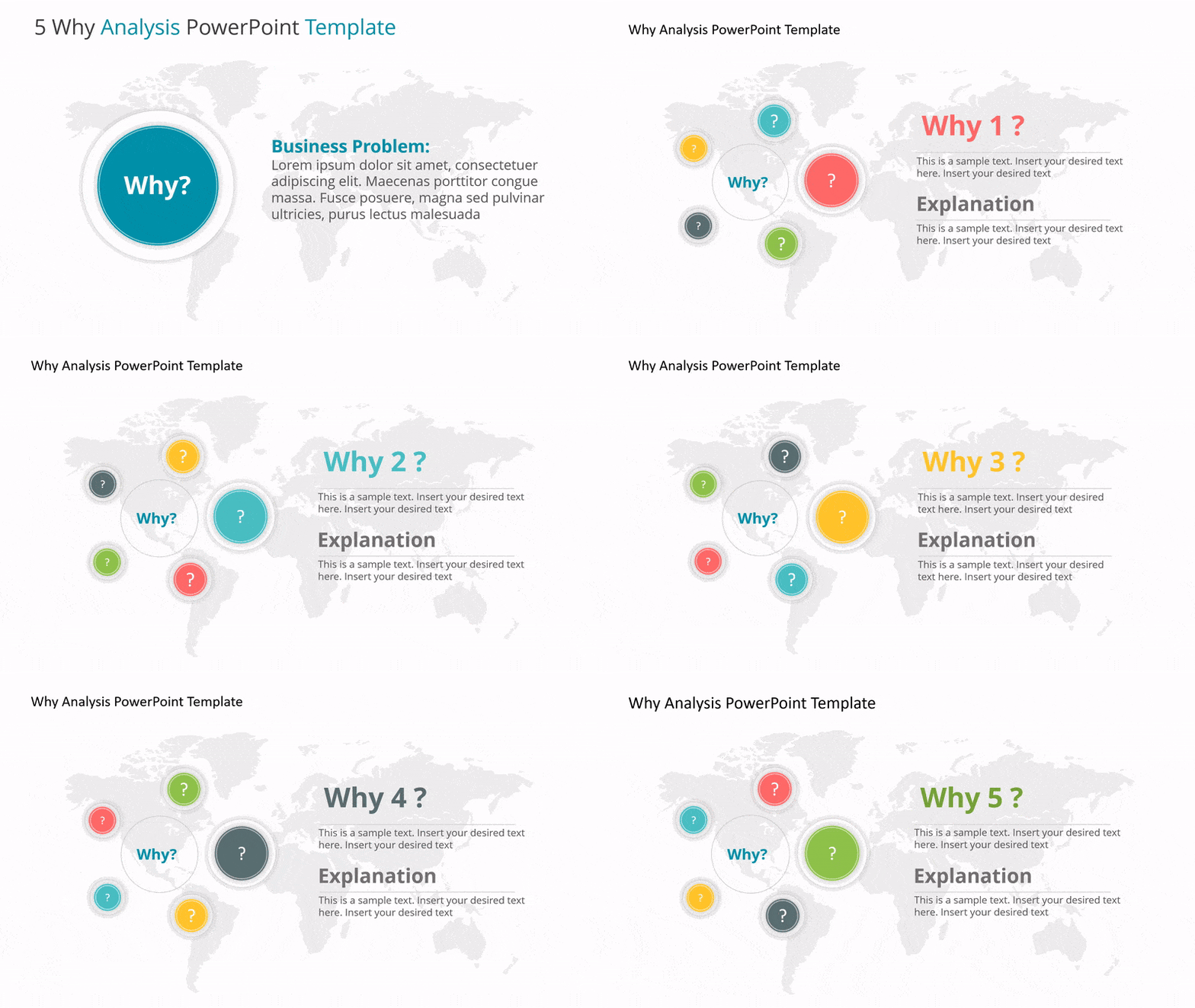
Once you’ve done the analysis, you’ll want to present it persuasively. These editable templates make your findings clear — pick the visual style that fits your deck.
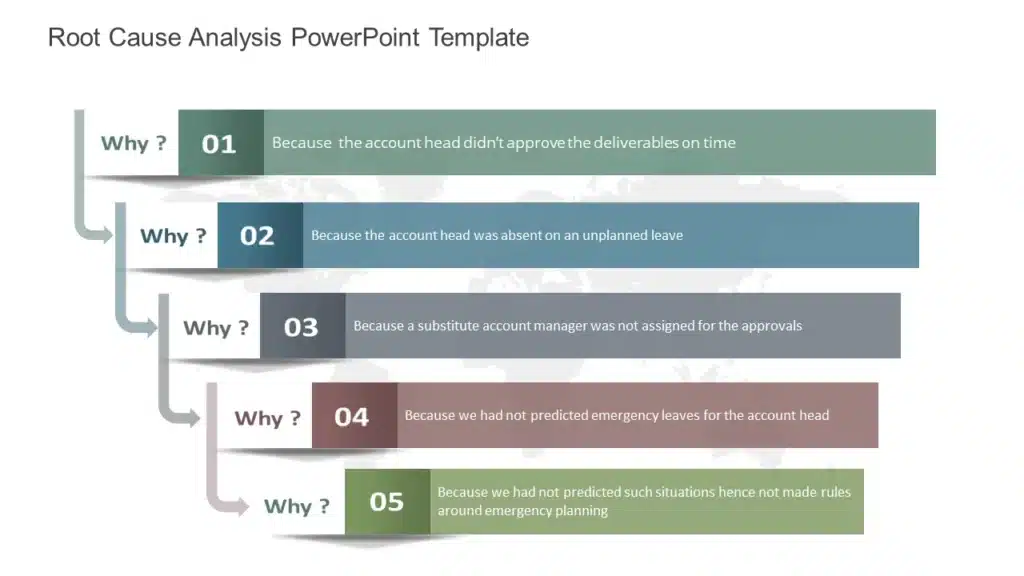
Root Cause Analysis PowerPoint Template
A clean list layout that shows “Why” asked repeatedly until the root cause emerges — easy for an audience to follow. Fully editable colors and backgrounds.
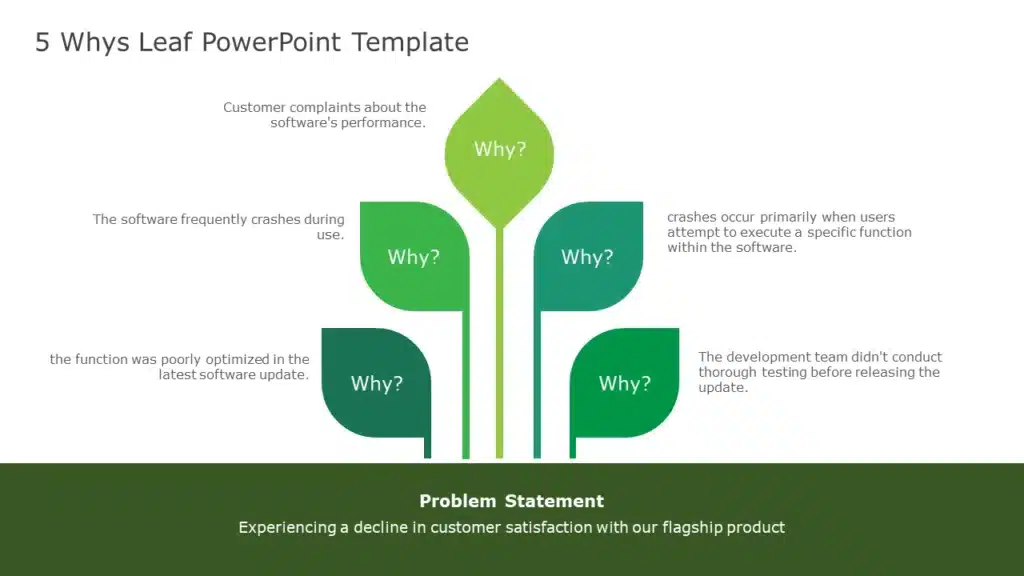
5 Whys Leaf PowerPoint Template
Five leaf petals represent the whys — the middle leaf the main why, surrounding leaves the follow-ups. A distinctive, eco-style visual.
Animated 5 Whys Business Analysis PowerPoint Template
Uses animation to reveal each of the five causes in turn, with a slide per “why.” Fully editable.
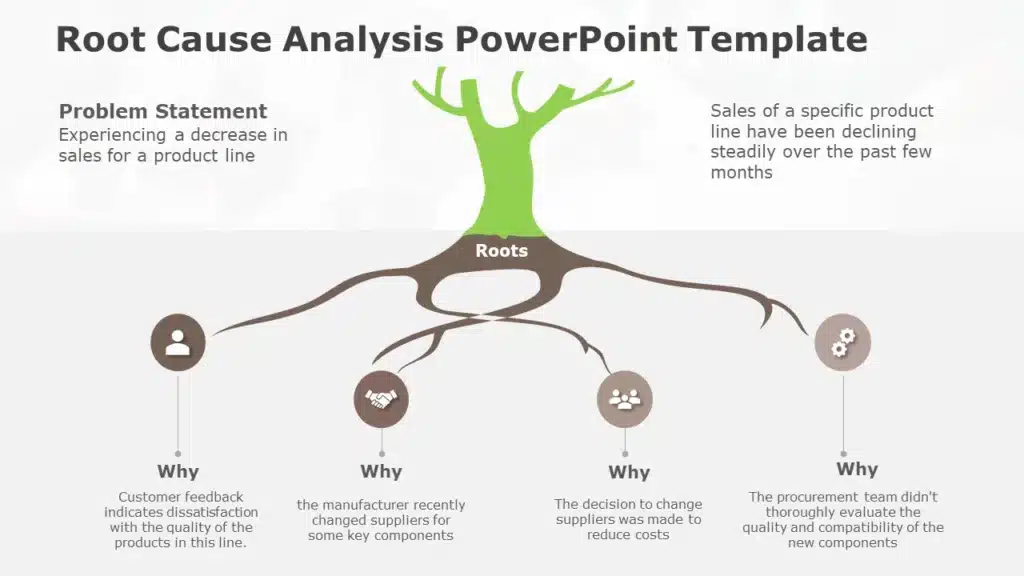
Root Cause Analysis PowerPoint Template (Tree Design)
A tree layout documenting the problem statement, primary and secondary causes, and recommended solutions — useful across manufacturing, healthcare, and project management.
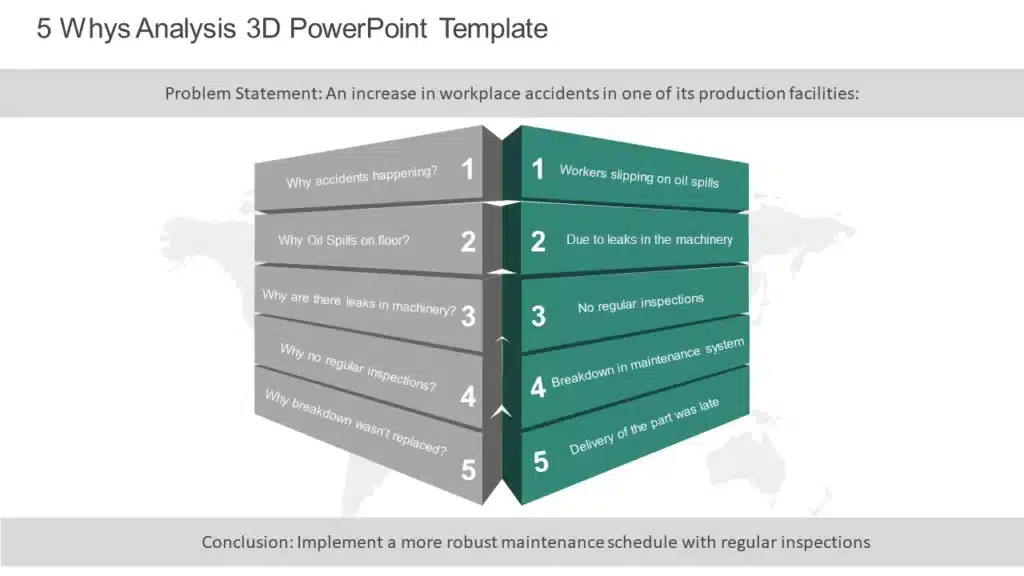
5 Whys 3D PowerPoint Template
Two color-coded sections with five lists each — whys on the left, answers on the right — plus header/footer for the problem statement and conclusion.
Browse our full Root Cause Analysis template collection and 5 Why Analysis templates — all available for both MS PowerPoint and Google Slides.
Conclusion
The 5 Whys is an ideal problem-solving tool for entrepreneurs and established companies alike: find the root cause, then build corrective or preventive solutions. Its success depends on the team’s willingness to dig past symptoms and stay open to more than one root cause. Done well, it can meaningfully improve your organization’s processes. Explore our PowerPoint templates and level up your next root cause analysis presentation.
FAQs
-
Can you give real-world examples of the 5 Whys in action?
Yes. A manufacturer with frequent machine breakdowns can use the 5 Whys to trace the issue to insufficient maintenance training — then fix it with a targeted program (see Example 2 above).
-
How do I use the 5 Whys to find the root cause of a problem?
Start by clearly defining the problem, then ask “why” of each answer until you reach a cause you can act on. Document each step.
-
What are common mistakes people make in a 5 Whys analysis?
Stopping too early with vague answers, failing to verify findings with data, and blaming individuals instead of examining systemic issues.
-
Can you show a simple 5 Whys example for a workplace issue?
If a deadline is missed: the team didn’t get resources on time → procurement was delayed → requirements were unclear → there was insufficient stakeholder communication → no communication protocol existed. Root cause: no communication protocol.
-
Are there templates available for a 5 Whys analysis?
Yes — editable PowerPoint and Google Slides templates let you document each question and answer clearly (see the templates above).
-
Can you give a step-by-step breakdown of a 5 Whys exercise?
Define the problem, ask the first “why” and record the answer, repeat for each answer up to five times (or until you reach the root cause), validate with evidence, then develop and implement solutions.
-
Do you have fun or creative 5 Whys examples for teaching beginners?
Yes — relatable scenarios like a surprise party that went wrong (Example 4) work well: peeling back the “whys” reveals issues like poor communication or planning.
-
How many answers should I expect in a 5 Whys?
Usually one primary root cause, but you may hit multiple valid answers at different stages. Document and explore each branch.
-
Can the 5 Whys be used outside business settings?
Absolutely — it works in personal, educational, or any setting where you need to find a root cause.
-
What is a 5 why analysis, and what is it used for?
A “5 why analysis” (or why-why analysis) is a shorthand for the same technique — a short, structured round of “why” questions, mostly used for quick, informal root-cause checks.
Table Of Content


Related posts from the same category

12 May, 2025 | SlideUpLift
Understanding Fishbone Diagram: With Examples and Templates That Make Problem-Solving Easy
In the ever-changing world of problem-solving and process improvement, the Fishbone Diagram, also called the Ishikawa or Cause and Effect Diagram, is a simple and great tool. Originally, this diagram

8 Feb, 2022 | SlideUpLift
Ten Presenting Styles : What Kind Are You?
Do you feel nervous when it comes to public speaking? Don’t worry; you’re not alone. Do you know that according to research, one of the biggest phobias in 2014 was

18 Aug, 2021 | SlideUpLift
Risk Management: The What and the How
Whenever starting a new venture, or embarking on a new project, the risk is an inherent part of the process. A seemingly gentle tread into unknown waters, can be fraught

4 May, 2022 | SlideUpLift
What Is A Key To Problem Solving? CATWOE Analysis Has The Answers
What lies at the core of addressing thorny business issues? We believe it is problem-solving. The most common and difficult obstacle to resolving problems using first principles is defining the

3 Jan, 2024 | SlideUpLift
How to Build a PMO From Scratch? PMO Setup Explained!
A Project Management Office document (PMO) is pivotal in ensuring organizational success. It provides a centralized hub for standardizing project processes, improving efficiency, and facilitating effective communication. It enhances project

30 Jan, 2024 | SlideUpLift
9 Box Talent Review Explained [Detailed 9 Box Matrix Guide]
Quick Answer A 9 box talent review is a talent management tool that plots employees on a 3x3 grid across two dimensions: current performance and future potential. Managers use it

5 Mar, 2024 | SlideUpLift
SWOT Analysis Examples: Real-World Examples for Business, Projects & Products
The fastest way to understand a SWOT analysis is to see completed ones. Below are five detailed SWOT examples — two well-known companies, a small business, a project, and a

24 Jul, 2024 | SlideUpLift
SWOT Analysis: The Complete Guide to Strengths, Weaknesses, Opportunities & Threats
One of the biggest challenges professionals face is a lack of structured thinking when strategizing plans, conducting competitor analysis, or evaluating current strategies. This often leads to wasted time, inconsistent

27 Dec, 2023 | SlideUpLift
How to Explain SWOT Analysis in Presentation?
Research has shown that 85% of people are more likely to buy what you are saying if presented with visual content in the form of a presentation. PowerPoint presentations have

24 Jan, 2024 | SlideUpLift
How to Make a Roadmap Presentation That Wins Buy-In
Quick answer: To make a roadmap presentation that lands, tailor it to your audience, build it around a narrative instead of a list of dates, present at the right level